
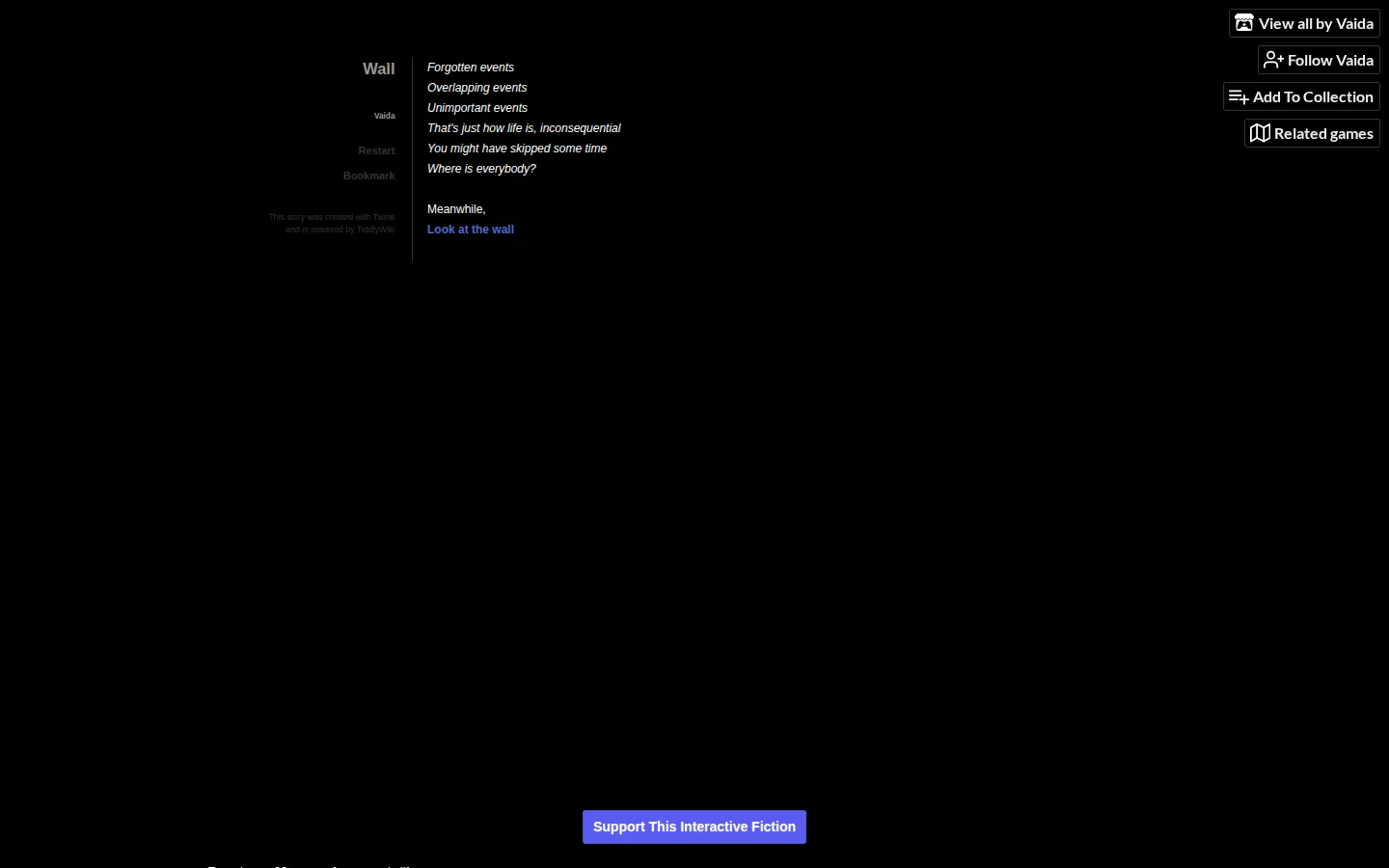
Wall is a compact Twine story that watches two decades of a life from the fixed viewpoint of an apartment wall. The narrow frame turns growing up into a sequence of traces and changes, with a mouse-only, one-button format designed for a visit measured in minutes.
What is Wall?
The premise is wonderfully narrow: an apartment wall becomes the witness while a person's life moves forward around it. Across twenty years, that fixed viewpoint gives ordinary change unusual weight. The browser presentation keeps the machinery quiet and the reading central, while the built-in rewind, restart, and bookmark controls give you room to revisit the sequence without turning the piece into a sprawling route map. It is a small work with a long clock inside it.
What you can do there
- Read twenty years of a life through an apartment wall
- Use rewind, restart, and bookmark controls
Why we picked it
Compressing a coming-of-age story into one wall is exactly the sort of formal constraint that makes a tiny web game cast a surprisingly large shadow. The project pairs that device with a brief, approachable Twine format instead of overbuilding the idea.
How to get the most from it
Open the embedded story with JavaScript enabled and read at an unhurried pace. A mouse or pointer is the documented input. Use Rewind to revisit a recent turn, Bookmark if you want a return point, or Restart for a clean pass through the piece.
Good to know
Plan on a browser with JavaScript and a pointer. The itch.io listing calls Wall mouse-only and one-button, with a typical run of a few minutes. Mobile, keyboard-only, screen-reader, audio, and save-state behavior are undocumented.
Who made it, and when?
Vaida Plankyte is the credited creator or organization.
Creator’s official page Open WallMore like this
Histography

A dense timeline where eras collapse into a field of small historical sparks.
Steve's Old Computer Museum

A wonderfully dusty filing cabinet of computers from before beige boxes learned to hide their weirdness.
Wayback Machine

A time machine for webpages, complete with a calendar and the occasional missing wire.
Bartosz Ciechanowski

Science essays with levers, sliders, and a knack for making machinery behave.