
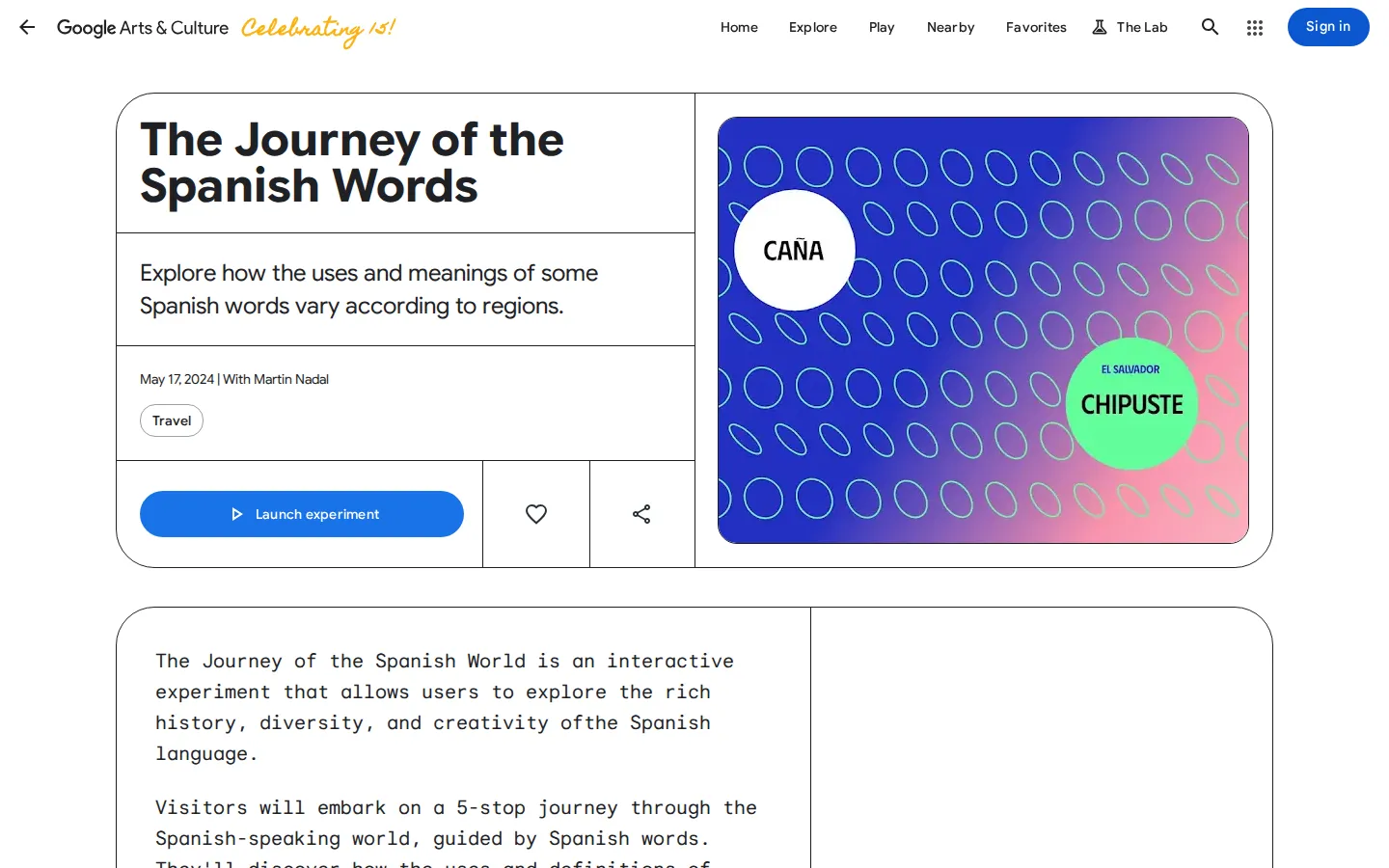
The Journey of the Spanish Words frames regional vocabulary as a five-stop trip. Follow connections among Spanish dictionary definitions and compare how a word relates to different countries. It is an inviting starting point for curiosity about language variation.
What is The Journey of the Spanish Words?
Google Arts & Culture credits Martin Nadal on this experiment. Its material comes from the Royal Spanish Academy dictionary, with BERT used to connect similar definitions. Geography gives those connections a route to follow: the same language can carry different local associations. The landing page places a Travel entry beside the explanation, with the experience inside an embedded player. The appeal is the question it raises about familiar vocabulary: which meaning travels with you, and which belongs to a particular place?
What you can do there
- Follow five stops comparing Spanish word meanings by country
Why we picked it
A dictionary usually asks you to look up one answer. This premise gives you a reason to compare answers across places. That makes a compact vocabulary detour more interesting than a list of translations, especially when a familiar word catches you off guard.
How to get the most from it
Use the Travel entry to begin the route. Pause over a connection that surprises you and compare the country context with the definition. Bring one puzzling example to a dictionary or a conversation with a speaker from that region; it makes a useful next question.
Good to know
The connections are computational comparisons of dictionary definitions. Treat them as prompts for further reading, rather than proof of how everyone in a country speaks. The page does not document the full corpus edition or model settings, and the route is a focused experiment rather than a comprehensive language lesson.
Who made it, and when?
Martin Nadal is the credited creator or organization.
Creator’s official page Open The Journey of the Spanish WordsMore like this
Nicky Case

Playable explanations about trust, systems, anxiety, networks, and the way people affect one another.
The Illustrated TLS Connection

TLS, unpacked until the handshake has nowhere left to hide.
Learn Git Branching

Git’s family tree, finally allowed to move while you poke it.
How DNS Works

A DNS lesson that takes the scenic route through the internet