
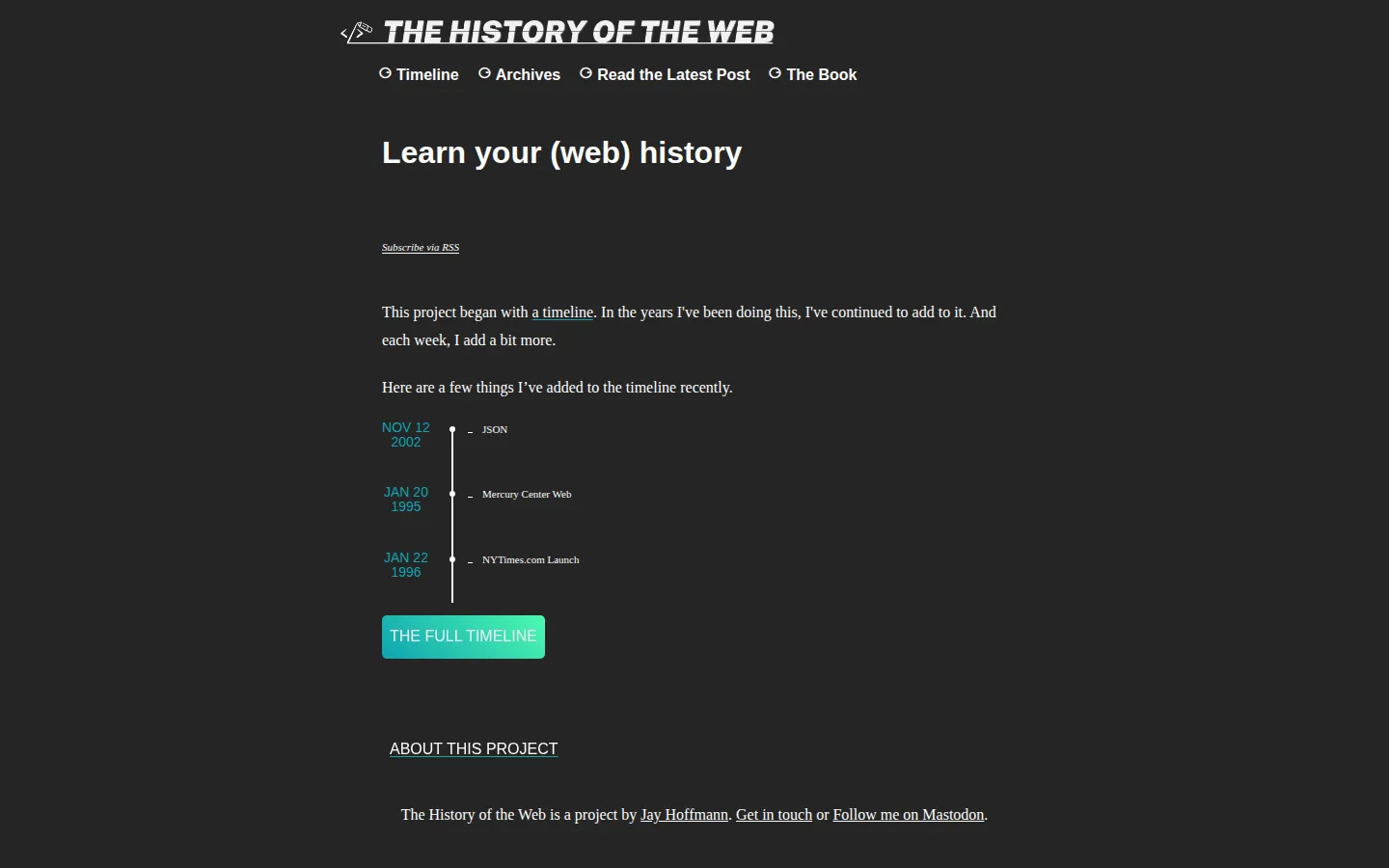
The History of the Web turns decades of browser lore, standards debates, vanished communities, and technical breakthroughs into a browseable timeline plus a deep shelf of essays. Start with a year, follow an intriguing milestone, and expect the trail to wander from protocol history into the people and culture around it.
What is The History of the Web?
The timeline is the spine: a long run of dated entries beginning before the World Wide Web had a public name and continuing through milestones such as browsers, search tools, standards, publishing platforms, and online communities. Many entries sprout a second path into a focused article, so a skim can quickly become a surprisingly human story about who pushed an idea forward, who resisted it, and what the web chose to keep. The homepage also points toward recent writing, the archive, a book, and RSS. This is less an encyclopedia than a lovingly maintained set of connected trails, which makes it especially good for readers who prefer history with side quests.
What you can do there
- Browse dated milestones in the web's history
- Read essays about web technologies, people, and culture
- Follow recent additions or subscribe by RSS
Why we picked it
It makes technical history feel browseable without sanding off the strange parts. A date about a protocol can sit beside a vanished community or an advertising experiment, and the related essays give curious readers somewhere useful to go next. That mixture of chronology and rabbit holes suits Site Stumble beautifully.
How to get the most from it
Open the full timeline and pick a period you remember—or one from before your first modem. Scan the bold milestones, then follow a linked essay when a browser, standard, community, or forgotten service catches your attention. For a shorter visit, use the homepage's latest-post route or subscribe through RSS.
Good to know
The public pages inspected were readable without an account or paywall, while the linked book is a separate route whose current terms were not verified. The timeline is selective, not a claim to catalog every event, and its visible year groups currently run through 2017; newer interpretation appears in the article feed. Some related audio readings are hosted elsewhere.
Who made it, and when?
Jay Hoffmann is the credited creator or organization. A documented update was recorded June 3, 2026.
Creator’s official page Open The History of the WebMore like this
Histography

A dense timeline where eras collapse into a field of small historical sparks.
Steve's Old Computer Museum

A wonderfully dusty filing cabinet of computers from before beige boxes learned to hide their weirdness.
Wayback Machine

A time machine for webpages, complete with a calendar and the occasional missing wire.
Bartosz Ciechanowski

Science essays with levers, sliders, and a knack for making machinery behave.