
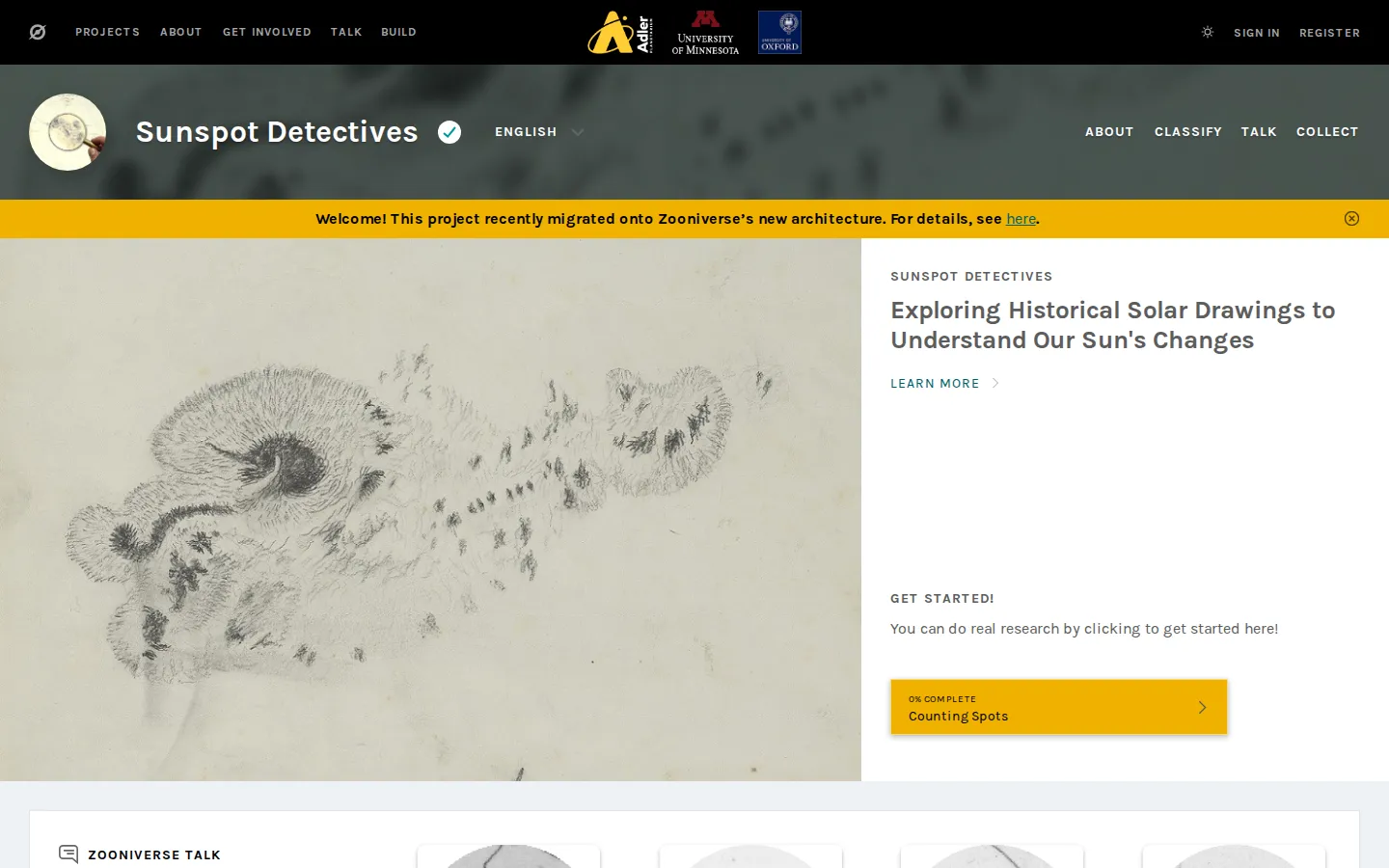
Sunspot Detectives hands you cropped details from Angelo Secchi's 1853-1878 solar drawings and asks for one humble number: how many spots are there? The answer feeds a larger attempt to reconstruct long-term solar activity from an archive where pencil, paper age, and physics all overlap.
What is Sunspot Detectives?
The task begins with hand-drawn observations made at Rome's Collegio Romano, not a modern telescope feed. Each subject isolates a sunspot group from a larger page, and volunteers count the individual dark spots. That simplicity is deceptive: tiny groups, faded paper, smudges, and different drawing styles can turn one number into a miniature argument with a nineteenth-century pencil. The project combines many answers, reviews disagreement, and is building a time series that can support later work on the international sunspot number. Its November 2024 update says the original batch was completed, extra data were added, and difficult cases were due another pass. The site has since migrated to a new Zooniverse architecture, so its currently visible zeroed statistics do not tell the whole story.
What you can do there
- Count individual sunspots in cropped nineteenth-century drawings
- Compare difficult marks with the tutorial and field guide
Why we picked it
This is an unusually neat handshake between an analog archive and contemporary crowd science. The action takes seconds to understand, yet the blemishes and brushwork make human judgment genuinely useful. It also gives a direct feel for how a scientific record is built: not from one heroic answer, but from many careful counts, checked for disagreement before they become a historical series.
How to get the most from it
Open Counting Spots, read the short tutorial, and count the distinct dark spots inside the cropped group rather than every mark on the paper. Use the field guide when a tiny crop or smudge is ambiguous, and revise the number before pressing Done if needed. Talk is the sensible place for a drawing that remains genuinely puzzling. If no subject appears, the Results page shows how earlier volunteer counts were combined and where disagreement triggered another pass.
Good to know
The project recently moved to Zooniverse's newer architecture. Its visible counters were all zero during this check, but the team's 2024 update describes a completed original dataset and later additions, so those counters should not be read as lifetime totals. Some crops are deliberately small because enlargement can exaggerate smudges. These are drawings made from safely projected telescope images; never look directly at the Sun yourself. Current subject availability, device support, accessibility, audio, and account behavior were not tested in a rendered session.
Who made it, and when?
Max Planck Institute for Solar System Research and INAF Observatory of Rome is the credited creator or organization. The earliest supported launch date we found is March 5, 2024. A documented update was recorded November 24, 2024.
Creator’s official page Open Sunspot DetectivesMore like this
Histography

A dense timeline where eras collapse into a field of small historical sparks.
Steve's Old Computer Museum

A wonderfully dusty filing cabinet of computers from before beige boxes learned to hide their weirdness.
Wayback Machine

A time machine for webpages, complete with a calendar and the occasional missing wire.
Bartosz Ciechanowski

Science essays with levers, sliders, and a knack for making machinery behave.