
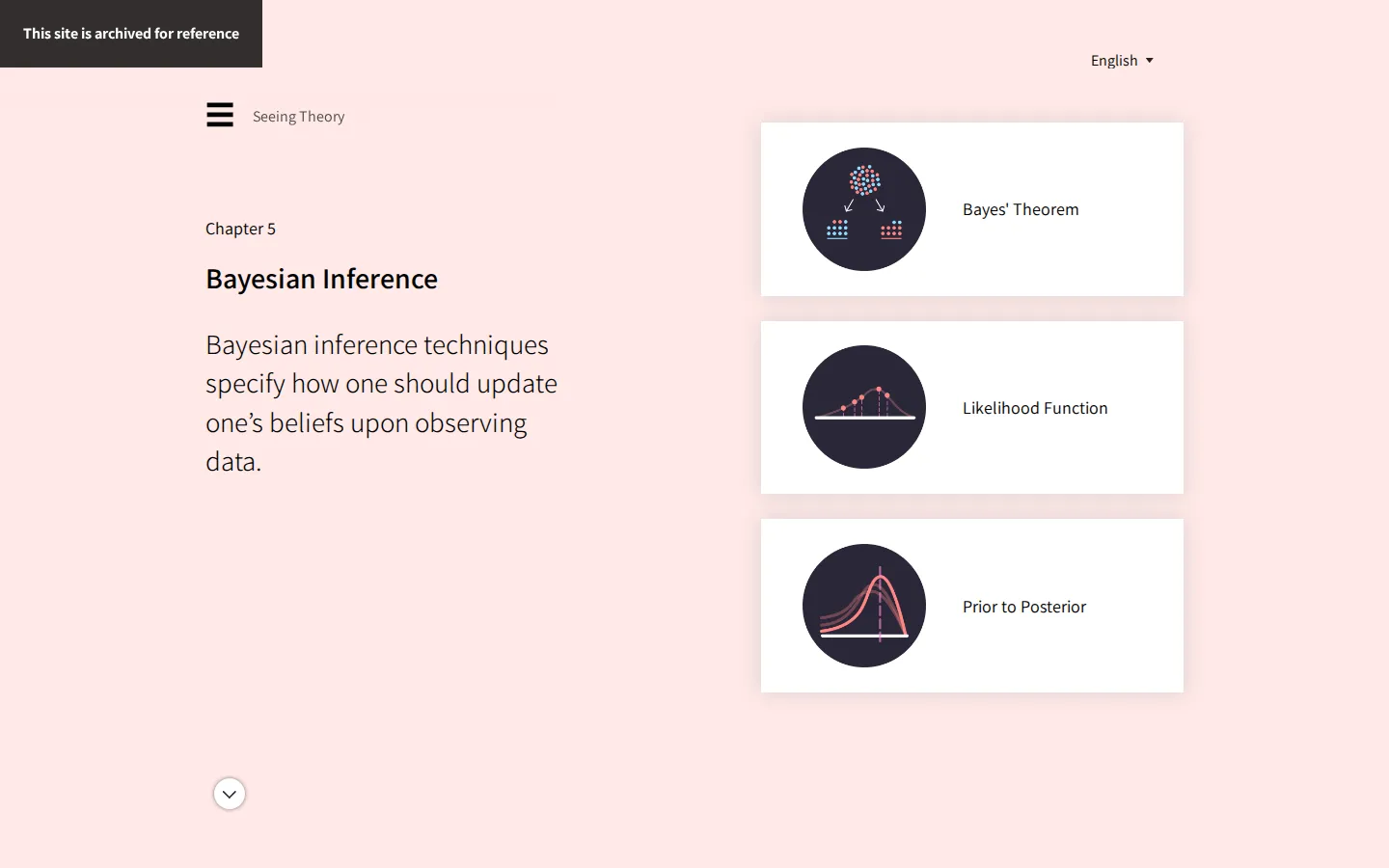
Seeing Theory turns Bayesian inference into three compact lessons where priors, likelihoods, and posteriors have knobs and consequences. A medical-test simulation and a biased-coin model give the formulas something concrete to push against, though the project is now archived.
What is Seeing Theory: Bayesian Inference?
Chapter 5 begins with the classic trap of a positive result for a rare disease: test accuracy sounds decisive until the base rate enters the room. The page exposes controls for changing the population and test assumptions, running simulated patients, and comparing the resulting probabilities. A second section moves to likelihood with selectable distributions and sample sizes. The final section uses a possibly biased coin, adjustable Beta-prior parameters, and repeated flips to show how new data reshapes a posterior that can become the next prior. The lesson sits inside a six-chapter path from basic probability through regression, so it works best as one stop in a larger statistical story rather than as a solitary calculator.
What you can do there
- Simulate a diagnostic test
- Inspect a likelihood function
- Update a prior distribution with coin-toss data
Why we picked it
The chapter gives Bayes' theorem a pulse. Instead of leaving the reader with a rearranged conditional-probability formula, it connects prior assumptions to visible simulated evidence and then repeats the idea with a coin model. Independent design recognition supports what the structure suggests: this is concept visualization, not decorative charting.
How to get the most from it
Start with the disease-test example and change one assumption at a time before running the simulated population. In the likelihood section, compare sample sizes rather than jumping straight to a large one. For the coin model, choose a deliberately lopsided prior, flip repeatedly, and watch how accumulating data changes its influence. Use the chapter PDF when you want a slower mathematical reading alongside the controls.
Good to know
The page labels itself archived, and the project's repository says code maintenance ended in 2019 even though Brown continues to host it. Treat the medical-test setup strictly as an educational example. The controls, animations, downloads, mobile behavior, accessibility, current browser performance, and network behavior were not executed in this review, and no screenshot was captured.
Who made it, and when?
Daniel Kunin is the credited creator or organization.
Creator’s official page Open Seeing Theory: Bayesian InferenceMore like this
Nicky Case

Playable explanations about trust, systems, anxiety, networks, and the way people affect one another.
The Illustrated TLS Connection

TLS, unpacked until the handshake has nowhere left to hide.
Learn Git Branching

Git’s family tree, finally allowed to move while you poke it.
How DNS Works

A DNS lesson that takes the scenic route through the internet