
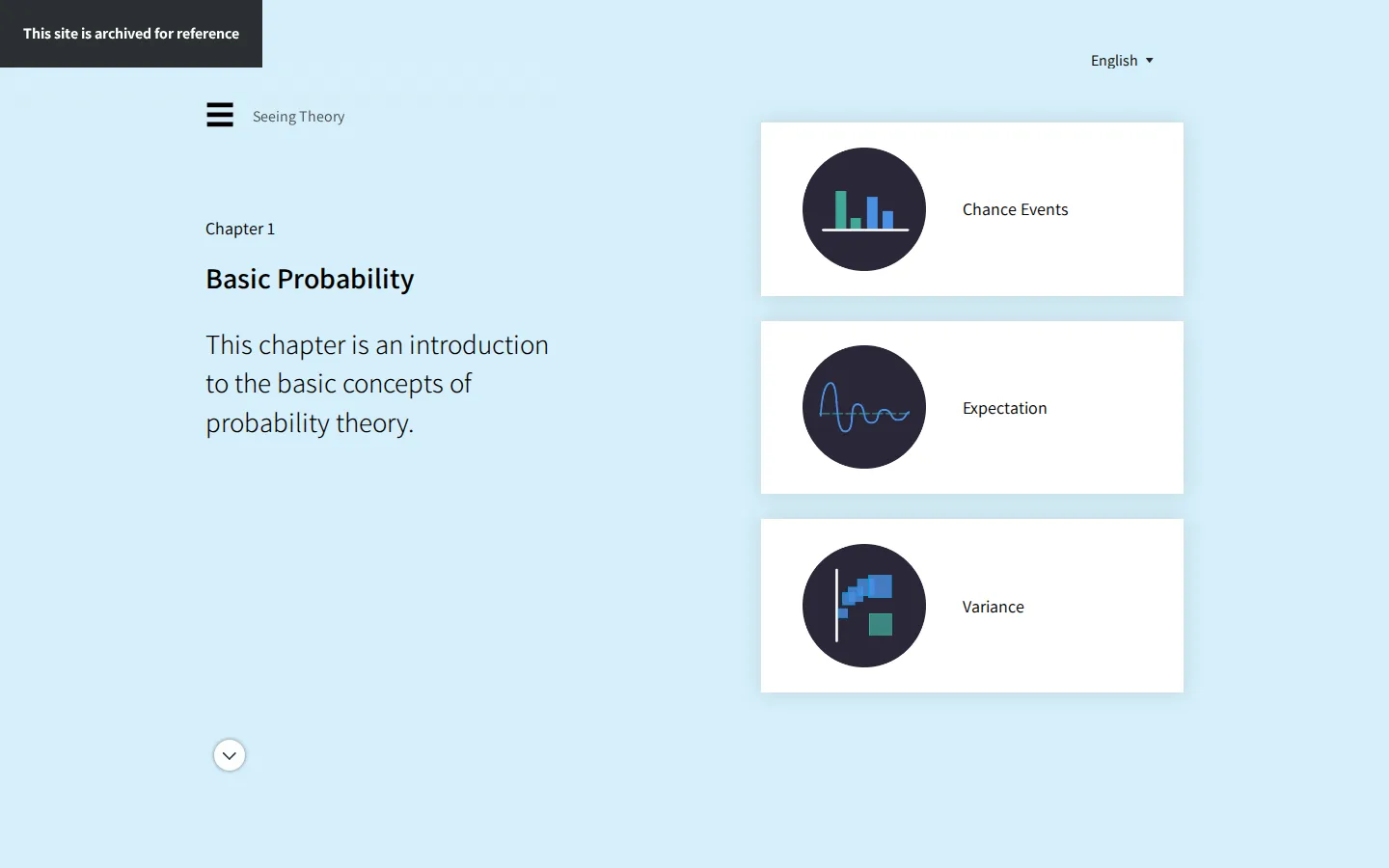
Seeing Theory's opening chapter turns chance, expectation, and variance into compact experiments with coins, dice, and cards. The writing supplies the formulas, while the controls are designed to make long-run behavior visible. It remains useful as a reference, but the project is archived and no longer maintained.
What is Seeing Theory: Basic Probability?
Basic Probability is three miniature lessons joined into one scroll. The coin section contrasts short-run wobble with long-run frequency and lets the true probability move away from a fair split. The die section connects repeated rolls to an expected value, while the card section uses a selectable ten-card deck to give variance something more tangible than a squared-difference formula. Buttons for a single trial and a batch of 100 make the chapter particularly good at showing how noisy samples gradually settle around a theoretical target. A full chapter menu leads onward through compound probability, distributions, inference, Bayesian ideas, and regression.
What you can do there
- Flip simulated coins and compare observed frequency with probability
- Roll simulated dice to watch a sample mean approach expectation
- Draw and toggle cards to examine variance
Why we picked it
The page gives abstract notation a set of small, concrete jobs. Coins demonstrate likelihood, dice pull an average toward expectation, and cards turn spread into something visitors can alter. That tight pairing of explanation and experiment makes the chapter a strong intuition-builder without pretending to be an entire statistics course.
How to get the most from it
Run a handful of single trials before pressing the 100-trial buttons; the contrast makes convergence easier to notice. Then bias the coin or die distribution and toggle cards in the deck to see which theoretical quantities move with those choices. Read the short explanation beside each experiment before changing several controls at once.
Good to know
The page is openly accessible and does not ask for an account, but it labels itself as archived for reference. The project's own 2019 note says development has stopped, so treat it as a polished supplemental lesson rather than a maintained course or current platform. Live interaction, device support, accessibility, audio, and privacy behavior were not tested in a rendered session.
Who made it, and when?
Daniel Kunin is the credited creator or organization. A documented update was recorded 2019.
Creator’s official page Open Seeing Theory: Basic ProbabilityMore like this
Nicky Case

Playable explanations about trust, systems, anxiety, networks, and the way people affect one another.
The Illustrated TLS Connection

TLS, unpacked until the handshake has nowhere left to hide.
Learn Git Branching

Git’s family tree, finally allowed to move while you poke it.
How DNS Works

A DNS lesson that takes the scenic route through the internet