
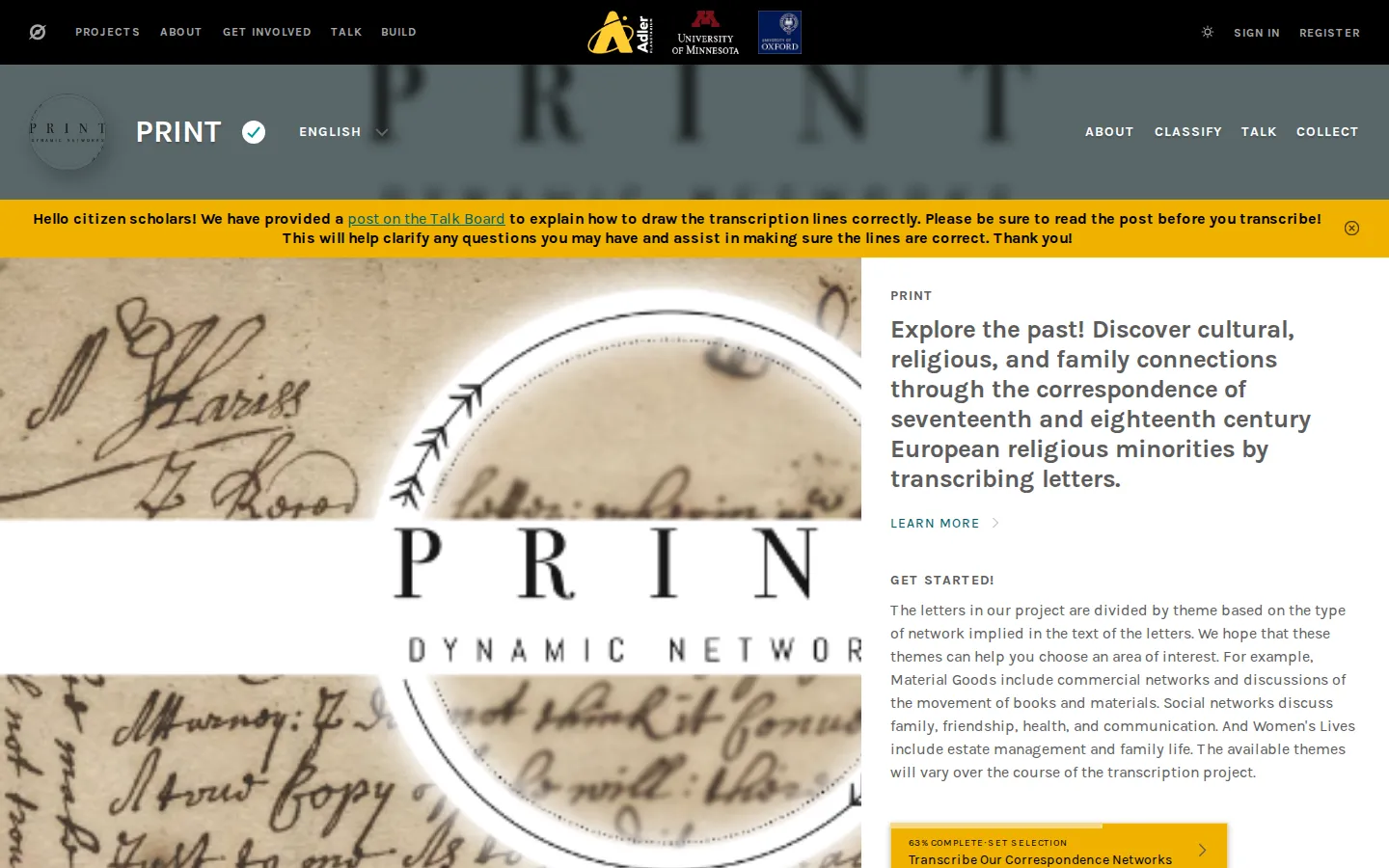
PRINT opens a working desk onto roughly 3,000 letters written by Anabaptists, Quakers, and Pietists in the seventeenth and eighteenth centuries. Volunteers draw lines through the scans and transcribe the text so historians can search the correspondence and rebuild the family, religious, commercial, and travel networks hidden inside it.
What is PRINT?
The raw material here is not a tidy stack of famous speeches. It is correspondence from ordinary people whose relationships crossed borders, archives, and languages. PRINT groups its transcription work by the kinds of connections the letters reveal: goods and books in motion, family and health news, women's estate work, friendship, and communication itself. Your contribution begins at the smallest scale, matching a line of difficult handwriting to typed text. The project's larger ambition is delightfully structural: join those lines into searchable records, then use the people and places inside them to show how information networks shaped early Atlantic migration. It is history built from margins, signatures, favors, worries, and routes between desks.
What you can do there
- Draw transcription lines across scanned handwriting
- Transcribe letters by a chosen social or material theme
Why we picked it
PRINT gives archival transcription a visible destination beyond digitization for its own sake. Each recovered line can feed a correspondence database and, eventually, maps of how communities moved information and people. The changing themes also let volunteers choose a human angle rather than face one undifferentiated manuscript pile.
How to get the most from it
Read the linked Talk guidance on drawing transcription lines before opening a document. Pick a theme that will hold your attention, enlarge the scan as much as the workspace allows, and work slowly across one line at a time. Preserve uncertainty instead of polishing unfamiliar names or spellings into something merely plausible.
Good to know
The landing page currently shows 64 percent complete but zero active subjects and classifications, so available themes may change or pause. The source collection spans English, Dutch, and German, while the interface is presented in English. No isolated workspace, account, accessibility, mobile, or submission check was available for this review.
Who made it, and when?
PRINT Dynamic Networks at the University of Central Florida is the credited creator or organization. The earliest supported launch date we found is January 31, 2023.
Creator’s official page Open PRINTMore like this
Histography

A dense timeline where eras collapse into a field of small historical sparks.
Steve's Old Computer Museum

A wonderfully dusty filing cabinet of computers from before beige boxes learned to hide their weirdness.
Wayback Machine

A time machine for webpages, complete with a calendar and the occasional missing wire.
Bartosz Ciechanowski

Science essays with levers, sliders, and a knack for making machinery behave.