
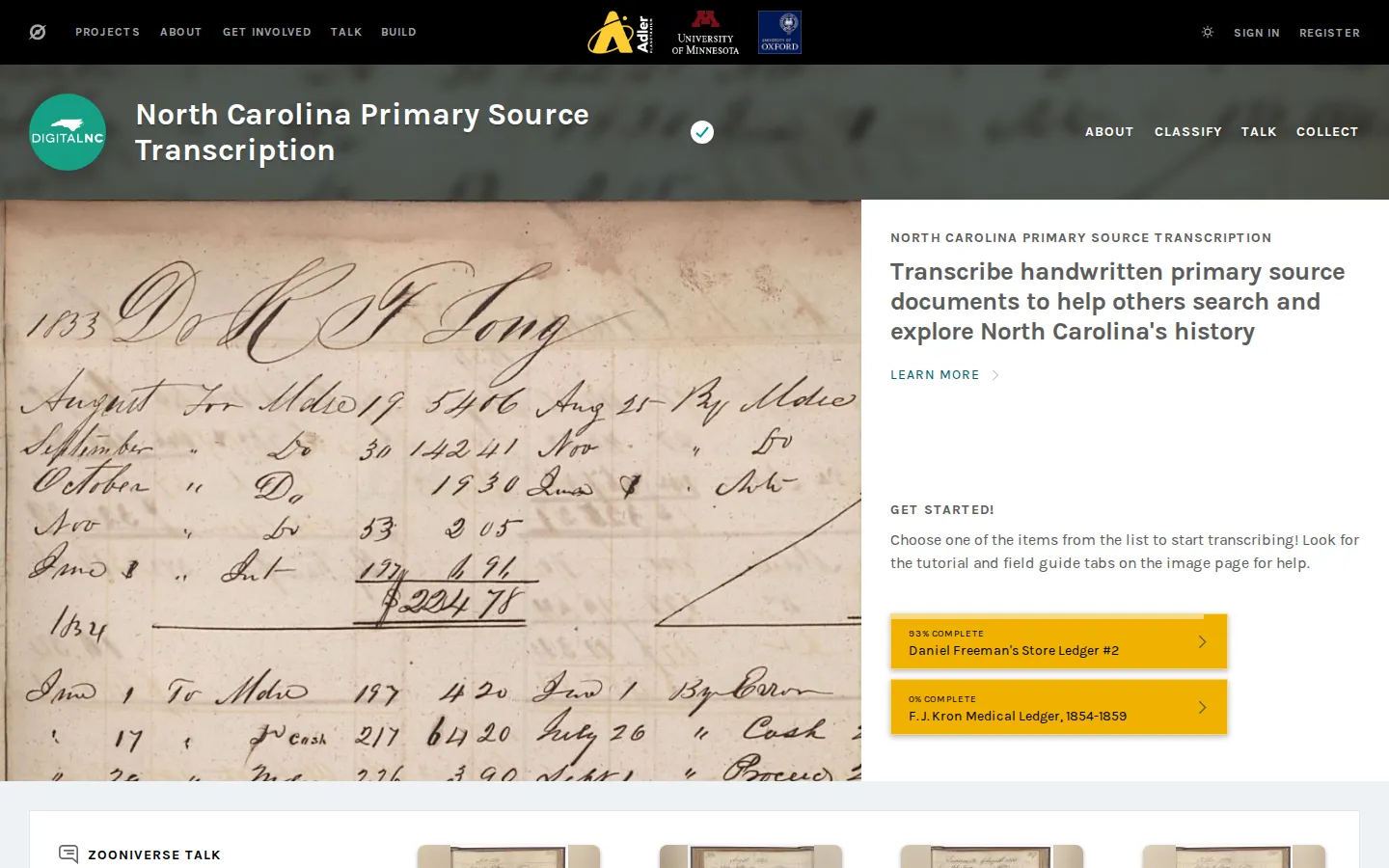
North Carolina Primary Source Transcription hands you digitized letters, ledgers, newspapers, and other archival pages that ordinary text recognition misses. Read the handwriting, type what you see, and help DigitalNC make names, places, and stories findable beyond a catalog record.
What is North Carolina Primary Source Transcription?
This is useful work disguised as a close-reading puzzle. The North Carolina Digital Heritage Center has already scanned material from libraries, archives, museums, and historical societies, but a beautiful image of a handwritten page is still nearly invisible to full-text search. The project asks volunteers to bridge that gap one line at a time. A tutorial and field guide sit beside the task, and completed, verified transcriptions have begun returning to DigitalNC as searchable text. The pilot also studies the less glamorous machinery behind crowdsourcing: permissions, document selection, public interest, verification, and fitting volunteer data back into a working digital repository.
What you can do there
- Choose a digitized North Carolina primary source
- Read and transcribe handwritten or irregularly printed text
- Use the tutorial, field guide, or discussion board when a passage is difficult
Why we picked it
The reward is unusually tangible. A correctly read surname or place can unlock a document for the next researcher, genealogist, student, or incurable ledger snoop. It also exposes the honest limits of automation: when old ink, wandering penmanship, and irregular printing defeat OCR, a careful human can still coax the words back into circulation.
How to get the most from it
Pick a document that looks readable before volunteering for the hardest scrawl in the drawer. Keep the field guide open, preserve spelling and punctuation according to the project's rules, and resist smoothing unfamiliar wording into what you expect it to say. If a passage stays ambiguous, use the discussion area instead of forcing a confident guess.
Good to know
The transcription editor and submission flow were not executed for this field note, so account, saving, and correction behavior remain unverified. Historical documents can also contain difficult subjects or dated language, and handwriting quality varies wildly. The site's landing and statistics views showed inconsistent progress totals; treat those counters as moving interface data, not a reliable measure of how much work remains.
Who made it, and when?
North Carolina Digital Heritage Center is the credited creator or organization. The earliest supported launch date we found is April 12, 2023.
Creator’s official page Open North Carolina Primary Source TranscriptionMore like this
Histography

A dense timeline where eras collapse into a field of small historical sparks.
Steve's Old Computer Museum

A wonderfully dusty filing cabinet of computers from before beige boxes learned to hide their weirdness.
Wayback Machine

A time machine for webpages, complete with a calendar and the occasional missing wire.
Bartosz Ciechanowski

Science essays with levers, sliders, and a knack for making machinery behave.