
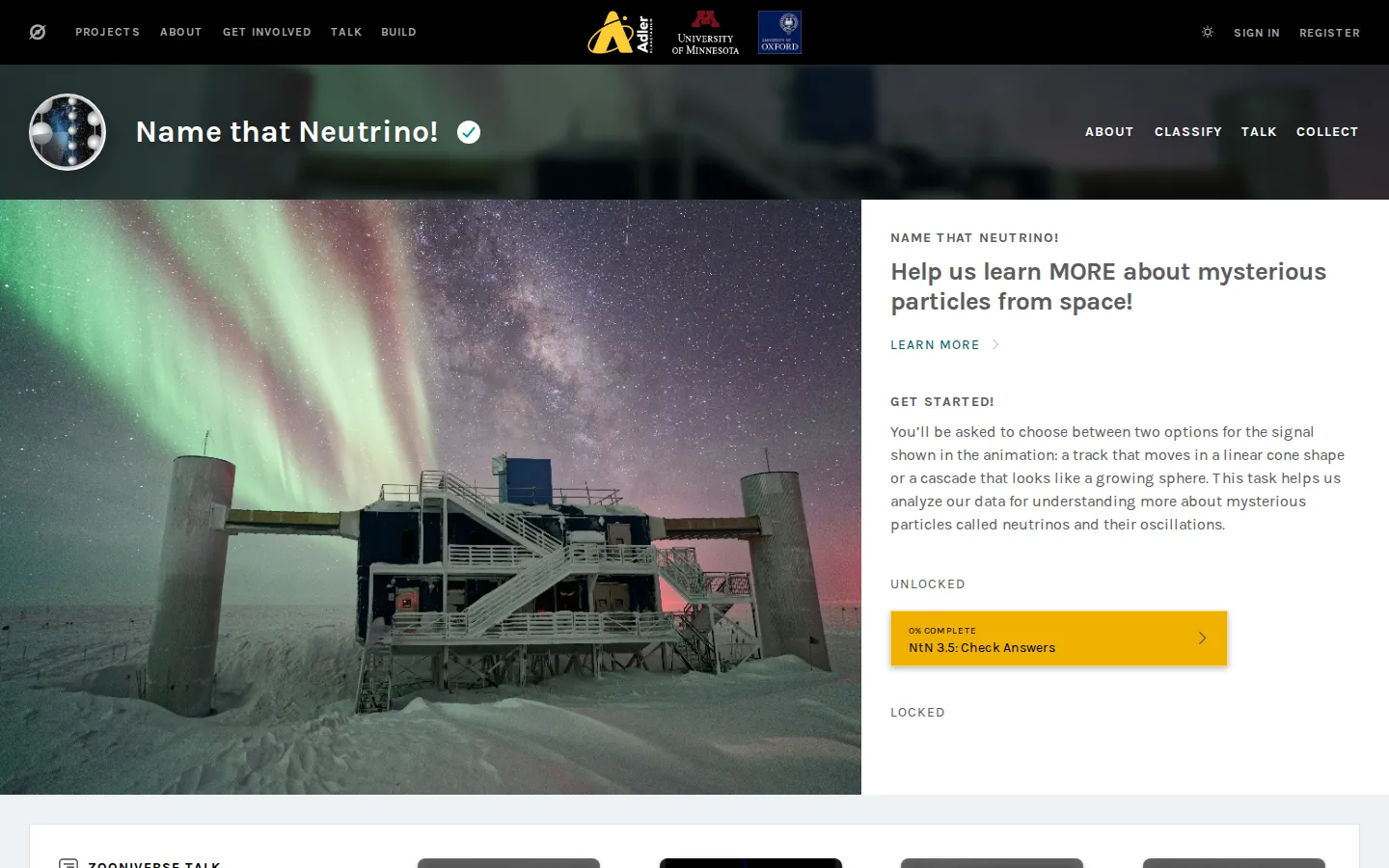
Name that Neutrino! turns IceCube detector events into animated bubble constellations and asks you to read their shape. A long track points one way; a rounder cascade blooms another. The classifications are compared with machine predictions, making this both a physics lesson and a careful human-versus-algorithm experiment.
What is Name that Neutrino!?
Instead of stars, you watch light ripple through a cubic kilometer of instrumented Antarctic ice. Bubble size reflects how much light a sensor caught, while the color shift from red toward blue shows time advancing. That makes particle events legible as motion: some draw directional tracks and others swell into cascades. The first published study used 4,273 simulated, noisy event videos and collected more than 128,000 classifications. Its results were promising but not magical; volunteers and the neural network agreed most clearly on cascades, while several track types remained harder to separate.
What you can do there
- Watch animated IceCube event displays
- Compare the shape and timing of colored light bubbles
- Classify a signal as a track or cascade
Why we picked it
The site gives an invisible particle a surprisingly readable footprint, then lets ordinary pattern recognition meet a real machine-learning benchmark. We especially appreciate that the published results keep the uncertainty intact: citizen science worked as a feasible research method, but the team still identified where training and validation needed improvement.
How to get the most from it
Take the tutorial seriously, then watch the full time sequence before choosing a label. Follow the overall geometry rather than one bright bubble: tracks persist in a direction, while cascades spread more spherically. If two shapes seem plausible, use the field guide or discussion area instead of forcing a confident guess.
Good to know
The project launched on March 14, 2023 and offers six language options. Rotating 3D event animations are central to the task. Current availability is muddy: the landing page invites participation and shows 67 percent complete, while the named 2.0 workflow has also been indexed as out of data. Live counters are zero and should not be treated as historical totals.
Who made it, and when?
IceCube Collaboration is the credited creator or organization. The earliest supported launch date we found is March 14, 2023.
Creator’s official page Open Name that Neutrino!More like this
Nicky Case

Playable explanations about trust, systems, anxiety, networks, and the way people affect one another.
The Illustrated TLS Connection

TLS, unpacked until the handshake has nowhere left to hide.
Learn Git Branching

Git’s family tree, finally allowed to move while you poke it.
How DNS Works

A DNS lesson that takes the scenic route through the internet