
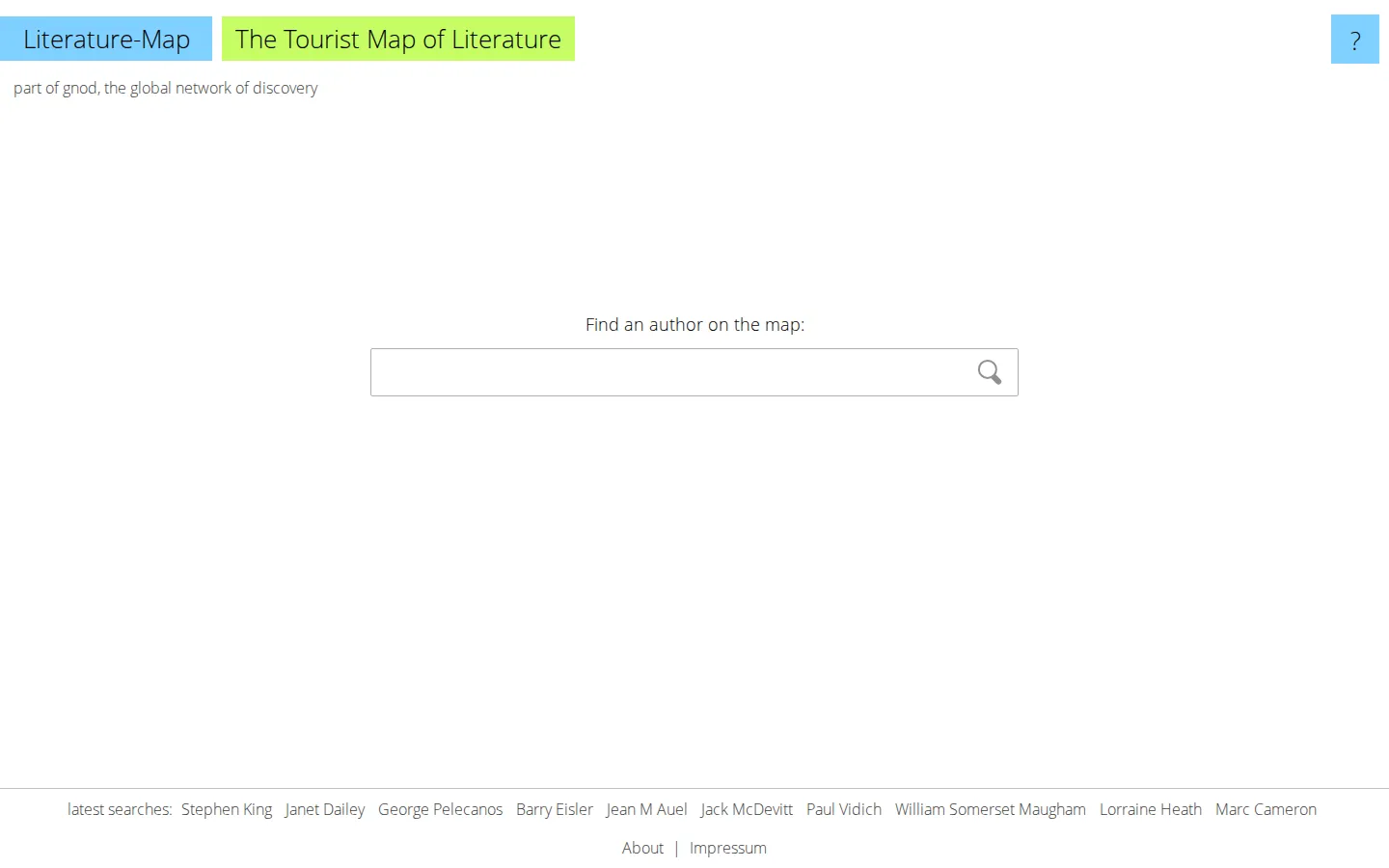
Literature Map turns one familiar author into a clickable field of nearby writers, arranging names by overlap in reader taste. It is a nimble way to leave the bestseller conveyor belt and wander toward someone new, though it stops at authors rather than choosing a particular book.
What is Literature Map?
The front page keeps the bargain wonderfully small: type an author, then inspect the writers gathered around that name. The underlying idea comes from Gnod's Gnooks recommendation system, where authors move closer as more people report liking both. Each result becomes another route through the map, so a search for C. S. Lewis can branch toward G. K. Chesterton, Madeleine L'Engle, J.R.R. Tolkien, Philip Pullman, Neil Gaiman, and plenty of less obvious company. There are no blurbs competing for attention. The names and their relative proximity do the nudging, turning reader taste into a compact literary neighborhood rather than a ranked shopping list.
What you can do there
- Search for a favorite author
- Browse related writers
- Follow an author name into another map
Why we picked it
It makes recommendation browsing feel spatial and pleasantly nosy. Instead of handing over one supposedly perfect answer, Literature Map lays out several directions and lets curiosity choose the next turn. That open-ended structure is especially useful when a favorite author has exhausted your immediate to-read pile.
How to get the most from it
Start with an author whose work you know well, then inspect the closest cluster before chasing the outliers. Click one promising name to redraw the neighborhood, and keep a separate list of candidates so the map can stay a discovery tool instead of becoming a maze.
Good to know
The suggestions operate at the author level, so you will still need a library catalog, bookseller, or review source to choose a title. Proximity reflects shared reader taste, not a guarantee of matching genre, style, politics, or quality; treat an odd neighbor as a lead, not a verdict.
Who made it, and when?
Marek Gibney is the credited creator or organization.
Creator’s official page Open Literature MapMore like this
Histography

A dense timeline where eras collapse into a field of small historical sparks.
Steve's Old Computer Museum

A wonderfully dusty filing cabinet of computers from before beige boxes learned to hide their weirdness.
Wayback Machine

A time machine for webpages, complete with a calendar and the occasional missing wire.
Bartosz Ciechanowski

Science essays with levers, sliders, and a knack for making machinery behave.