
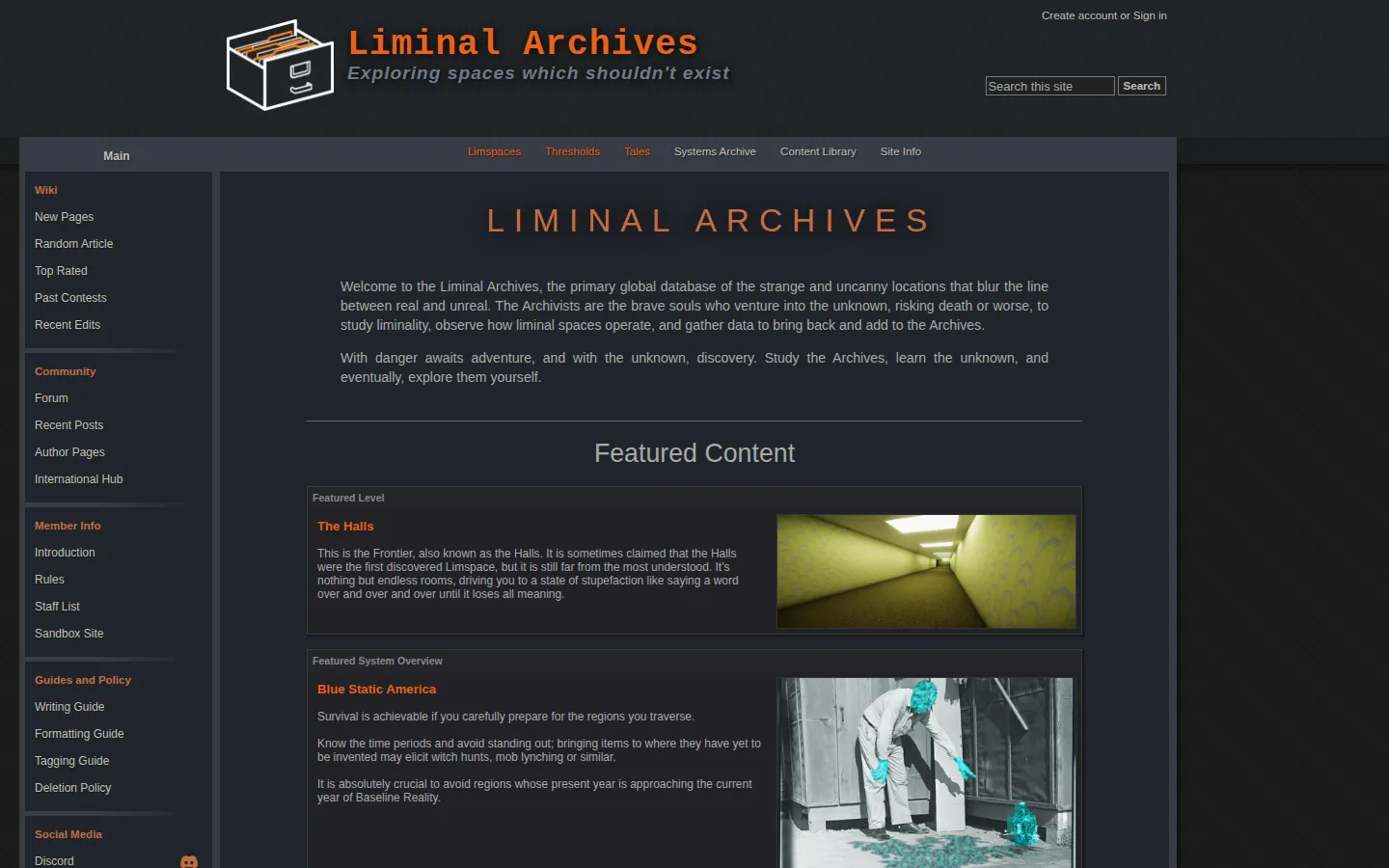
Liminal Archives is a collaborative fiction site dressed in the manner of a serious repository. Its shelves hold limspaces, thresholds, entities, objects, and other documents from a shared world where the strange gets cataloged instead of explained away.
What is Liminal Archives?
Liminal Archives approaches the uncanny with a librarian’s posture. The main page invites visitors to study the archives and explore the unknown, while the site’s own writing guide lays out a much broader cabinet of fiction: limspaces, thresholds, levels, entities, objects, documents, and prose. The result is not a reference archive of real events, but a shared fictional universe that rewards the reader who is happy to follow labels into unfamiliar corridors. An independent containment-fiction reference places the community in the Backrooms and Tech Support orbit, but the archive has its own organization and vocabulary. That matters because the pleasure here is not simply spotting a familiar internet-horror shape. It is watching many writers build a world through field notes, reports, and entries that pretend the impossible has already been given a folder, a title, and somewhere to be filed.
What you can do there
- Read fictional archive entries
- Browse liminal-world categories
- Prepare a contribution using the writing guide
Why we picked it
The archive format gives collaborative fiction a particularly satisfying rhythm. Each entry can feel like a recovered document, yet the categories invite you to keep following connections across a much larger made-up world. It is built for curiosity rather than a single plot.
How to get the most from it
Begin with a category that sounds irresistible, then read one entry without trying to learn the whole setting at once. Follow a related label when it appears, and let the site’s internal taxonomy do the wandering for you. Aspiring writers can consult the site’s writing guide before drafting.
Good to know
Liminal Archives is fiction presented in an archival style, not a source for real-world claims. We did not open individual entries or the contribution flow, so content themes, moderation, account needs, accessibility, privacy, sound, motion, and device behavior still need a hands-on check.
Open Liminal ArchivesMore like this
Histography

A dense timeline where eras collapse into a field of small historical sparks.
Steve's Old Computer Museum

A wonderfully dusty filing cabinet of computers from before beige boxes learned to hide their weirdness.
Wayback Machine

A time machine for webpages, complete with a calendar and the occasional missing wire.
Bartosz Ciechanowski

Science essays with levers, sliders, and a knack for making machinery behave.