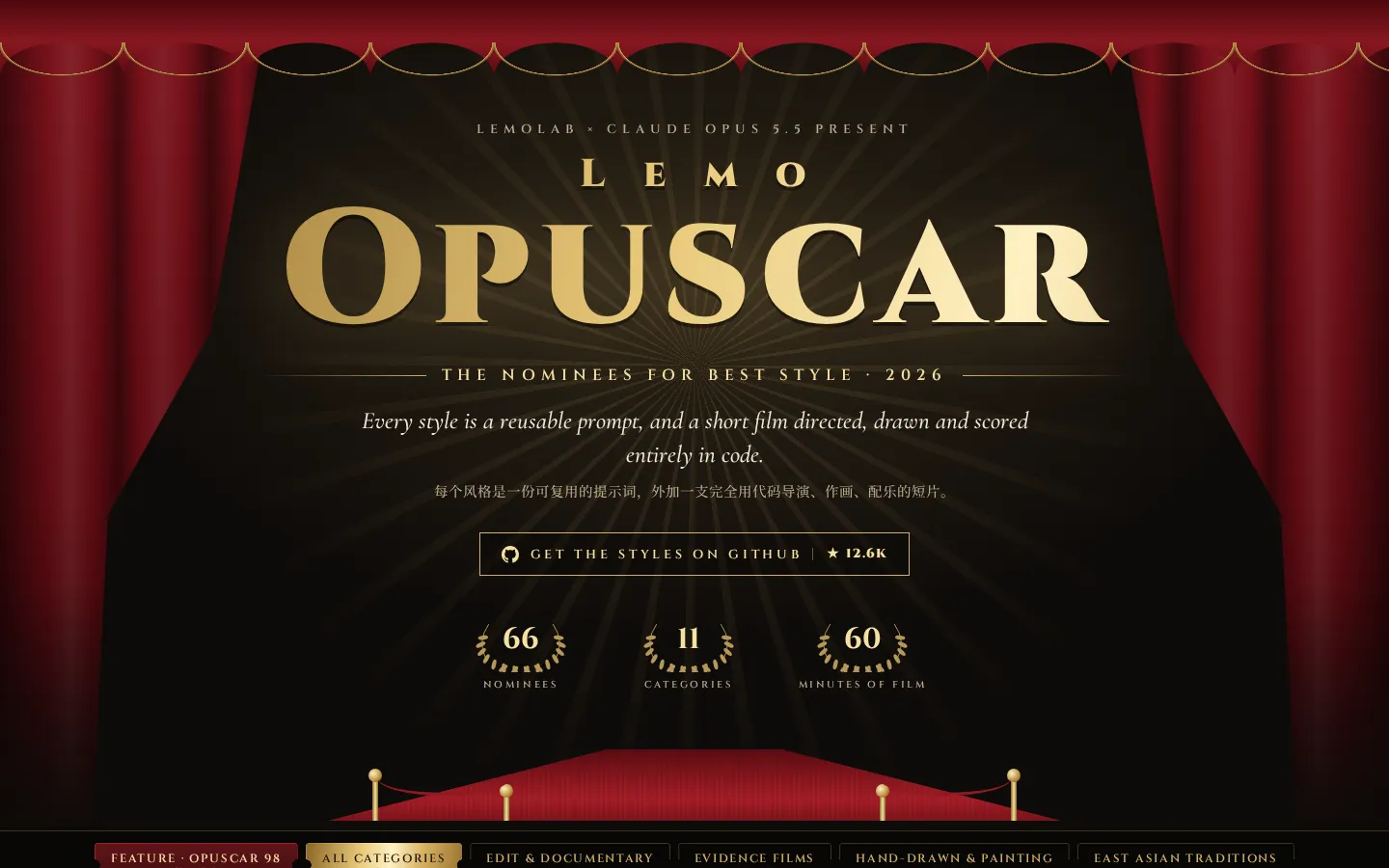
Lemo-Opuscar is a bilingual showroom for short films drawn, cut, scored, and mixed through code. Sixty-six styles range from watercolor and woodcut to news packages, data stories, games, and 3D materials; every card pairs a sample film with the style sheet used to guide a coding agent.
What is Lemo-Opuscar?
The page behaves like a very long awards ballot for visual approaches. Each nominee gets a still, a runtime, a compact premise, suggested use cases, and two useful exits: watch the finished short or inspect its reusable style instructions. The categories jump happily from evidence-led documentary formats to Chinese ink wash, risograph, ASCII terminals, game aesthetics, keynote graphics, and glossy 3D. A six-minute feature restyles nearly a century of Best Picture winners, while the smaller cards make the collection easier to nibble. The companion repository turns the gallery into a working kit, but the page is already worthwhile as a catalog of how differently a one-minute story can move, sound, and frame itself.
What you can do there
- Browse short-film styles by category
- Open sample films and reusable style sheets
- Install the companion skill to make a new coded film
Why we picked it
This is more generous than a mood board. The finished examples sit beside their construction notes, so curiosity can travel from 'that looks good' to 'how was that look directed?' without a scavenger hunt. The bilingual labels and unusually specific use-case tags also make the sprawl feel curated rather than dumped in a heap.
How to get the most from it
Start with a category that matches the job rather than scrolling all 66 styles in order. Open two or three films, compare pace and information density, then read the matching style sheets before installing anything. If you try the companion skill, begin with a short, low-stakes brief and request a storyboard pause; the independent test suggests the bundled tooling is capable, but polish still rewards another pass.
Good to know
Browsing the gallery is free, but making a film is a local production workflow that expects Claude Code, Node, Python, ffmpeg, a headless browser, and optional voice or music downloads. The maker tunes the library for Claude Opus 5.5 and warns that other models may drift. The current page has 66 styles, while the strongest independent hands-on review tested an earlier 59-style revision and found a few missing assets and integration rough edges. Sound is part of most examples, and some styles may contain brisk cutting or strong motion.
Who made it, and when?
Lemomo is the credited creator or organization.
Creator’s official page Open Lemo-OpuscarMore like this
Histography

A dense timeline where eras collapse into a field of small historical sparks.
Steve's Old Computer Museum

A wonderfully dusty filing cabinet of computers from before beige boxes learned to hide their weirdness.
Wayback Machine

A time machine for webpages, complete with a calendar and the occasional missing wire.
Bartosz Ciechanowski

Science essays with levers, sliders, and a knack for making machinery behave.