
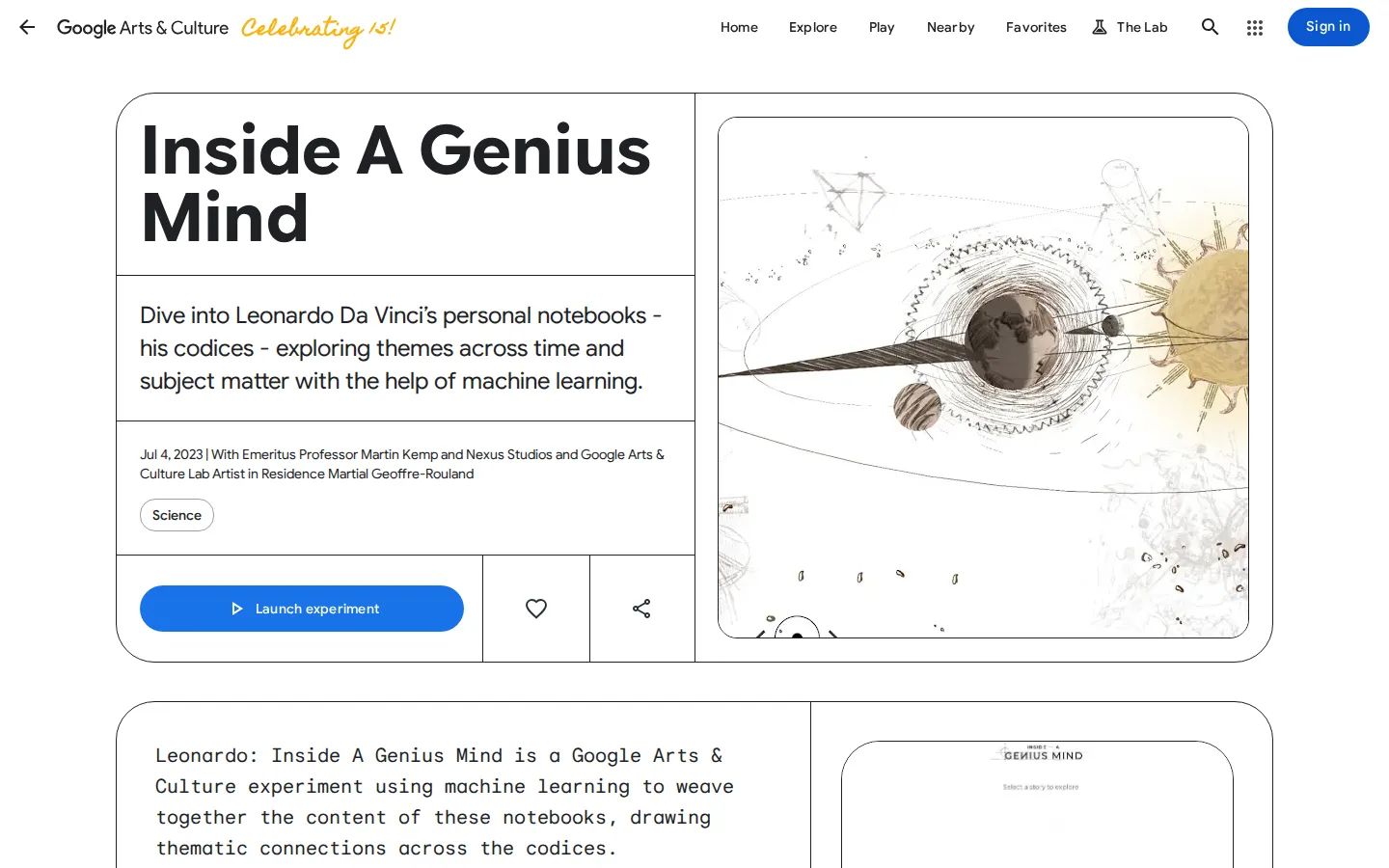
Inside A Genius Mind turns Leonardo da Vinci's codices into linked visual stories, pairing thousands of extracted drawings with thematic connections found through machine learning. It is a more inviting doorway into the notebooks than starting with a stack of facsimile pages, though the machinery behind those connections stays mostly backstage.
What is Inside a Genius Mind?
This experiment treats Leonardo's notebooks less like a shelf of precious volumes and more like a restless thought map. Curated paths carry you between sketches from different codices, following recurring shapes and subjects such as water, plants, hair, flight, sound, and mechanics. The pleasure is in the cross-pollination: a curl of water can rhyme with a lock of hair, and an engineering doodle can sit beside a study of nature without being forced into separate academic drawers. Google says machine learning helped organize more than 3,000 extracted drawings, while Martin Kemp's curatorial work gives the paths historical shape. The target is only one room in a much larger Leonardo retrospective, so nearby links can lead onward to artwork close-ups, notebook explainers, and 3D inventions. Treat the thematic links as an interpretive lens rather than a replacement for scholarly editions of the codices.
What you can do there
- Follow curated stories through Leonardo's notebook drawings
- Trace thematic links across multiple codices
Why we picked it
Leonardo's pages are famously abundant and gloriously unruly; this project makes that sprawl approachable without sanding away the surprise. Its best trick is not merely digitizing old paper, but arranging distant sketches so a visitor can notice how one visual idea keeps resurfacing across art, anatomy, mechanics, and nature.
How to get the most from it
Begin with one curated story instead of trying to absorb the whole collection. Follow a recurring form or subject across several drawings, pause when an unexpected pairing appears, then use the wider Leonardo hub if you want the museum source, codex context, or a related 3D invention.
Good to know
The live embedded interaction, animation, keyboard support, mobile behavior, accessibility, audio, and performance were not exercised in this check. The page is free to open and sits inside Google Arts & Culture, with account and privacy links in the surrounding service. Collection totals vary by scope across official materials: the focused experiment describes more than 718 analyzed pages, while the wider retrospective cites 1,300 notebook pages.
Who made it, and when?
Google Arts & Culture, Martin Kemp, Martial Geoffre-Rouland, and Nexus Studios is the credited creator or organization. The earliest supported launch date we found is July 4, 2023.
Creator’s official page Open Inside a Genius MindMore like this
Histography

A dense timeline where eras collapse into a field of small historical sparks.
Steve's Old Computer Museum

A wonderfully dusty filing cabinet of computers from before beige boxes learned to hide their weirdness.
Wayback Machine

A time machine for webpages, complete with a calendar and the occasional missing wire.
Bartosz Ciechanowski

Science essays with levers, sliders, and a knack for making machinery behave.