
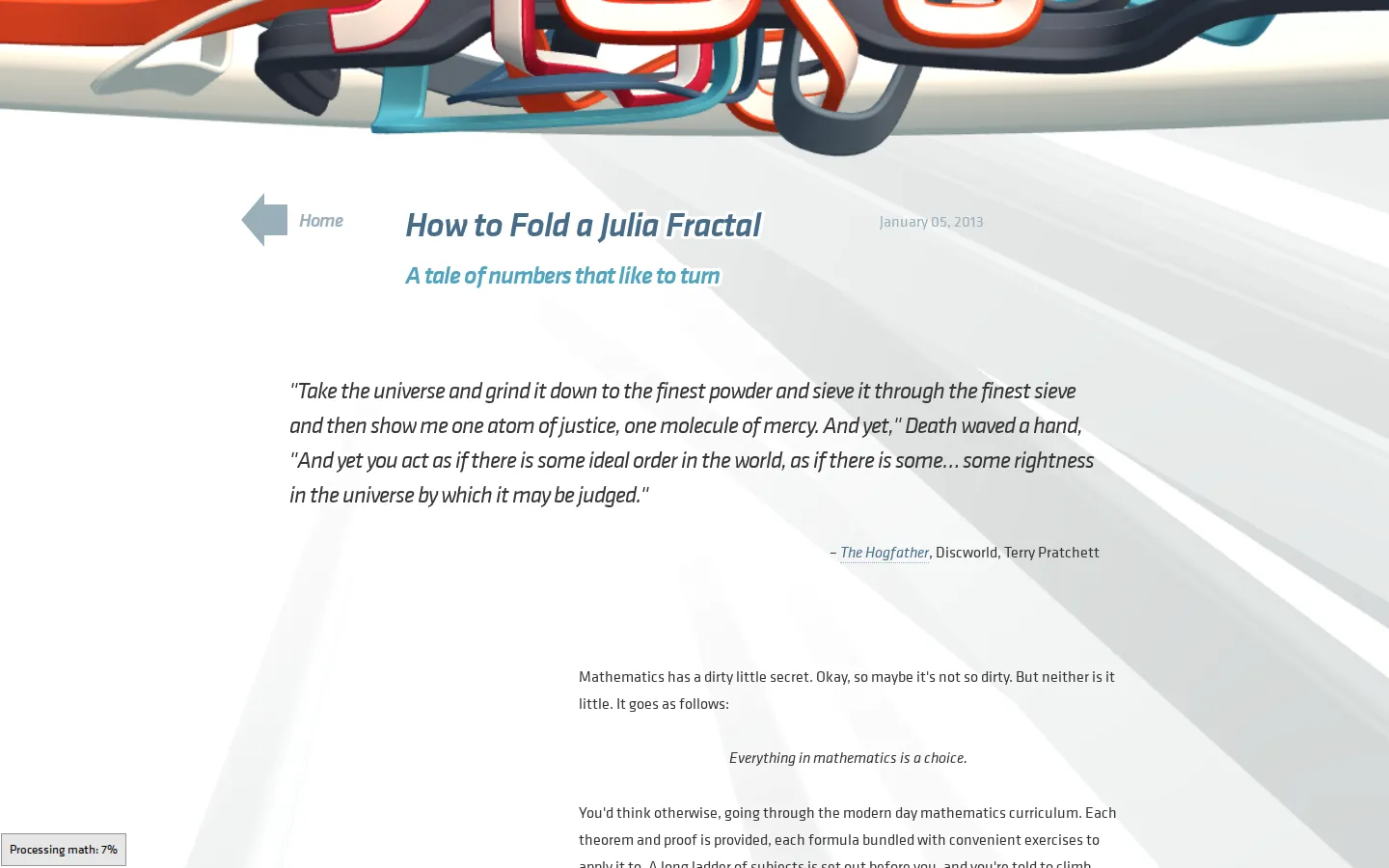
Steven Wittens turns a demanding corner of mathematics into a visual journey: numbers become rotations, square roots peel the complex plane apart, and repeated folds gradually sharpen into Julia-set dragons, clouds, spirals, and snowflakes.
What is How to Fold a Julia Fractal?
This is a long-form explanation with the instincts of a stage magician who keeps showing the mechanism. It begins on the familiar number line, reframes multiplication as growth plus rotation, and builds a circular picture of complex numbers before the floor starts bending. From there, the plane stretches, splits, folds, and recombines through square roots and powers. Reverse Julia iteration turns a safe disc into an increasingly intricate boundary; the same machinery then opens toward the Mandelbrot set, waves, interference, and the limits of what four-dimensional mappings let us picture. Equations are present, but the central argument lives in motion and geometry rather than symbol shuffling.
What you can do there
- Follow a visual introduction to complex numbers
- Watch the complex plane fold into Julia sets
- Connect Julia, Mandelbrot, and wave behavior
Why we picked it
The essay gives a difficult abstraction a physical verb: fold. That single choice carries the reader from imaginary numbers to fractal iteration without pretending the math is trivial, while the branching parade of shapes supplies a handsome payoff for staying with it.
How to get the most from it
Read from the beginning instead of jumping straight to the fractal. The early rotation examples establish the visual grammar used later. When a diagram is available, follow one marked point through a transformation before scanning the whole surface; the local motion makes each fold much easier to parse.
Good to know
The page is substantial and is best treated as a focused reading session, not a two-minute gallery stop. Its visual modules use WebGL, so a compatible browser and graphics stack matter. The current animations, controls, mobile layout, accessibility, sound, and performance have not been verified in a rendered session.
Who made it, and when?
Steven Wittens is the credited creator or organization. The earliest supported launch date we found is January 5, 2013.
Creator’s official page Open How to Fold a Julia FractalMore like this
Nicky Case

Playable explanations about trust, systems, anxiety, networks, and the way people affect one another.
The Illustrated TLS Connection

TLS, unpacked until the handshake has nowhere left to hide.
Learn Git Branching

Git’s family tree, finally allowed to move while you poke it.
How DNS Works

A DNS lesson that takes the scenic route through the internet