
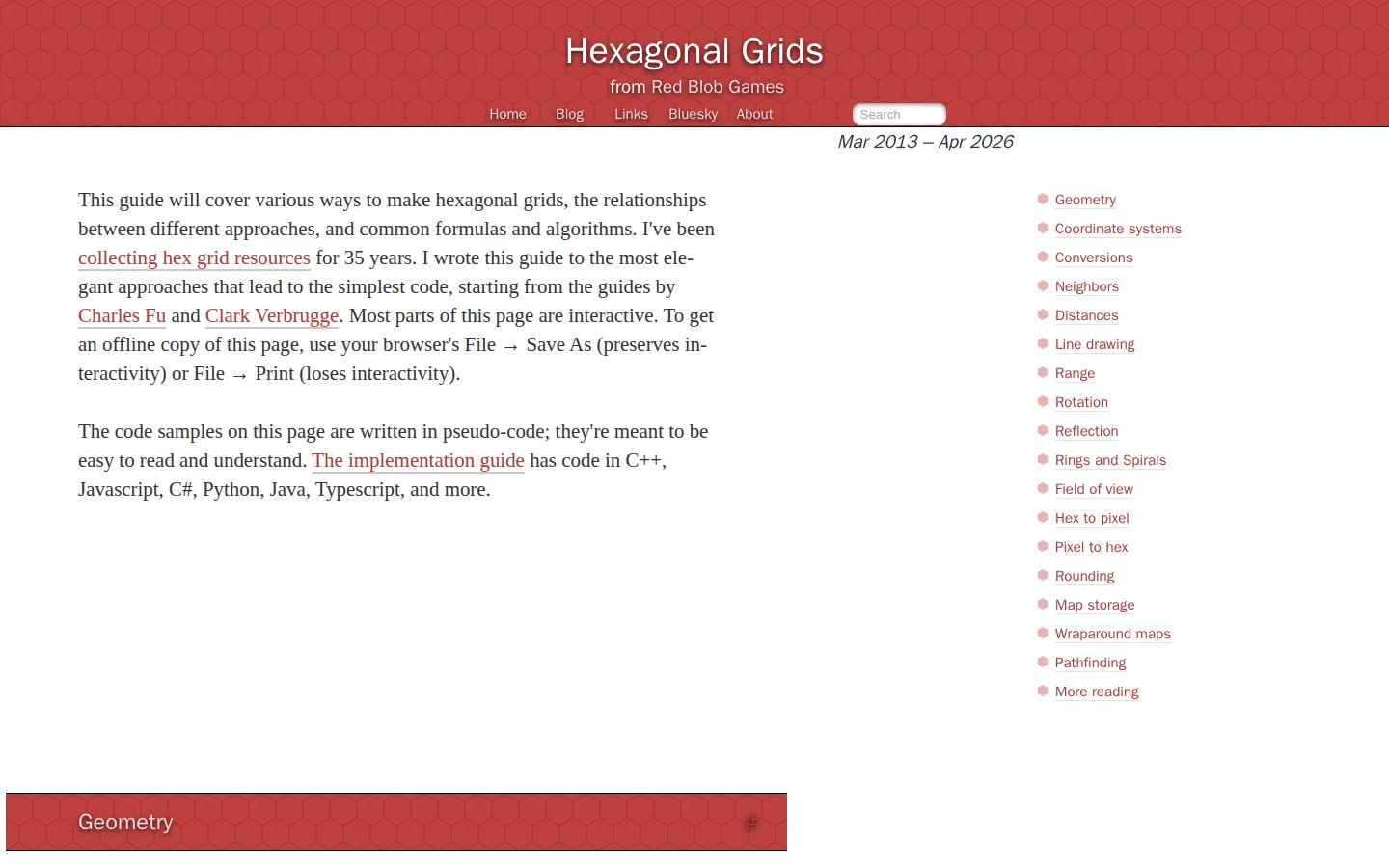
Amit Patel's Hexagonal Grids guide turns a famously fiddly game-development problem into a visual reference for coordinate systems, conversions, neighbors, distances, ranges, lines, rotations, storage, and pathfinding. The page pairs readable pseudocode with diagrams designed to make the formulas feel less like contraband mathematics.
What is Hexagonal Grids?
The guide begins with the awkward truth that hexagons have several legitimate coordinate systems, then gives each one a job. Offset coordinates suit familiar rectangular storage; axial and cube coordinates make vector-like algorithms cleaner; doubled coordinates occupy a useful middle ground. From there the page builds outward through conversions, neighbor tables, distance, line drawing, rings, field of view, pixel mapping, rounding, storage, and pathfinding. A companion implementation guide carries the same ideas into multiple programming languages. The result is not a recipe card but a working atlas: each formula sits near the geometric reason it exists.
What you can do there
- Compare coordinate systems for hex grids
- Study formulas and pseudocode for common grid algorithms
- Use interactive diagrams to connect geometry with implementation
Why we picked it
This is technical writing that treats confusion as a design problem. The coordinate diagrams, explicit tradeoffs, pseudocode, implementation companion, and long trail of references make it useful both when learning the topic and when returning months later to fix one stubborn conversion bug.
How to get the most from it
Choose your map shape before choosing coordinates. For a rectangular board, compare offset and doubled systems; for irregular shapes or algorithm-heavy work, start with axial or cube. Then jump to the one operation you need, test it against a tiny hand-labeled grid, and open the implementation companion only after the geometry makes sense.
Good to know
Most diagrams require JavaScript and SVG, and their live behavior was not exercised here. The main page uses pseudocode; production-ready details live in the companion implementations and still deserve tests in your own coordinate conventions. Red Blob Games says its articles are free, need no signup, and contain no ads. Saving the page through the browser can preserve interactivity, while printing does not.
Who made it, and when?
Amit Patel is the credited creator or organization. The earliest supported launch date we found is March 11, 2013. A documented update was recorded July 24, 2026.
Creator’s official page Open Hexagonal GridsMore like this
Nicky Case

Playable explanations about trust, systems, anxiety, networks, and the way people affect one another.
The Illustrated TLS Connection

TLS, unpacked until the handshake has nowhere left to hide.
Learn Git Branching

Git’s family tree, finally allowed to move while you poke it.
How DNS Works

A DNS lesson that takes the scenic route through the internet