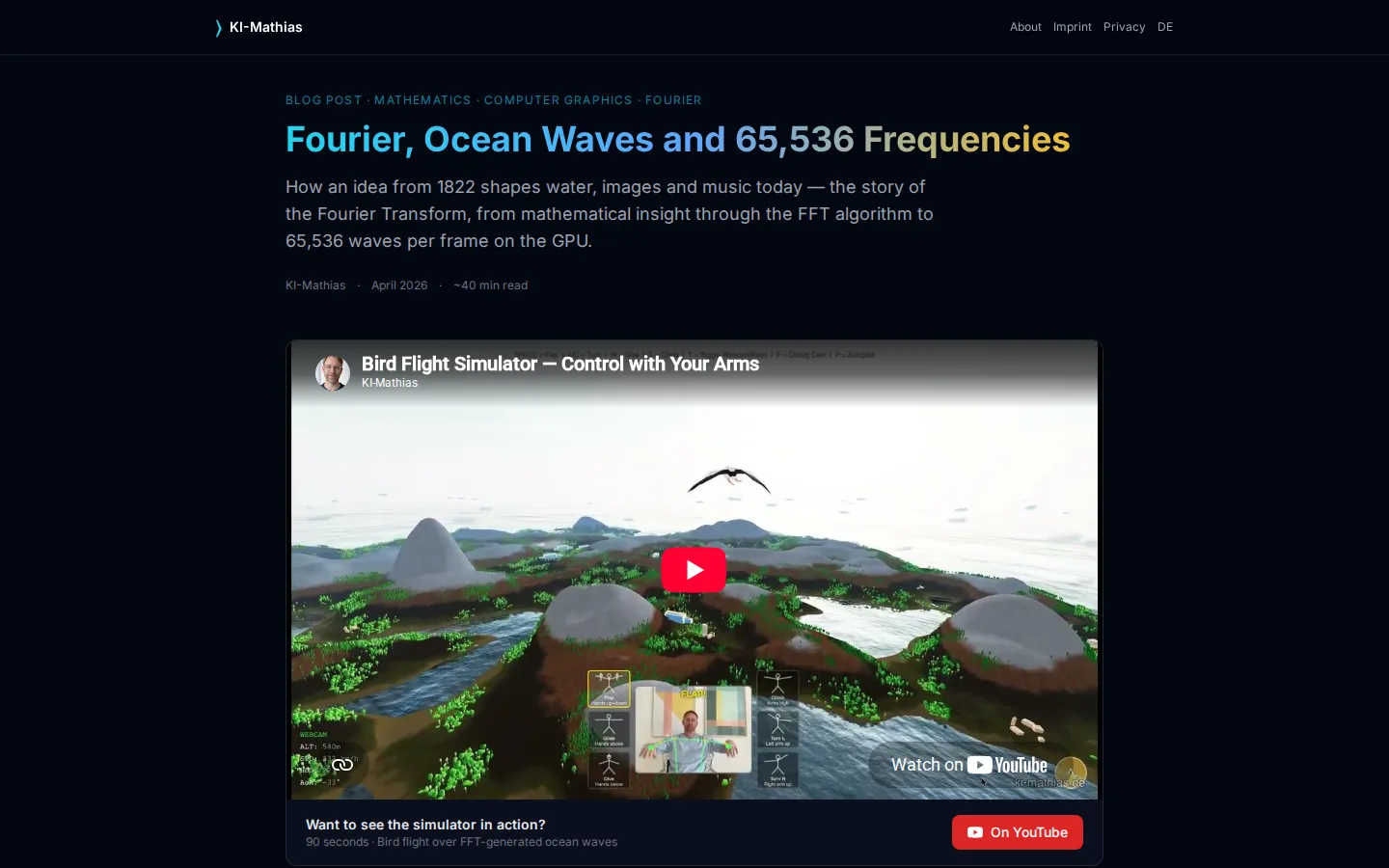
This long-form visual explainer starts with a browser bird-flight demo, then follows the mathematics beneath its animated ocean. It moves from basic Fourier decomposition through image and audio examples to inverse-FFT wave synthesis, with source code and practical controls close at hand.
What is Fourier & Ocean Waves?
The article puts a tangible destination beside the theory: a bird-flight simulator whose water is assembled from frequency data. From there it works backward through procedural terrain, signal decomposition, image and audio transforms, and the inverse process that turns a wave spectrum into a moving surface. Diagrams, formulas, implementation notes, keyboard controls, and a public code repository let readers choose how deep to go. The result feels less like a detached math lesson and more like lifting the floorboards of a graphics demo to see which equations are carrying the weight.
What you can do there
- Read a visual explanation of Fourier transforms
- Open the linked bird-flight simulator
- Inspect the public simulator source code
Why we picked it
Fourier transforms can become a blur of symbols when they lack a visible consequence. Here the consequence is an ocean you can approach through a flight demo, while the article connects that surface to the same family of ideas used in images and sound. The unusually open trail from explanation to controls to source code rewards both casual curiosity and technical inspection.
How to get the most from it
Start with the opening explanation and keep the listed controls nearby. If your device is comfortable with a 3D scene, open the linked simulator long enough to give the ocean a concrete shape, then return to the sections on frequency space and inverse transforms. The public repository is the useful last stop for readers who want implementation detail rather than another pass through the formulas.
Good to know
This is a substantial technical read, and the linked simulator adds continuous 3D motion. Its repository documents mobile tilt, webcam-pose, and keyboard control modes plus a WebGPU path with WebGL2 fallback, but those behaviors were not operated during this check. No approved screenshot is attached, and current audio, permission, privacy, advertising, and accessibility behavior remains unverified.
Who made it, and when?
Mathias Leonhardt is the credited creator or organization.
Creator’s official page Open Fourier & Ocean WavesMore like this
Nicky Case

Playable explanations about trust, systems, anxiety, networks, and the way people affect one another.
The Illustrated TLS Connection

TLS, unpacked until the handshake has nowhere left to hide.
Learn Git Branching

Git’s family tree, finally allowed to move while you poke it.
How DNS Works

A DNS lesson that takes the scenic route through the internet