
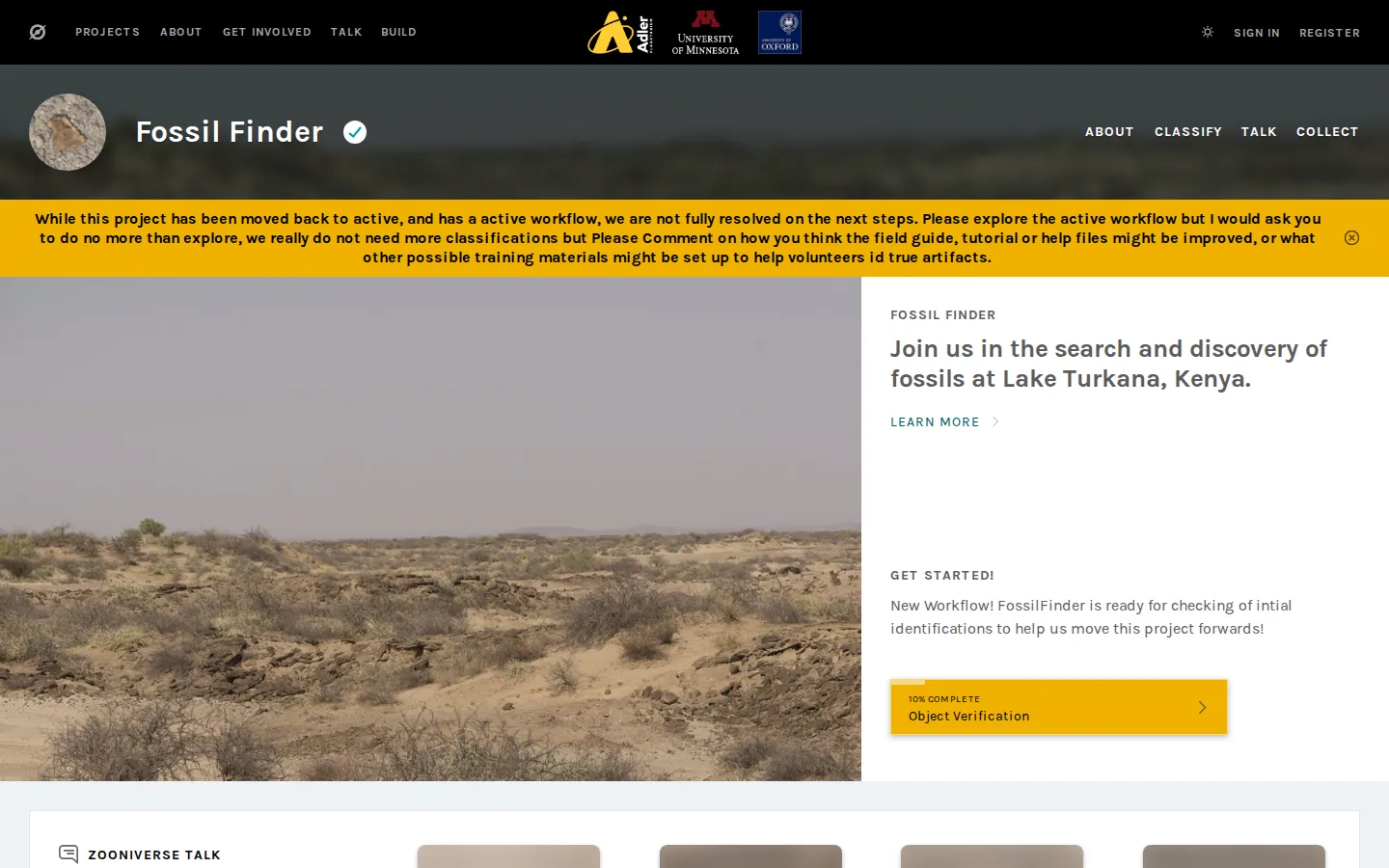
Fossil Finder turns remote slices of Kenya's Lake Turkana Basin into a citizen-science search table. The pleasure is slow and forensic: scan rocky ground, learn the visual clues, and compare possible bones, teeth, tools, and ordinary geology. Treat it as an explorable research archive for now—the project's own pages disagree about whether useful classification work remains.
What is Fossil Finder?
The raw material here is unusually literal: photographs of fossil-bearing ground gathered from above, including imagery made with cameras carried by kites and other field platforms. Volunteers were asked to mark suspicious fragments, then later to judge clusters where many people had pointed to the same possible bone or tooth. That bridge from dusty pixels to field checks is the hook. A 2018 project update reported 59,000 subject images and more than 675,000 classifications, with researchers having visited a limited set of marked locations. The interface may now be more exhibit than active dig desk, but it still shows how patient pattern spotting can become research data.
What you can do there
- Inspect aerial photographs of fossil-bearing ground
- Review highlighted candidate objects
- Read the project's methods, team, and results
Why we picked it
Most fossil sites hand you the polished discovery; this one hands you the visual uncertainty before the label exists. Pebble, tooth, tool, or wishful thinking? Even without running the classifier, the documented workflow makes the scientific bottleneck tangible and gives the archive a satisfying needle-in-a-gravel-pile charm.
How to get the most from it
Start with the project background and results before opening the classification area. Learn the difference between rock, bone, tooth, and tool cues, then inspect a few images slowly rather than racing for dramatic finds. Use Talk for context, and regard any current workflow as exploratory unless the project posts a clearer request for new classifications.
Good to know
The current project notice asks visitors to explore but says more classifications are not needed, while another first-party page describes the project as paused or out of data. Image quality has varied historically, and the classification tools, mobile behavior, accessibility, account requirements, and present subject supply were not tested in this review. No screenshot was captured; detected project art remains unapproved evidence only.
Who made it, and when?
Fossil Finder research team is the credited creator or organization. The earliest supported launch date we found is 2015. A documented update was recorded April 2018.
Creator’s official page Open Fossil FinderMore like this
Nicky Case

Playable explanations about trust, systems, anxiety, networks, and the way people affect one another.
The Illustrated TLS Connection

TLS, unpacked until the handshake has nowhere left to hide.
Learn Git Branching

Git’s family tree, finally allowed to move while you poke it.
How DNS Works

A DNS lesson that takes the scenic route through the internet