
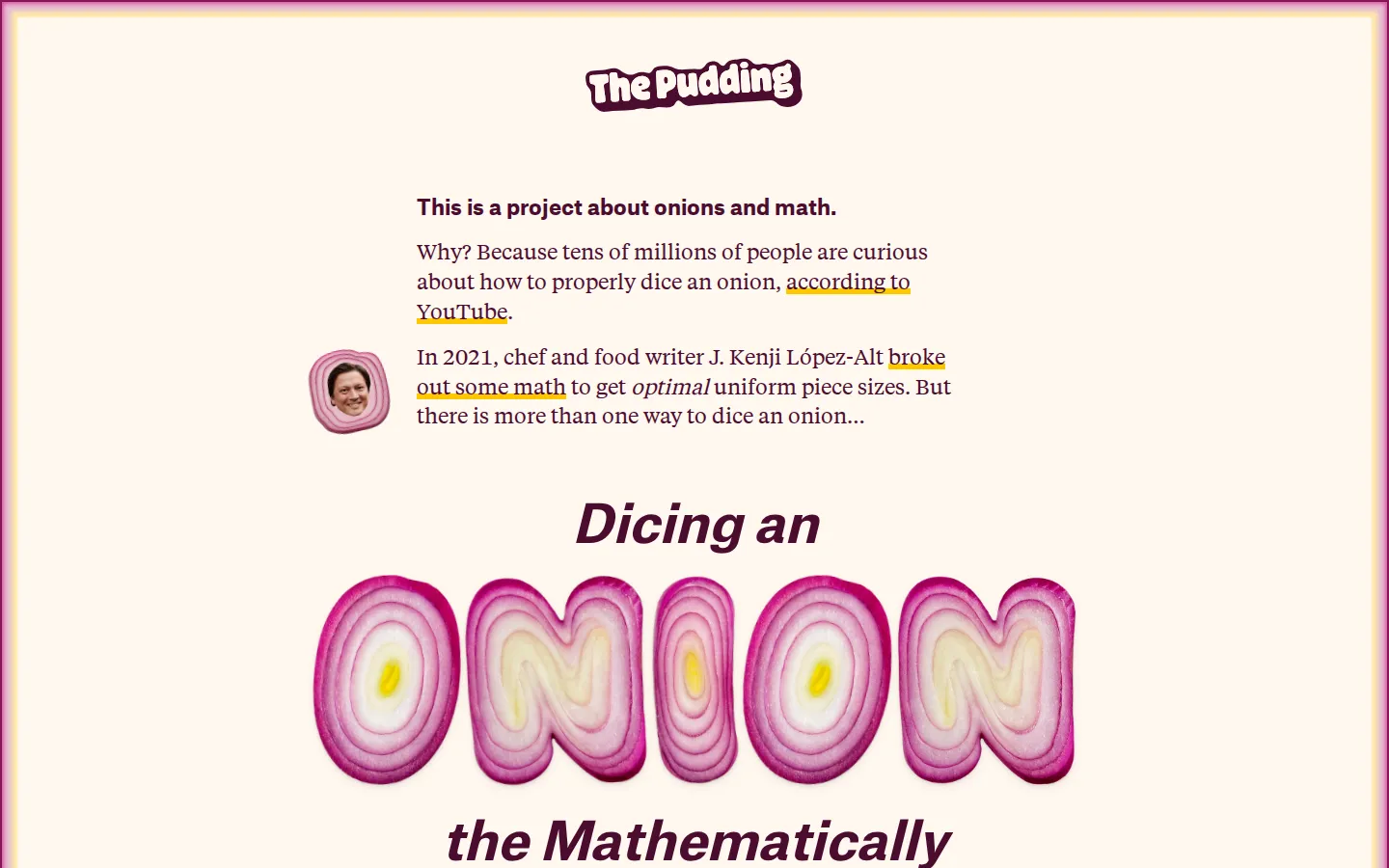
Dicing an Onion builds a simplified cross-section of a layered onion and lets you compare vertical, radial, below-center, and horizontal cuts by how evenly they divide its area. Sliders, exploded diagrams, and a table of model-specific winners turn a familiar prep task into a wonderfully excessive piece of recreational math.
What is Dicing an Onion, the Mathematically Optimal Way?
The question is humble: how should you aim a knife if you want evenly sized onion pieces? The response is delightfully disproportionate. Andrew Aquino, Russell Samora, and Jan Diehm draw a half onion as concentric arcs, score the resulting pieces with relative standard deviation, and let you alter the layer count, number of cuts, horizontal cuts, and target depth. Exploded diagrams make unevenness visible before the percentages arrive. The essay then tests 19,320 combinations in its finite model and contrasts those results with the continuous, infinitely layered version behind the roughly 55.731-percent onion constant. That comparison is the best part. A value that sounds universal turns out to depend on what kind of onion the math imagines. The authors do not hide the joke or the limitation: real onions are three-dimensional, knives are not infinitely thin, and near-perfect dice matter more to an internet debate than to most dinners.
What you can do there
- Compare vertical, radial, below-center, and horizontal onion cuts
- Adjust layers, cut counts, and target depth with interactive controls
- Inspect diagrams and a table of model-specific optima
Why we picked it
This is what interactive explanation does well: it lets a reader feel why a result changes instead of merely accepting a tidy number. The sliders and exploded pieces turn variance into something you can inspect, while the finite-versus-infinite comparison delivers a genuine mathematical wrinkle. It is rigorous enough to provoke objections and playful enough to welcome them.
How to get the most from it
Move through the cutting methods in order so the baseline comparisons make sense. Change one control at a time, toggle the exploded view, and watch both the shapes and the relative standard deviation. When you reach the optimal-techniques table, switch layer counts to see why there is no single finite-onion target depth for every setup.
Good to know
The model measures areas in a two-dimensional cross-section, not the volume or cooking rate of real onion pieces. Its numerical winners therefore describe the model, not a knife-safety rule or culinary guarantee. The page itself emphasizes that modestly uneven dice are rarely a serious problem for home cooks; use a safe technique and a sharp knife, not a protractor at the cutting board.
Who made it, and when?
Andrew Aquino, Russell Samora, and Jan Diehm is the credited creator or organization. The earliest supported launch date we found is August 15, 2025.
Creator’s official page Open Dicing an Onion, the Mathematically Optimal WayMore like this
Nicky Case

Playable explanations about trust, systems, anxiety, networks, and the way people affect one another.
The Illustrated TLS Connection

TLS, unpacked until the handshake has nowhere left to hide.
Learn Git Branching

Git’s family tree, finally allowed to move while you poke it.
How DNS Works

A DNS lesson that takes the scenic route through the internet