
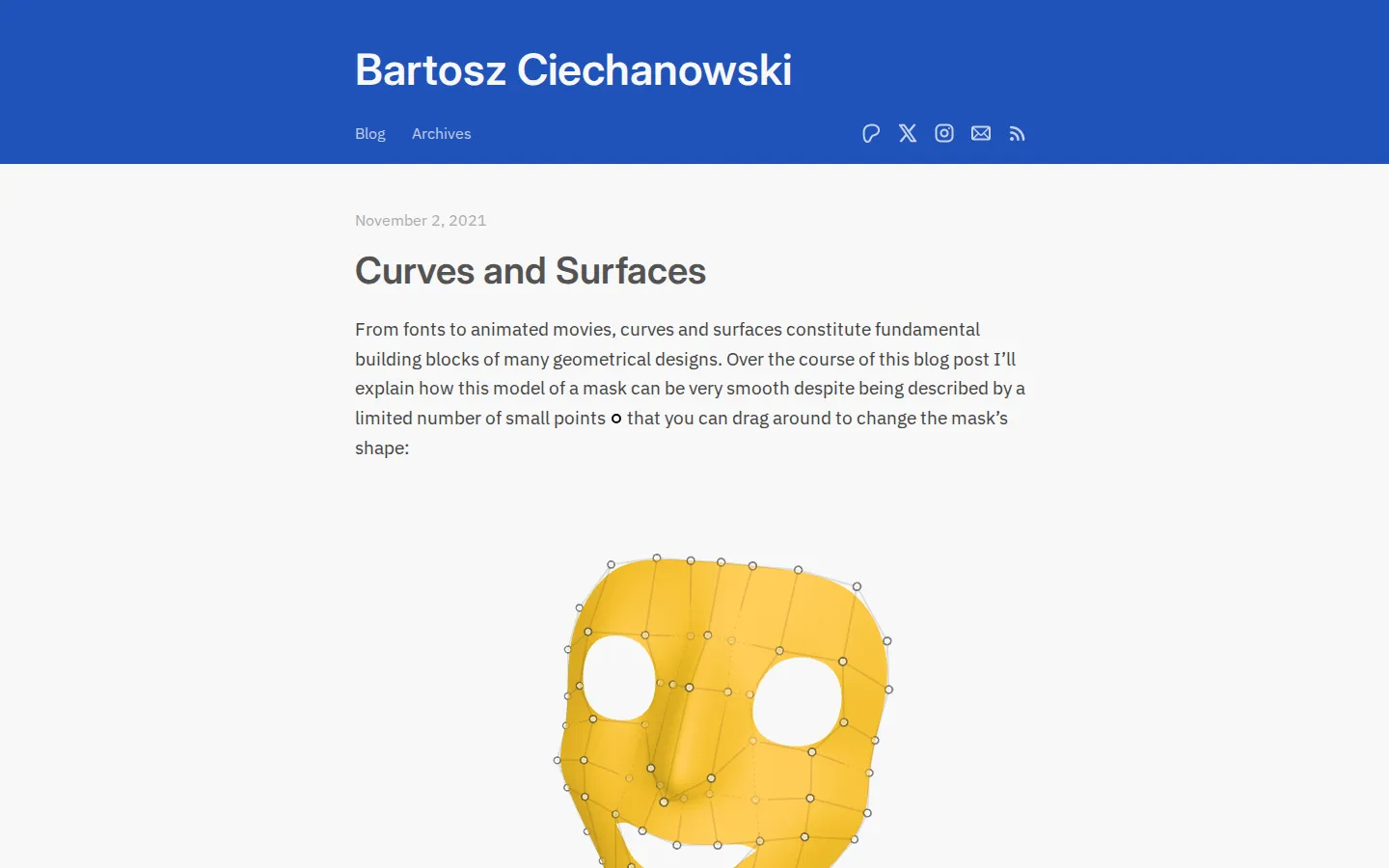
Curves and Surfaces turns the mathematics behind fonts, glossy products, and animated characters into a chain of interactive models. It moves from one straight segment to Bézier curves, B-splines, NURBS, and subdivision surfaces without losing the thread.
What is Curves and Surfaces?
The essay begins with the smallest useful gesture: drag two endpoints and watch a straight segment emerge through interpolation. Then it keeps upgrading the idea. A third point bends the path into a quadratic Bézier curve; repeated interpolation produces cubic curves; a grid of curves grows into a surface patch. The difficult middle chapters earn their complexity by showing why a giant Bézier curve is awkward, why joined pieces need matching tangents and curvature, and how B-splines localize a control point's reach. By the time a coarse mask-shaped mesh is smoothed with Catmull-Clark subdivision, the polished shell feels like the result of understandable little rules rather than graphics sorcery.
What you can do there
- Shape curves and surfaces with control points
- Inspect interpolation, continuity, curvature, and basis functions
- Follow a path from Bézier curves to subdivision surfaces
Why we picked it
This is a rare explanation that keeps equations, design tools, and physical consequences on the same page. Weighting functions become draggable shapes; curvature continuity becomes a wobble in a mirror or a jolt on a rail curve; subdivision becomes a sequence of weighted mesh edits. The interactions are there to expose cause and effect, not merely to make the article sparkle.
How to get the most from it
Work through it in order and move only one control point or slider at a time. Pause when the article switches from curves to surfaces and ask which one-dimensional idea has just gained another parameter. The reflection and train-track sections are useful reality checks before the later dive into knots, weights, NURBS, and subdivision rules.
Good to know
Set aside real reading time: the page crosses geometry, numerical construction, industrial design, and computer graphics. The live models were not executed during review, so device support, keyboard access, motion comfort, and performance remain uncertain. The article is openly readable and links to optional Patreon support; no current audio behavior was verified.
Who made it, and when?
Bartosz Ciechanowski is the credited creator or organization.
Creator’s official page Open Curves and SurfacesMore like this
Nicky Case

Playable explanations about trust, systems, anxiety, networks, and the way people affect one another.
The Illustrated TLS Connection

TLS, unpacked until the handshake has nowhere left to hide.
Learn Git Branching

Git’s family tree, finally allowed to move while you poke it.
How DNS Works

A DNS lesson that takes the scenic route through the internet