
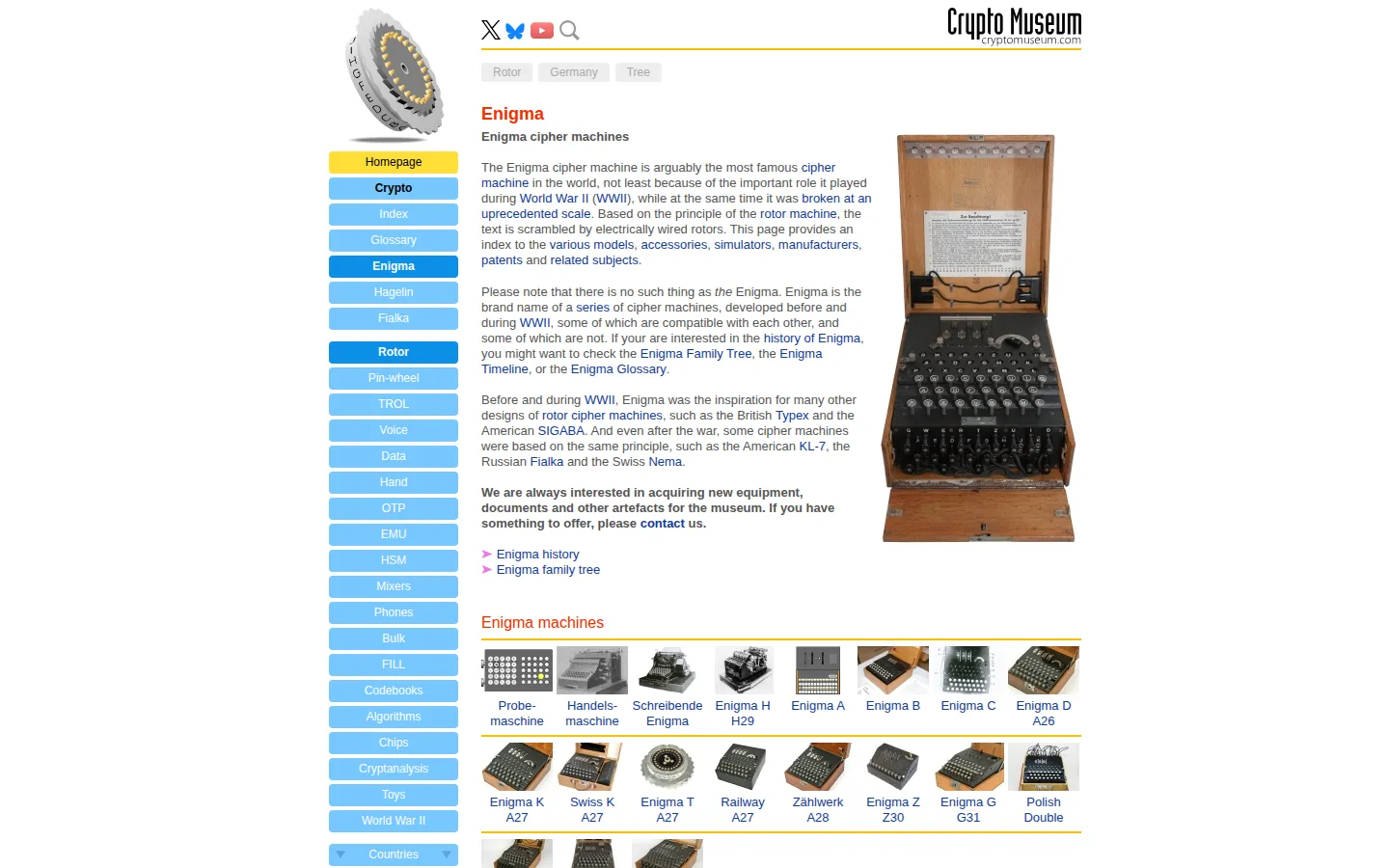
Crypto Museum's Enigma index is less a single article than a switchboard into models, wiring, accessories, patents, messages, simulators, restoration notes, photographs, and codebreaking history. Its best correction arrives immediately: Enigma was a family of machines, not one universally interchangeable box.
What is Crypto Museum: Enigma?
The page starts broad, then keeps finding trapdoors. A model gallery runs from early printing machines through commercial, military, railway, intelligence, and naval variants; nearby branches lead to plugboards, rotors, lamps, printers, recovered messages, patents, family trees, and replicas. Comparison tables and detail pages reward the reader who wants to know why a name, wheel count, or wiring change matters. It also separates the machine's operation from the history of breaking its traffic, including the Polish work that preceded later British and American machinery. This is a virtual museum in the literal sense: the exhibit is the link structure, and curiosity is the docent.
What you can do there
- Browse Enigma models and variants
- Follow technical pages on operation, wiring, patents, and accessories
- Trace the machine family through history, messages, and codebreaking
Why we picked it
The archive makes technical history tactile without flattening it into a famous-name story. Its insistence on model differences, object provenance, ongoing corrections, and restoration evidence turns an iconic silhouette into a complicated lineage of engineering decisions and wartime use.
How to get the most from it
Begin with the family tree or timeline, then choose one familiar model such as Enigma I or M4 and one unfamiliar branch for contrast. Keep the main index open as a map; the wiring, working-principle, messages, and Bombe pages make more sense after you have anchored yourself to a specific machine.
Good to know
This is a dense reference archive rather than a guided tour, and some pages lead to long documents, simulators, or embedded videos. Crypto Museum says its website uses no cookies or trackers, though that statement and third-party video behavior were not independently tested. Images are copyrighted unless a page says otherwise, and the museum distinguishes collection objects from machines it only examined or cannot obtain.
Who made it, and when?
Paul Reuvers and Marc Simons is the credited creator or organization. The earliest supported launch date we found is 2008.
Creator’s official page Open Crypto Museum: EnigmaMore like this
Histography

A dense timeline where eras collapse into a field of small historical sparks.
Steve's Old Computer Museum

A wonderfully dusty filing cabinet of computers from before beige boxes learned to hide their weirdness.
Wayback Machine

A time machine for webpages, complete with a calendar and the occasional missing wire.
Bartosz Ciechanowski

Science essays with levers, sliders, and a knack for making machinery behave.