
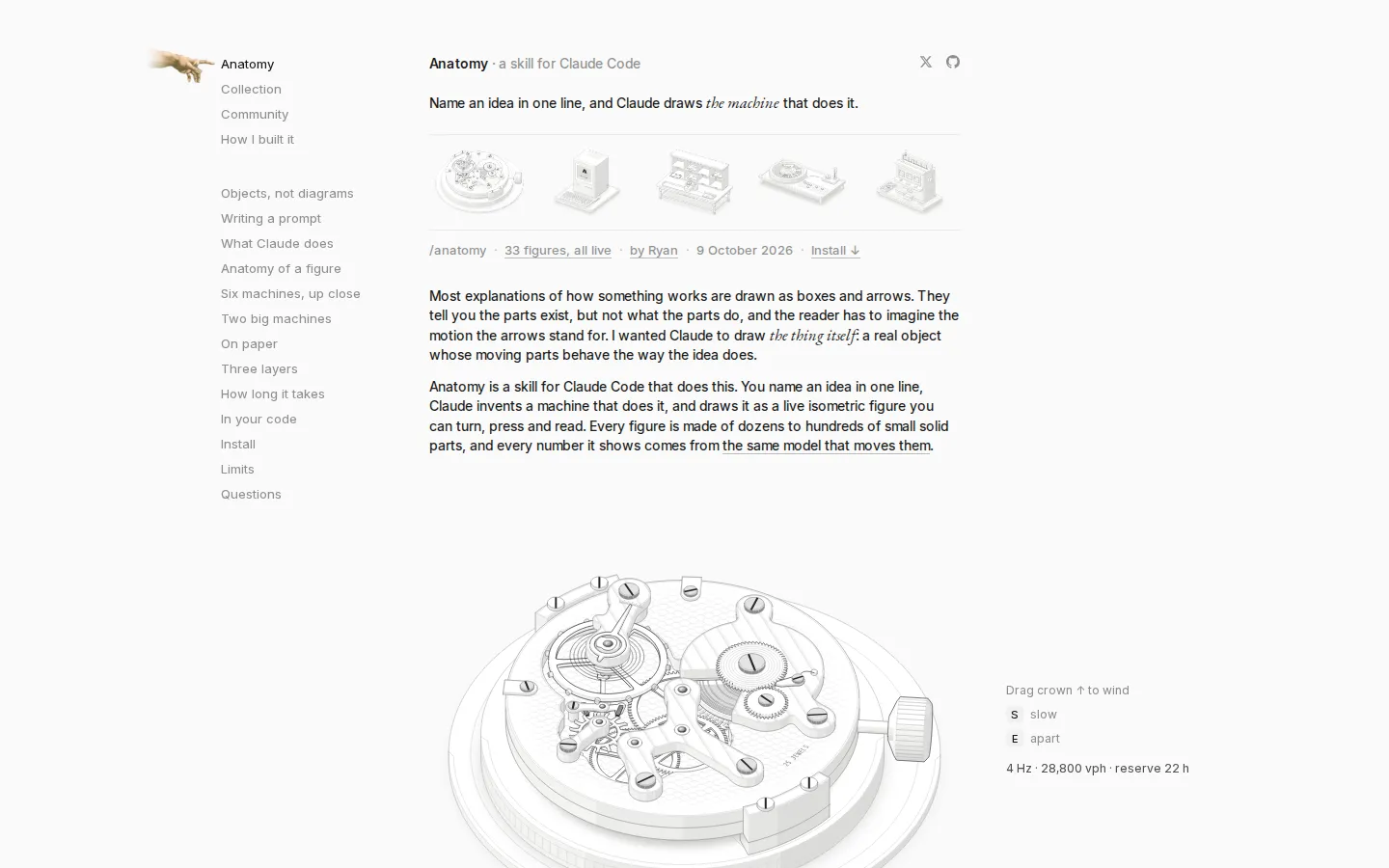
Anatomy replaces the usual box-and-arrow explainer with a cabinet of working isometric contraptions. Its public guide and collection show queues as marble runs, caches as bookcases, handshakes as ropeways, and much larger systems as dense mechanical figures. Each piece is meant to move, report its own model, and reveal the concept through the object rather than through labels floating around it.
What is Anatomy?
The homepage is both manifesto and mechanical curiosity shop. You can skim the rules that keep every figure solid and readable, wander through a collection of live explainers, inspect the build process, or take the open-source skill back to a coding project. Small concepts get charming physical metaphors: a bloom filter becomes a fruit machine and a mutex becomes a tank with one shared key. Bigger examples add hundreds of parts, optional shader effects, real-time readouts, and printable layouts. The delight comes from watching an abstraction acquire gears, levers, hoppers, lamps, and something you can actually manipulate.
What you can do there
- Browse live explanatory figures
- Read how the drawing system works
- Install the open-source skill
Why we picked it
Anatomy has a strong editorial idea and follows it all the way down to the screws: the object must perform the explanation. That constraint produces figures with more personality and teaching value than a decorative diagram generator. The site also exposes its limits, review loop, and verification machinery instead of pretending every first pass is correct.
How to get the most from it
Start with the collection and choose a concept you already understand, such as a queue or cache, so you can judge how faithfully the mechanism maps to the idea. Try the documented pointer and keyboard controls, then read the creator's build notes before installing anything. If you make a figure, check its numbers and play through every moving state before using it in teaching or documentation.
Good to know
The open-source skill is MIT licensed, but generating figures still uses whichever coding-agent service you bring to it. Detailed work can take hours, 3D mode is marked beta, and the creator explicitly recommends treating the first result as a draft. The live interactions, accessibility behavior, mobile performance, and print output were not independently reproduced during this review.
Who made it, and when?
Ryan / wheresryan22 is the credited creator or organization. The earliest supported launch date we found is October 9, 2026.
Creator’s official page Open AnatomyMore like this
Nicky Case

Playable explanations about trust, systems, anxiety, networks, and the way people affect one another.
The Illustrated TLS Connection

TLS, unpacked until the handshake has nowhere left to hide.
Learn Git Branching

Git’s family tree, finally allowed to move while you poke it.
How DNS Works

A DNS lesson that takes the scenic route through the internet