
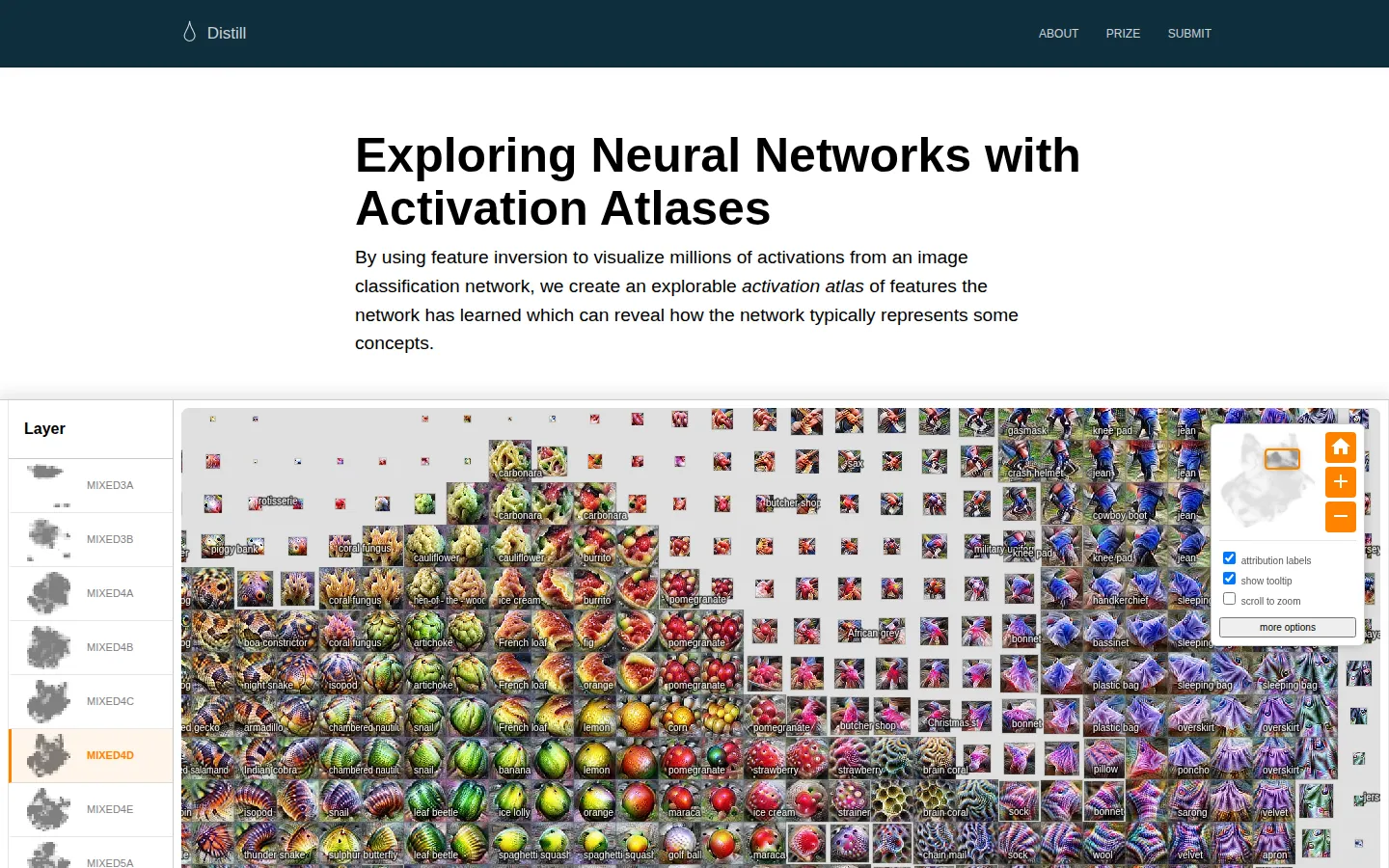
Activation Atlas turns the hidden layers of an image-recognition network into sprawling maps of textures, shapes, objects, and wonderfully uncertain hybrids. The article is technical, but its explorable diagrams give you an unusually concrete way to watch simple visual cues become more specific concepts.
What is Activation Atlas?
The page starts with the problem of translating a neural network's columns of numbers into something human eyes can inspect. It then builds the atlas in stages: sample activations from many images, arrange similar vectors near one another, average them into a grid, and turn each cell into a synthetic visual icon. The resulting maps resemble continents assembled from fur, fruit, windows, water, wheels, and dog ears. Moving between layers shows vague textures sharpening into recognizable parts and objects. Class-focused views add a second pleasure: they reveal odd shortcuts inside the model, including features that pull one label toward another for reasons that are visually plausible but conceptually wrong. This is less a push-button demo than a paper you can wander through, with the diagrams carrying much of the argument.
What you can do there
- Browse visual maps of features learned by InceptionV1
- Compare network layers and class-specific attributions
Why we picked it
Few technical explainers make a model's internal confusion feel this tangible. The atlas gives abstract interpretability work a landscape you can inspect, while the article is candid about sampling limits, approximations, and cases where a visual pattern may mislead. It rewards both quick visual wandering and a much slower read.
How to get the most from it
Begin with the layer tour before chasing a particular classification. Compare an early map with a later one, then zoom into one recurring family of shapes and watch how it changes. After that, the fireboat, snorkel, shark, and wok examples make the attribution and failure sections easier to follow.
Good to know
This is a long, English-language research article, not a lightweight neural-network toy. The examples center on one ImageNet-trained vision model, and the authors stress that the maps depend on the sampled data. Full-screen views and linked notebooks are available, but keyboard, touch, audio, and screen-reader behavior remain undocumented.
Who made it, and when?
Shan Carter, Zan Armstrong, Ludwig Schubert, Ian Johnson, and Chris Olah is the credited creator or organization. The earliest supported launch date we found is March 6, 2019.
Creator’s official page Open Activation AtlasMore like this
Nicky Case

Playable explanations about trust, systems, anxiety, networks, and the way people affect one another.
The Illustrated TLS Connection

TLS, unpacked until the handshake has nowhere left to hide.
Learn Git Branching

Git’s family tree, finally allowed to move while you poke it.
How DNS Works

A DNS lesson that takes the scenic route through the internet