
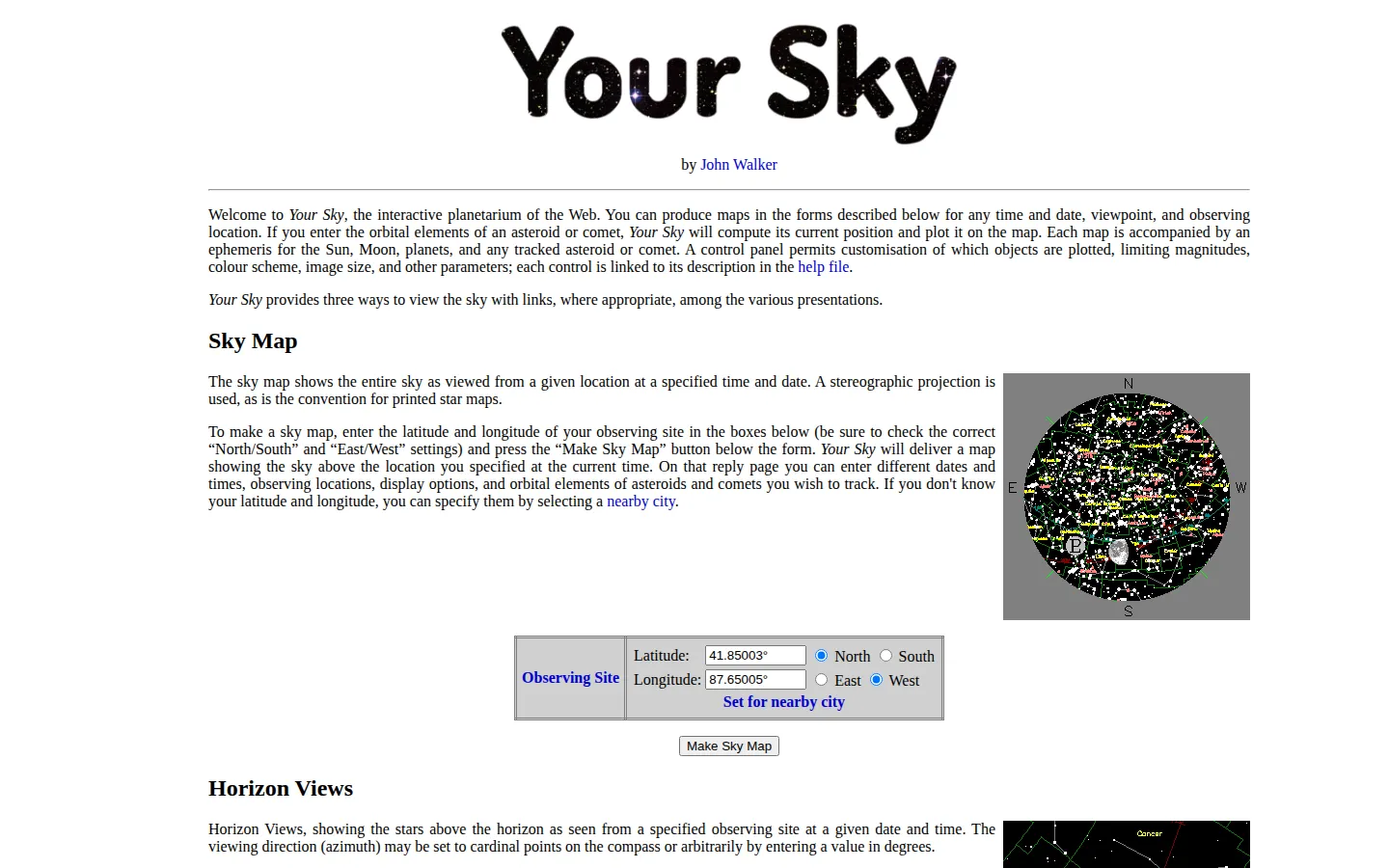
Your Sky is John Walker's long-running Fourmilab tool for making a tailored chart of the heavens. Give it an Earth location and a time, then shape the result around the particular patch of sky you want to consider.
What is Your Sky?
Your Sky belongs to the useful side of web nostalgia: the side where a modest interface conceals a lot of knobs. First implemented in 1998, it lets a visitor request a map for a chosen location and date rather than handing over one generic night. Official documentation describes all-sky and horizon views, a virtual-telescope option, and choices about stars, constellations, planets, deep-sky objects, comets, and asteroids. That makes it less like a dazzling simulation and more like a well-stocked astronomy workbench. The charm is in the specificity. Instead of asking what the sky looks like in the abstract, you ask what it should look like there, then. Its visual results and current request flow were not run in this review, so the best promise here is the documented scope, not a claim about a particular generated chart.
What you can do there
- Choose an observing location
- Set a date and time
- Generate a sky map
Why we picked it
There is something wonderfully direct about a sky tool that starts with the observer's place and time. Your Sky's long-lived, configurable approach turns a vague glance upward into a concrete question you can frame for yourself.
How to get the most from it
Start with your observing location and the date and time you care about, then keep the first map simple before adding more objects or display options. Compare the result with the real sky as a planning aid, not as a replacement for local weather or conditions.
Good to know
This draft did not submit a custom request or inspect a rendered chart. Current controls, output quality, mobile behavior, accessibility, and positional accuracy should be checked by an administrator before approval.
Who made it, and when?
John Walker is the credited creator or organization. The earliest supported launch date we found is January 1998.
Open Your SkyMore like this
Stellarium Web

Turn the browser into a planetarium matched to the sky above your location.
The Scale of the Universe 2

Slide from the smallest known scales to the largest structures in the observable universe.
100,000 Stars
Fly from the Sun into a 3D neighborhood of one hundred thousand nearby stars.
WorldWide Telescope

A sky atlas with a time machine tucked into its controls