
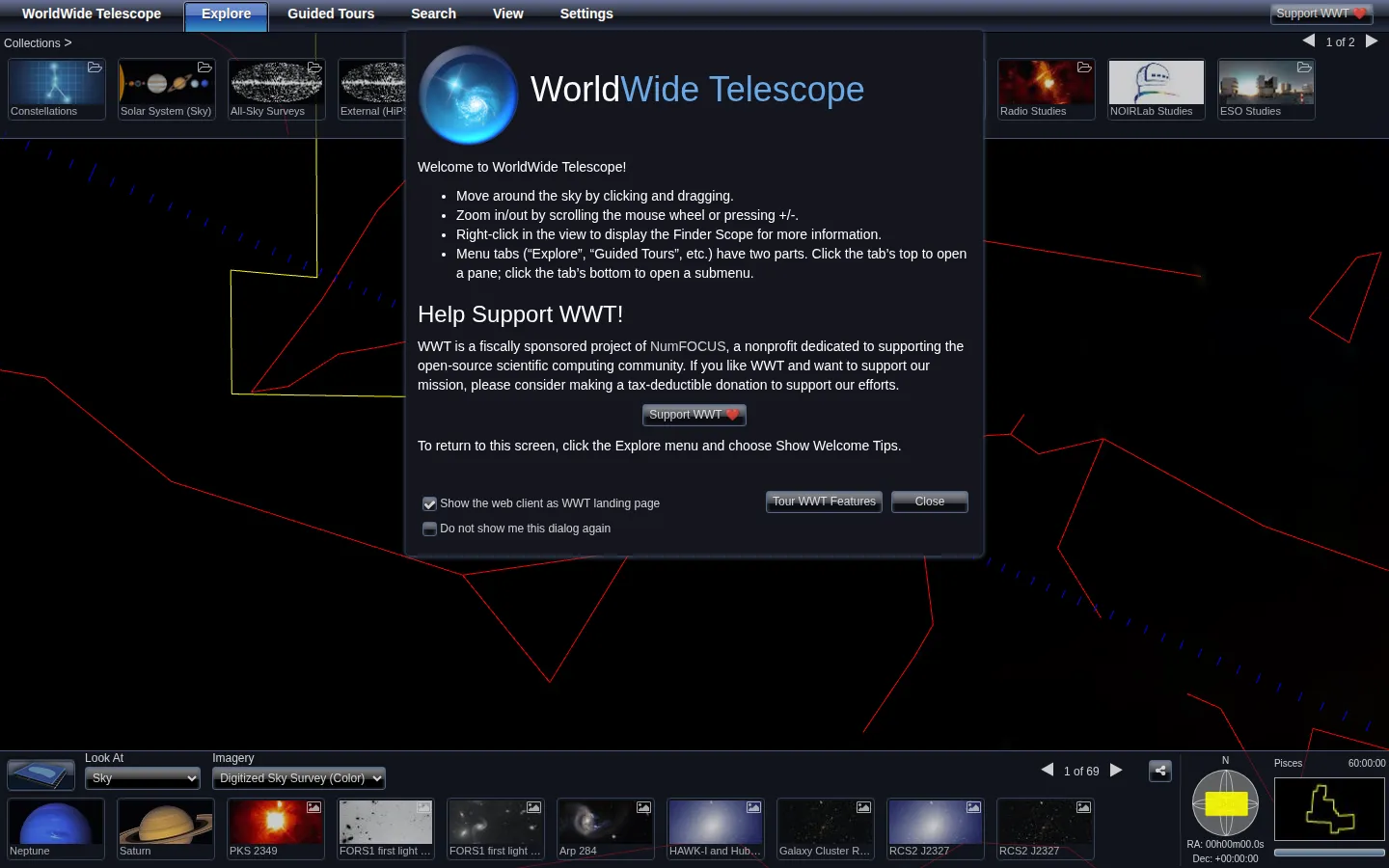
WorldWide Telescope turns a browser tab into a virtual observatory: a place to roam astronomical imagery, shift the clock, and approach the sky as a navigable map rather than a stack of museum labels.
What is WorldWide Telescope?
The web client is built around navigation rather than a single featured image. Its interface exposes a location, time mode, coordinates, and a Galactic Plane setting, while the project’s guide describes panning and zooming from the night sky into the Solar System and other astronomical panoramas. That gives the visit a map-room feeling: pick a direction, change the conditions, and keep following the thread. Guided tours offer a gentler route when the control panel feels like a telescope console. This is not a telescope reservation system or a quick daily-photo feed. It is a long-running, open-source viewing environment that gathers astronomical material into one place, with enough structure for deliberate exploration and enough room for a pleasantly accidental detour.
What you can do there
- Pan and zoom across astronomical imagery
- Browse guided tours
- Adjust time and observing location
Why we picked it
It makes a familiar subject feel navigable. The useful twist is not merely seeing space imagery, but moving through it with place and time controls that encourage a visitor to compare views instead of passively scrolling past them.
How to get the most from it
Open it on a stable connection, then begin with one mode or tour rather than changing every control at once. Once the map feels legible, adjust the time or observing location and use pan and zoom to follow a feature outward.
Good to know
The web client says a strong internet connection is best. It runs in the browser without installation, but the official manual notes that it has fewer specialized features than the Windows application.
Open WorldWide TelescopeMore like this
Stellarium Web

Turn the browser into a planetarium matched to the sky above your location.
The Scale of the Universe 2

Slide from the smallest known scales to the largest structures in the observable universe.
100,000 Stars
Fly from the Sun into a 3D neighborhood of one hundred thousand nearby stars.
Cosmos Explorer

A cosmic idea cabinet where every drawer comes with a few objections.