
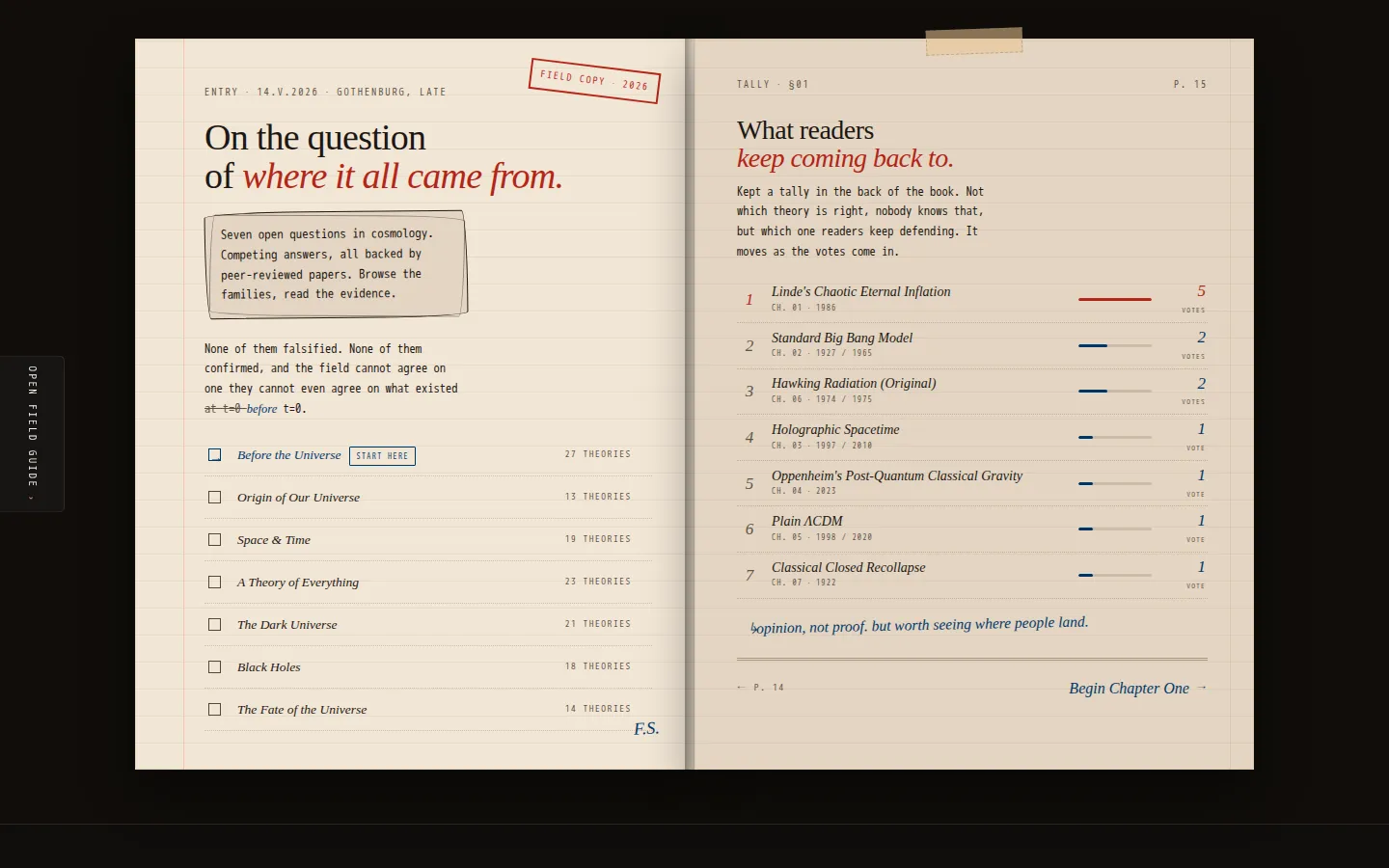
Cosmos Explorer turns heavyweight questions about the universe into an interactive map of competing theories. It pairs visual scenes with side-by-side variants, caveats, and routes back to the literature behind the labels.
What is Cosmos Explorer?
Cosmos Explorer is built for the point where a physics podcast names a theory, the room gets quiet, and you wish there were a map. Its subject matter ranges across cosmology and fundamental physics, but the useful trick is structural: an idea is not left alone on a pedestal. Related variants sit nearby, ready to compare. A Black Holes section, for instance, places Page-curve and replica-wormhole ideas among neighbouring entries instead of treating one label as the final word. The surrounding notes distinguish claims, supporting material, and objections. That makes the site more like a guided atlas of live questions than a list of cosmic answers.
What you can do there
- Browse competing theory variants
- Compare claims, counterpoints, and linked literature
Why we picked it
It gives theoretical physics a navigable shape. The mix of comparison controls, visual presentation, and visible caveats invites a reader to follow curiosity without pretending every speculative branch has the same footing.
How to get the most from it
Begin with a question or chapter that already has your attention, then open a theory and use the nearby comparison links. Read the claim and counterpoints together before following any primary-paper links.
Good to know
Cosmos Explorer says it is an independent educational project, not a peer-reviewed research institution. Treat it as a starting map for concepts and sources, especially when an entry carries unsettled or speculative ideas.
Open Cosmos ExplorerMore like this
Stellarium Web

Turn the browser into a planetarium matched to the sky above your location.
The Scale of the Universe 2

Slide from the smallest known scales to the largest structures in the observable universe.
100,000 Stars
Fly from the Sun into a 3D neighborhood of one hundred thousand nearby stars.
WorldWide Telescope

A sky atlas with a time machine tucked into its controls