
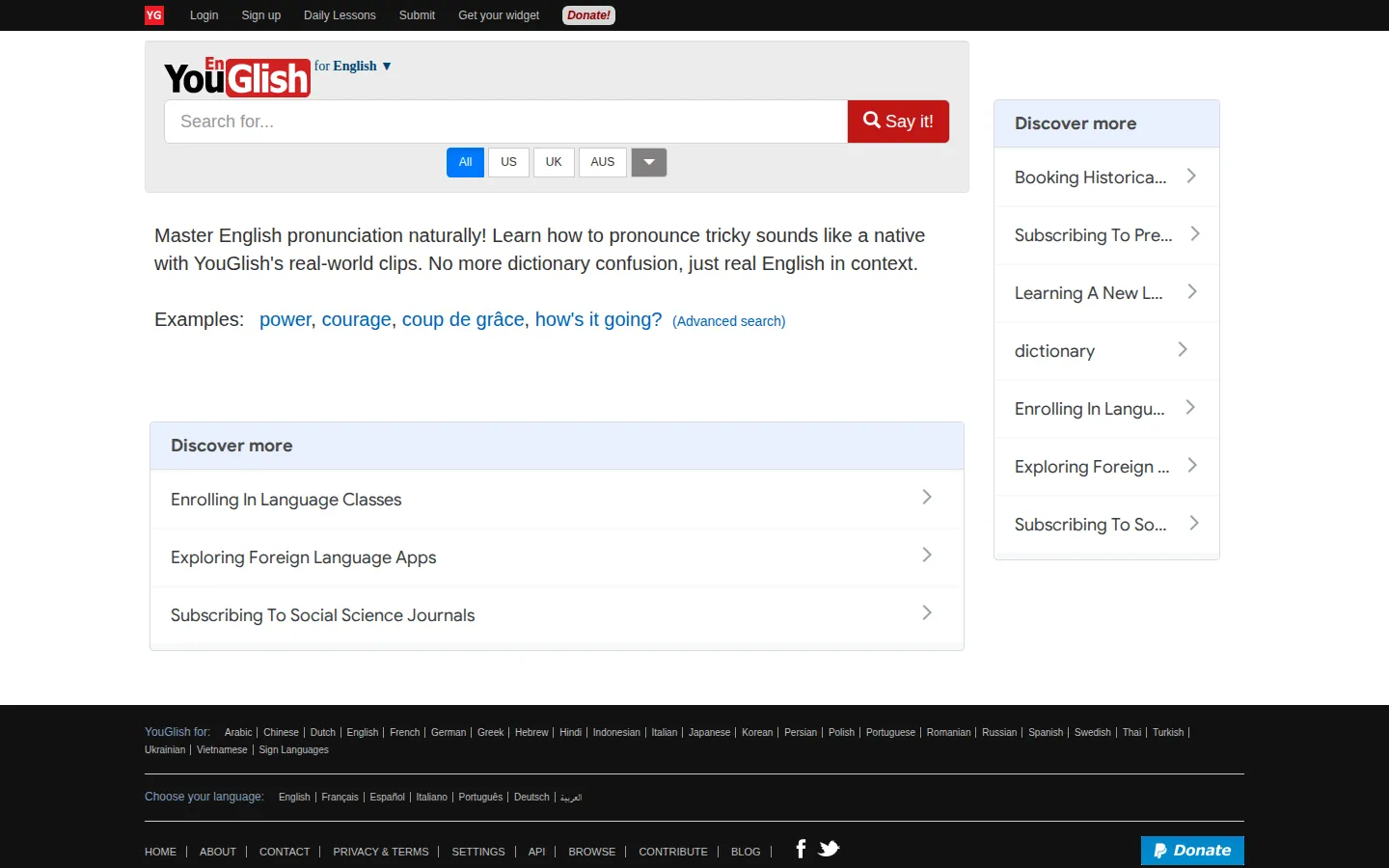
YouGlish turns a word or phrase into a run of YouTube moments where people actually say it. The useful trick is context: you can compare delivery, regional varieties, and sentence rhythm instead of trusting one spotless studio recording.
What is YouGlish?
The front page keeps the job wonderfully plain: choose a language, type the troublesome word or phrase, and press “Say it!” English searches can be narrowed to regional varieties including the United States, United Kingdom, Australia, Canada, Ireland, Scotland, and New Zealand. Supporting material documents result pages that jump near the spoken match, highlight it in captions, and offer clip navigation, slower playback, nearby words, phonetic help, and practice tips. Advanced query syntax can separate a noun from a verb, a question from an exclamation, or one topic from another. It is less a pronunciation oracle than a small searchlight aimed through everyday speech.
What you can do there
- Search a word or phrase in real-world video speech
- Compare contextual pronunciations and English regional varieties
Why we picked it
A dictionary recording tells you how one careful voice says a word; YouGlish helps reveal what happens when that word meets pace, accent, emphasis, and a whole sentence. That makes it especially handy for names, idioms, technical terms, and phrases whose rhythm matters as much as their individual sounds.
How to get the most from it
Begin with the plain word or phrase and listen across several examples before filtering. For English, compare two regional options rather than treating the first clip as a verdict. If a word changes by grammatical role, try the documented suffixes such as call:v for the verb and call:n for the noun; topic hashtags can trim ambiguous searches further.
Good to know
Sound and a steady connection are central because examples come through YouTube. Free use has a search-volume limit, some restricted features require an account, and paid plans raise usage limits. The available clips, captions, speakers, and video quality can vary, so comparison beats taking a single result as gospel.
Who made it, and when?
A documented update was recorded June 26, 2026.
Open YouGlishMore like this
Excalidraw

A fast whiteboard whose hand-drawn look makes unfinished ideas feel welcome.
ExplainShell

A plain-English map for the flags hiding inside a shell command.
Same Energy

A visual-search rabbit hole for when words are too blunt
Nice Game Hints

A polite little lantern for when a game puzzle eats the trail.