
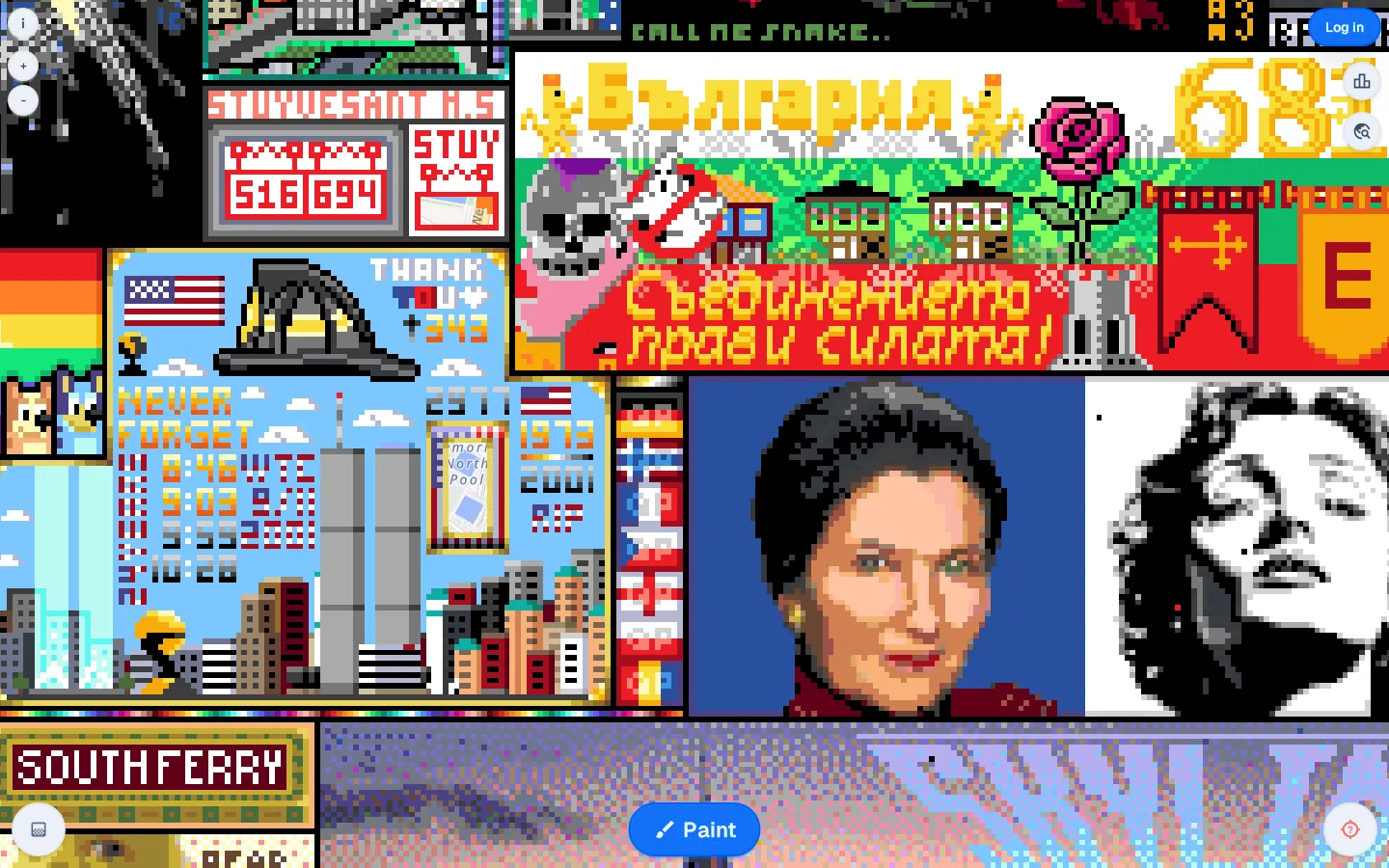
Wplace puts a changing pixel canvas over a world map and lets visitors encounter public artwork in the places where other people chose to leave it. The pleasure is less about a finished picture than watching a shared surface collect, change, and occasionally get contested.
What is Wplace?
Wplace makes geography feel oddly personal. Instead of treating a map as a reference, it gives people a public canvas spread across it. The destination opens onto a map with paint and zoom controls, along with ways to browse places and public contributions. A small drawing can become part of a local cluster, a flag, a joke, or a much larger collaboration, while the surrounding map keeps moving on without asking anyone to curate it. That gives the site a useful tension: there is room for patient collective artwork, but there is also limited space and the possibility that another visitor will alter it. The official rules make that tension explicit by separating ordinary territorial competition from harassment and random destructive scribbling. AP's reporting also describes a system built around replenishing pixels, which helps explain why the canvas rewards returning and noticing small changes rather than rushing toward a polished result. It is a place to wander first, contribute carefully if the current controls make sense to you, and accept that the map is an ongoing public process rather than a permanent gallery.
What you can do there
- Explore the map
- Place pixels
- Browse public artwork
Why we picked it
Most map experiences ask you to find something that already exists. Wplace asks you to notice what strangers have collectively decided belongs in a location, then leaves enough uncertainty for the next visit to feel different. It turns a familiar interface into a slow-moving social artifact without requiring a fixed narrative or a single author.
How to get the most from it
Begin by roaming the map and zooming into an area that catches your eye. Read the current rules before using any paint controls, especially around other people's work. If you decide to contribute, make a modest addition that works with what is already there instead of treating the space as blank. Revisit later to see how nearby activity has changed the piece.
Good to know
Wplace is a public, user-generated canvas, so contributions can change or be covered over and the tone can vary by area. The rules prohibit bots, multiple accounts, private information, inappropriate material, and deliberately random destructive overpainting, with moderation consequences for violations. The live canvas, account flow, cooldowns, and individual map regions were not tested for this profile.
Open WplaceMore like this
Zooniverse

Help real research by classifying galaxies, wildlife, weather records, manuscripts, and more.
StopotS

A fast little word scramble where your friends become the jury
Mandalagaba

A symmetry sketchpad where one stroke recruits a whole geometry crew
Kick the Ball Back

A tiny football emergency, one dragging foot, and several children who have no time for excuses.