
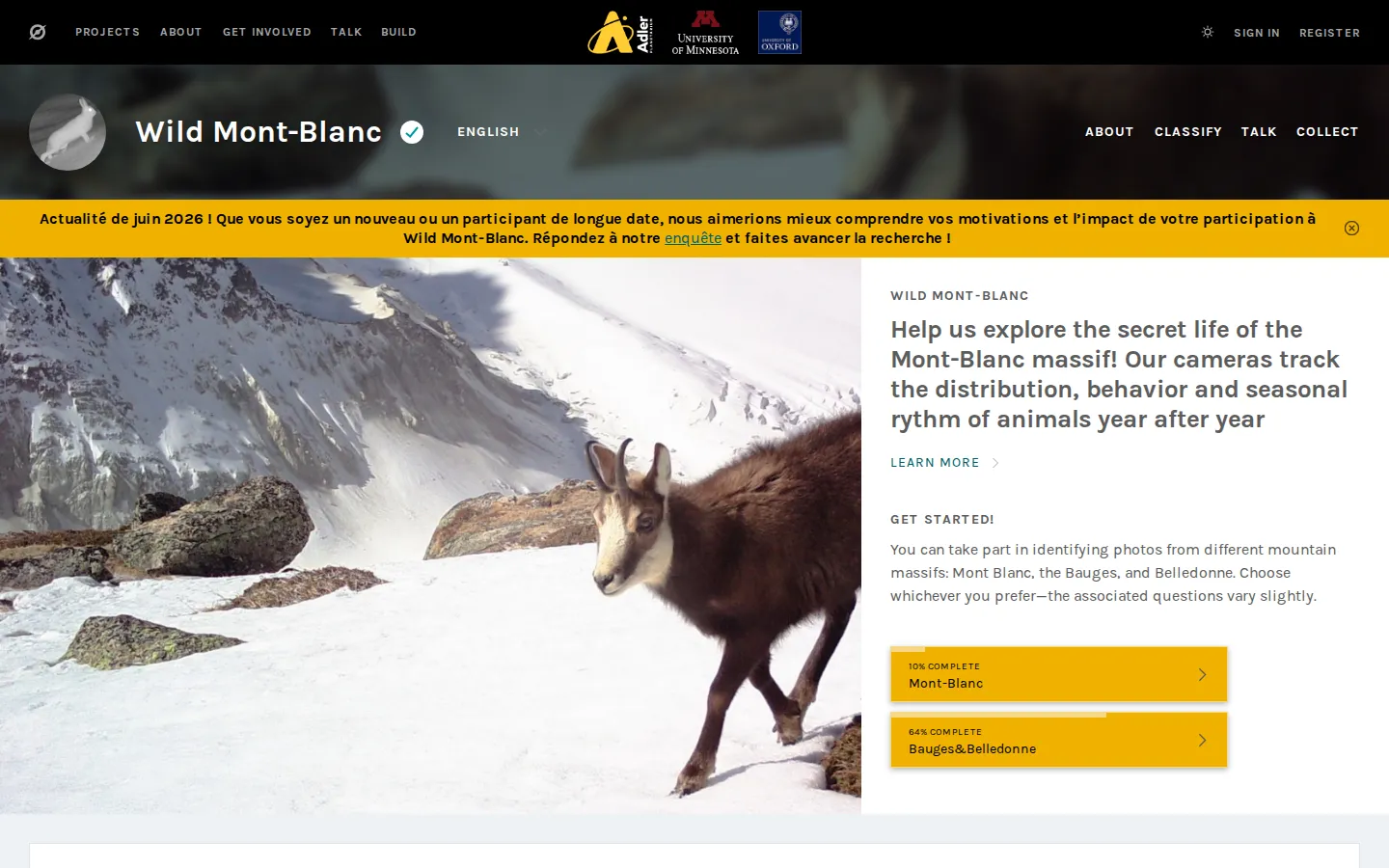
Wild Mont-Blanc puts years of mountain camera-trap photos on your desk and asks who wandered through: chamois, ibex, marmot, hare, bird, livestock, human, or nobody at all. Separate routes cover Mont Blanc, the Bauges, and Belledonne, feeding a long-running study of how Alpine animals use space and time as climate and human activity change.
What is Wild Mont-Blanc?
A frame may contain a postcard-ready ibex, a pair of ears at the edge, a collar number half hidden by fur, or one heroic blade of grass setting off the sensor. Your job is to identify species, count individuals, note age and behavior, and admit uncertainty when the evidence is mush. That restraint matters because multiple people inspect each image; disagreement lowers confidence and sends difficult cases toward scientist review. CREA Mont-Blanc has deployed cameras across elevation and habitat gradients since 2018, from roughly 1,300 to 2,700 meters, then extended the program into the Bauges and Belledonne massifs in 2024. The resulting record supports questions about habitat choice, migration, day-versus-night activity, feeding, camouflage moults, recreation, pastoralism, and warming mountain conditions.
What you can do there
- Identify animals in camera-trap photos
- Count animals and record age or behavior
- Note visible tags and collars
Why we picked it
This is wildlife watching with the fieldwork already done and the mess left intact. Empty and blurry frames are not filler; identifying them keeps the dataset honest. The chance of spotting a fox, lynx, ptarmigan, tagged chamois, or weather-battered mystery gives the repetitive work just enough mountain suspense.
How to get the most from it
Pick a massif, read its slightly different questions, and use the contrast control before giving up on a dark frame. Work from species to count, age, behavior, and visible tags rather than guessing the whole story at once. Use I don't know when the pixels will not cooperate, and send unusual sightings to Talk only after checking the guide and broad categories.
Good to know
The project is free, but not every trigger contains an animal and submissions cannot be edited afterward. Camera traps may also catch livestock, dogs, and people, and the current batch was not visually reviewed for sensitive material. The public page shows 18 percent completion beside zero visible platform counters, so its headline activity totals are unreliable. The classifier itself was not exercised here, leaving account, device, accessibility, audio, and privacy behavior unverified.
Who made it, and when?
CREA Mont-Blanc is the credited creator or organization. The earliest supported launch date we found is April 15, 2020.
Creator’s official page Open Wild Mont-BlancMore like this
OneZoom Tree of Life

Zoom through the evolutionary tree connecting millions of living species.
WindowSwap

Borrow someone else's window for a quiet view of another life and place.
OCEARCH Shark Tracker

A map where each dot has teeth and a travel itinerary
Is it dark outside?

A one-word verdict for a question your window could answer