
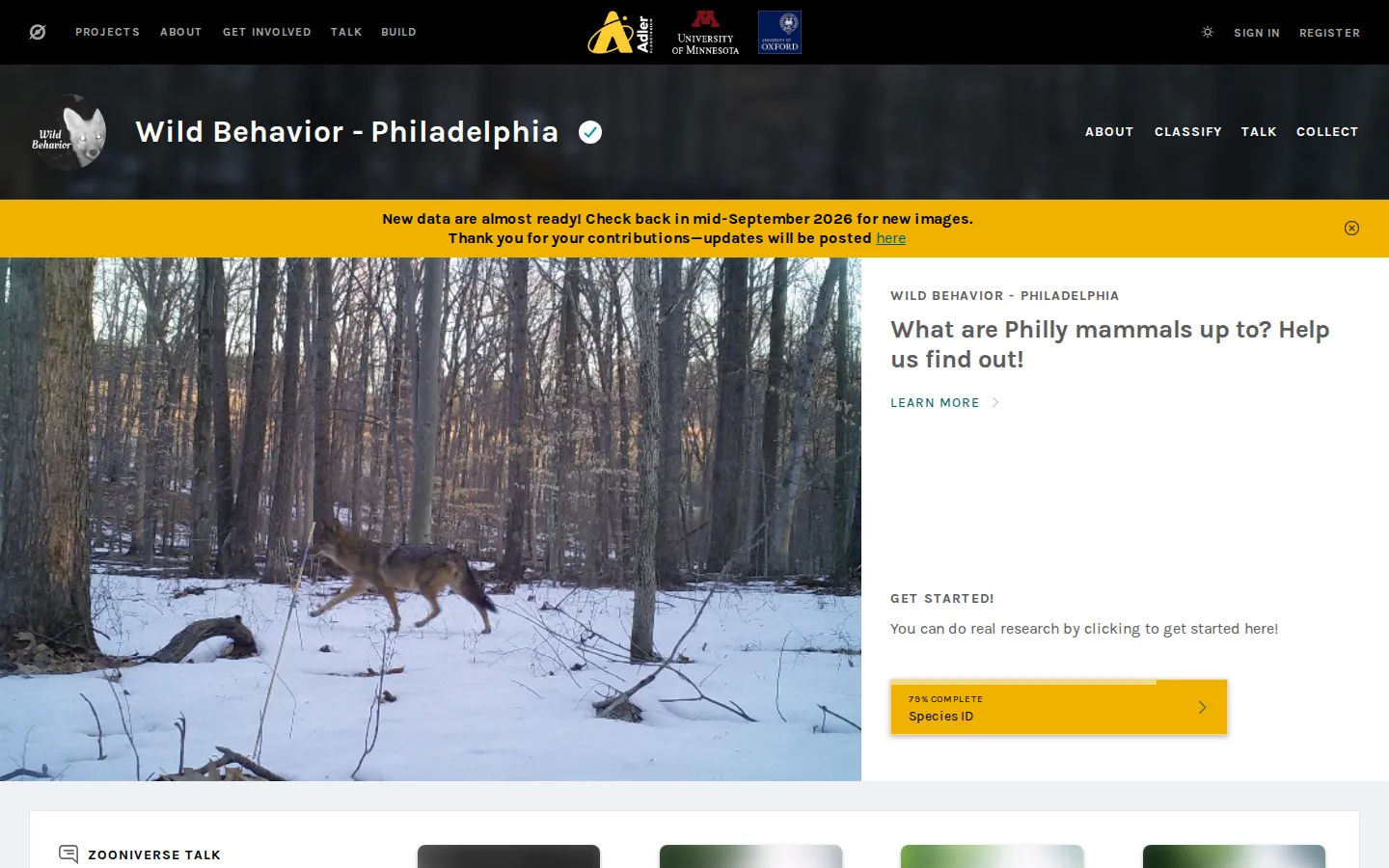
Wild Behavior - Philadelphia turns motion-camera stills into a compact urban-ecology puzzle. Identify the mammals in each frame, then describe what they appear to be doing so Temple researchers can compare wildlife across city landscapes.
What is Wild Behavior - Philadelphia?
The fun begins with the feeling that you have intercepted a tiny, unscripted scene: a deer half outside the frame, a fox reduced to ears and reddish fur, or a raccoon pausing somewhere people rarely see it. The work is more precise than animal spotting. After identifying each mammal, you answer behavior questions and can add another species when a frame contains company. A field guide helps when posture or camouflage makes the call fuzzy, while repeated volunteer reviews give the research team a consensus instead of treating one uncertain click as truth. The study material described by the team compares traditional and green burial areas in a Philadelphia cemetery, asking how landscape, native plants, and human activity relate to mammal presence and behavior.
What you can do there
- Identify mammals in trail-camera photos
- Describe visible animal behavior
- Use a field guide for ambiguous images
Why we picked it
Philadelphia's wild neighbors are hiding in plain sight, and these stills make that phrase literal. The project pairs the quick satisfaction of finding an animal with a more thoughtful behavior question, turning a familiar camera-trap task into a close look at how mammals negotiate human-shaped places.
How to get the most from it
Scan the whole frame before choosing a species; ears, tails, and patches of fur may be the only clues. Use the field guide, make your best call when the image is imperfect, add every mammal you can support, and reserve a behavior answer for what the still actually shows rather than inventing a story around it.
Good to know
Birds are intentionally outside this project's analysis, and the results page says the data are still being prepared. The site currently announces another image batch but shows zero active subjects, so classification may be unavailable until that batch appears.
Who made it, and when?
Integrative Ecology Lab at Temple University is the credited creator or organization. The earliest supported launch date we found is July 1, 2025.
Creator’s official page Open Wild Behavior - PhiladelphiaMore like this
OneZoom Tree of Life

Zoom through the evolutionary tree connecting millions of living species.
WindowSwap

Borrow someone else's window for a quiet view of another life and place.
OCEARCH Shark Tracker

A map where each dot has teeth and a travel itinerary
Is it dark outside?

A one-word verdict for a question your window could answer