
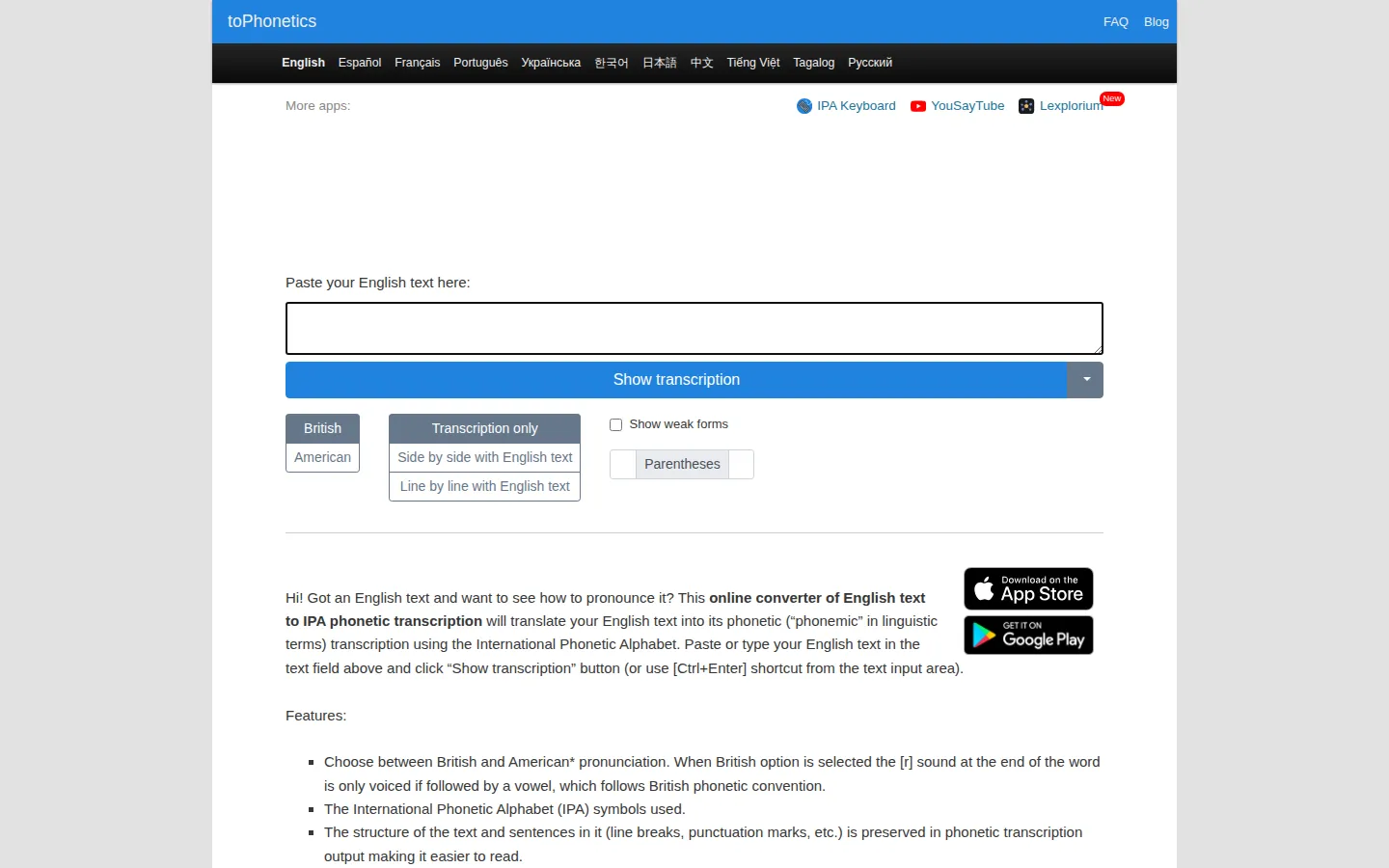
Paste an English word, sentence, or longer passage and toPhonetics lays out a broad IPA transcription in British or American English. Its side-by-side formats make the symbols easier to track against the original, while weak forms and alternate readings add useful context.
What is toPhonetics?
English spelling enjoys hiding trapdoors under ordinary-looking words. toPhonetics gives you a practical floor plan: enter a passage, choose a British or American treatment, and request IPA alone or pair each line with the source text. The current page also offers weak-form handling and explains how ambiguous readings and missing dictionary words are marked. That makes it handy for rehearsing a script, checking a stubborn name, or annotating language-study material. It is a broad phonemic guide, not a microscope for every accent detail, and the result still calls for judgment when context changes a word's pronunciation.
What you can do there
- Convert English text to IPA
- Compare British and American transcriptions
- Arrange IPA beside the original text
- Listen with supported browser voices
Why we picked it
The useful trick is scale. A dictionary can settle one word; this tool keeps sentences, punctuation, and line structure together so a whole passage remains readable. The dialect switch and paired layouts turn a wall of symbols into something you can actually follow without making the tool feel like a phonology exam.
How to get the most from it
Start with a short sentence, choose British or American English, and use the line-by-line layout until the symbols feel familiar. Enable weak forms for connected-speech clues, click any marked alternate reading to match the context, and double-check red or surprising words in a trusted dictionary. Ctrl+Enter is the documented quick-submit shortcut.
Good to know
The transcription is broad and dictionary-driven, so it does not measure your own pronunciation or capture every fine accent feature. Speech playback relies on voices supplied by your browser and operating system. The site's cookie policy discloses third-party advertising and analytics, and the live ad or consent experience was not rendered for this review. Do your own course assignments rather than handing in generated IPA as original work.
Who made it, and when?
Mu-Sonic Ltd is the credited creator or organization. The earliest supported launch date we found is 2013.
Creator’s official page Open toPhoneticsMore like this
Excalidraw

A fast whiteboard whose hand-drawn look makes unfinished ideas feel welcome.
ExplainShell

A plain-English map for the flags hiding inside a shell command.
Same Energy

A visual-search rabbit hole for when words are too blunt
Nice Game Hints

A polite little lantern for when a game puzzle eats the trail.