
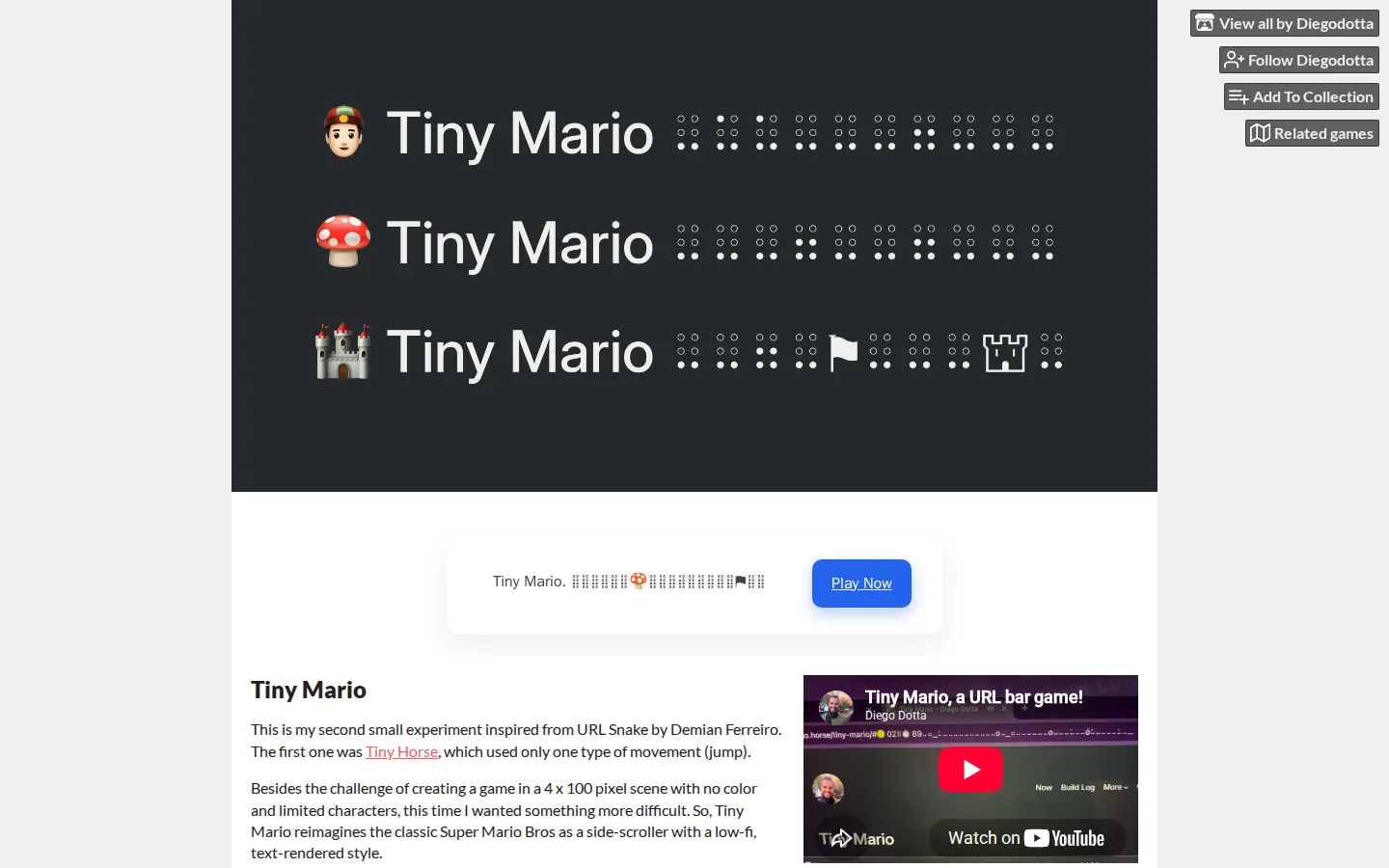
Tiny Mario compresses a one-level platformer into Unicode Braille and the narrow strip of a browser address bar. You get 99 seconds to grab coins, stomp enemies, find an underground route, and reach the flag—a wonderfully silly technical stunt whose microscopic scale is also its main obstacle.
What is Tiny Mario?
This fan-made browser experiment reduces the shape of Super Mario Bros. World 1-1 to a colorless stream of text cells. The player, ground, pipes, coins, enemies, and flag are encoded with Braille glyphs and a handful of symbols, while the changing address-bar string becomes the stage. Despite the tiny canvas, it includes basic physics, enemy stomps, a timer, a score, pipe travel, an underground section, music and sound changes, a stage clear, and restart controls. There is only one level, which suits the joke: it is less a campaign than a complete platformer ship folded into a bottle.
What you can do there
- Collect coins and reach the flag before the timer expires
- Enter a hidden underground section through a pipe
Why we picked it
The technical constraint is immediately legible and genuinely funny. Tiny Mario does not merely make the graphics small; it turns browser chrome into the display surface and still finds room for a secret route, scoring, enemies, and a finish line. That makes it a compact lesson in how much game design can survive radical reduction.
How to get the most from it
On desktop, use the arrow keys or WASD to move, with W, Space, or Up to jump and R to restart. Collect coins, avoid pits and enemies, and reach the flag before 99 seconds run out; one pipe leads below ground. If the address bar is too cramped, show the mirrored URL row and increase its monospace font size. Mobile visitors get on-page directional controls.
Good to know
The project is an independent experiment inspired by Super Mario Bros., not a full or official release. Its single level is intentionally microscopic, and community feedback has flagged both visibility trouble and possible browser-history clutter. The creator published the source under CC0, but third-party names, references, and audio have separate provenance questions.
Who made it, and when?
Diego Dotta is the credited creator or organization. A documented update was recorded November 13, 2025.
Creator’s official page Open Tiny MarioMore like this
CERN Line Mode Browser

A link list from the Web before it learned to decorate itself
Quenq

An interactive museum for playable internet history.
The Million Dollar Homepage
One million pixels from a gloriously chaotic web experiment.
Windows 93

A fake 1993 desktop where every click may take a glorious wrong turn.