
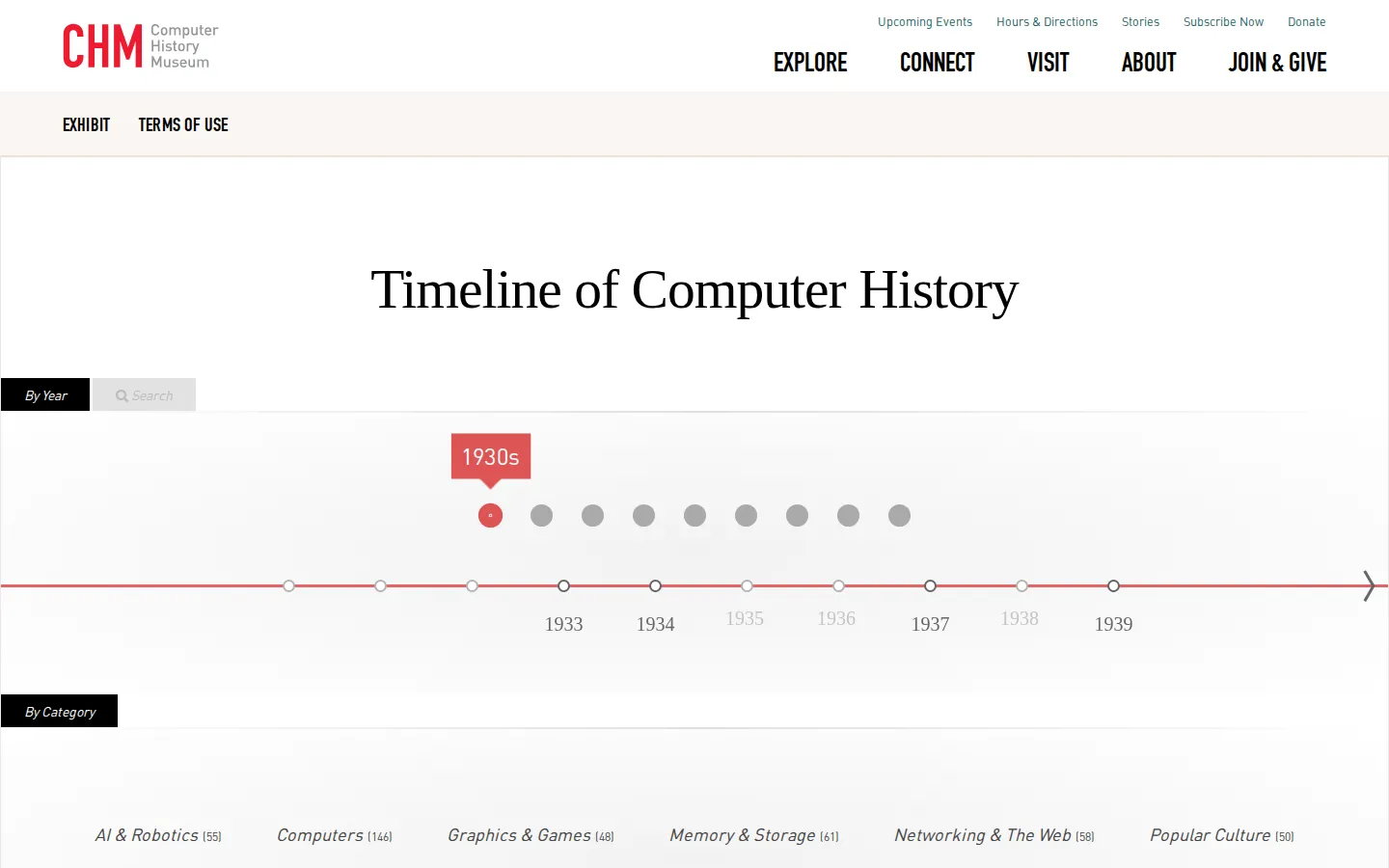
The Computer History Museum's timeline turns decades of machines, software, networks, games, storage, robotics, and digital culture into a browsable wall of illustrated milestones. Choose a year for chronology, pick a category for a thematic trail, or search for a particular name or invention. Its visible chronology currently stops in 2015.
What is Timeline of Computer History?
This is the sort of timeline that rewards wandering sideways. A year-by-year path runs from 1933 through 2015, but seven category doors make the same collection feel very different: follow computers and the parade is mostly machinery, switch to popular culture and games or media enter the story, then use networking or software to watch ideas spread between boxes. The landing page also throws up a handful of highlights, from George Stibitz's relay adder to time-sharing and portable PCs, so there is always an inviting loose thread to pull. Hundreds of category entries give the exhibit enough density for a quick lookup or a long nostalgia-and-invention detour.
What you can do there
- Browse computing milestones by year
- Filter milestones by subject category
- Search the timeline for people, inventions, and events
Why we picked it
Computing history is usually flattened into a short procession of famous machines. This timeline keeps hardware in view while making room for storage, code, networks, robotics, games, and popular culture. The ability to approach the same material by date, subject, or search makes the collection useful for both idle browsing and a focused classroom question.
How to get the most from it
Start with a decade you remember, then open the category view to see what was happening outside the headline machines. Search is the fastest route to a person or product. For a classroom visit, turn the page into a scavenger hunt: find one hardware milestone, one software milestone, and one cultural event from the same decade, then compare what changed first.
Good to know
The timeline is freely readable without an account, and independent education material has used it as a guided history resource. The visible year navigation ends at 2015, so it is better for the long arc of twentieth-century and early mobile-era computing than for recent developments. Live controls, device behavior, accessibility, media playback, privacy, and entry-by-entry accuracy were not tested.
Who made it, and when?
Computer History Museum is the credited creator or organization.
Creator’s official page Open Timeline of Computer HistoryMore like this
CERN Line Mode Browser

A link list from the Web before it learned to decorate itself
Quenq

An interactive museum for playable internet history.
The Million Dollar Homepage
One million pixels from a gloriously chaotic web experiment.
Windows 93

A fake 1993 desktop where every click may take a glorious wrong turn.