
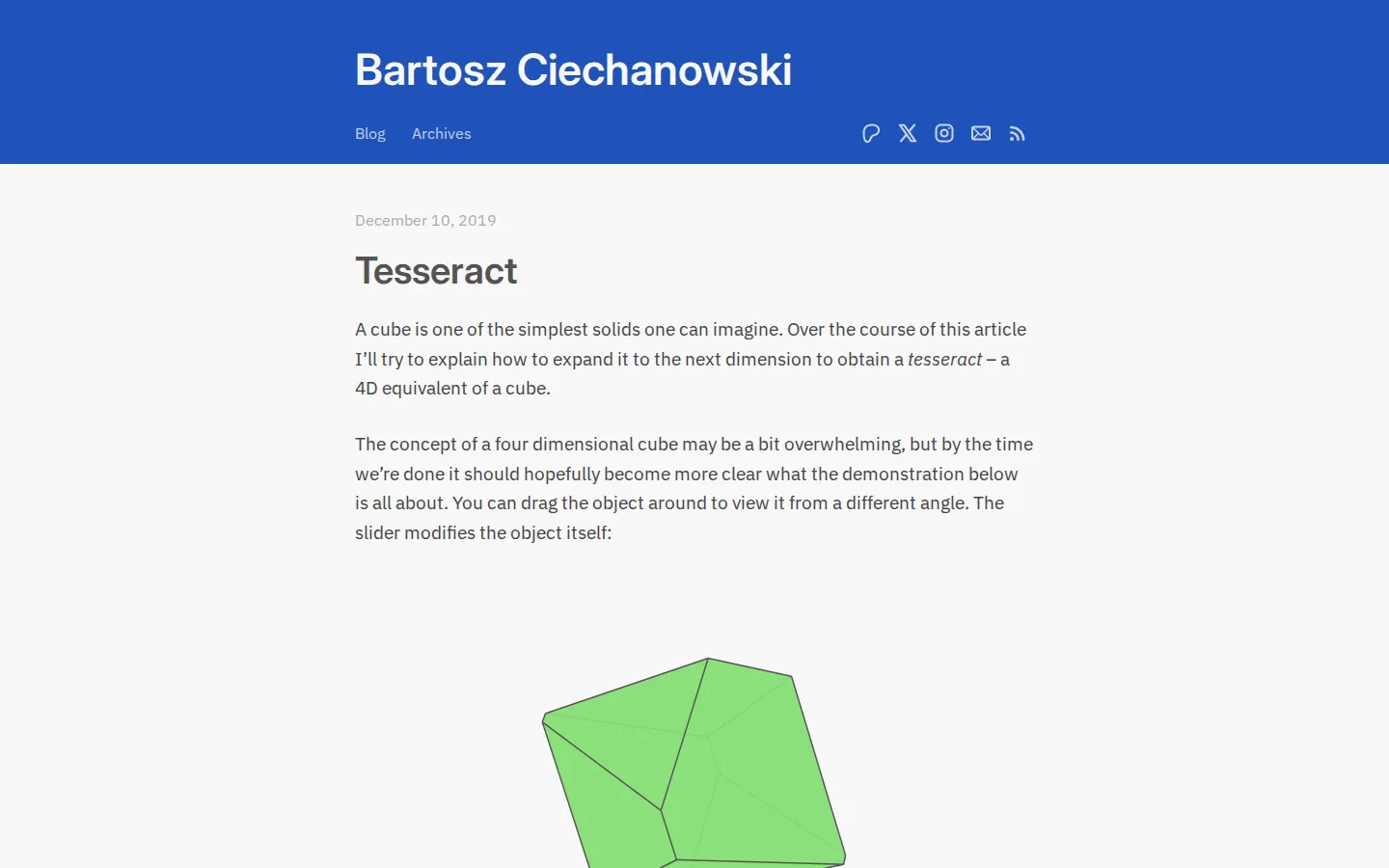
Tesseract is a patient visual essay about the four-dimensional cousin of a cube. It starts with a point, adds dimensions one by one, then uses projections, rotations, and slices to make an impossible object feel less impossible.
What is Tesseract?
The article refuses to drop a spinning wireframe on the page and call the job done. It earns the fourth dimension slowly: a point stretches into a line, a line into a square, and a square into a cube before the same move produces a tesseract. From there, the demonstrations tackle the awkward problem of showing higher-dimensional geometry inside a lower-dimensional view. Shadows reveal the object's eight cubical cells; rotation planes explain its stranger contortions; moving cross-sections show what a four-dimensional visitor might leave behind in ordinary space. The result is less a picture of a tesseract than a toolkit for thinking around one.
What you can do there
- Build geometric intuition from a point to a four-dimensional cube
- Adjust projections, rotations, and cross-sections
- Compare lower-dimensional analogies with a tesseract
Why we picked it
Few pages make confusion feel this productive. Each diagram arrives only after the preceding analogy has done its work, and the controls are tied to a precise question instead of sprinkled on as decoration. Even readers who never become comfortable with four dimensions can leave with a sharper sense of why every projection lies a little.
How to get the most from it
Read in order and resist the urge to race straight to the spinning tesseract. At each diagram, change one slider or viewpoint at a time, then return to the nearby paragraph and match the visible distortion to the explanation. The cube examples are the handrail; revisit them whenever the fourth dimension starts slipping away.
Good to know
This is a substantial mathematics essay, not a quick animation gallery. The live diagrams were not executed during review, so device support, keyboard access, motion comfort, and performance remain uncertain. The page is openly readable and links to optional Patreon support; no current audio behavior was verified.
Who made it, and when?
Bartosz Ciechanowski is the credited creator or organization.
Creator’s official page Open TesseractMore like this
Stellarium Web

Turn the browser into a planetarium matched to the sky above your location.
The Scale of the Universe 2

Slide from the smallest known scales to the largest structures in the observable universe.
100,000 Stars
Fly from the Sun into a 3D neighborhood of one hundred thousand nearby stars.
WorldWide Telescope

A sky atlas with a time machine tucked into its controls