
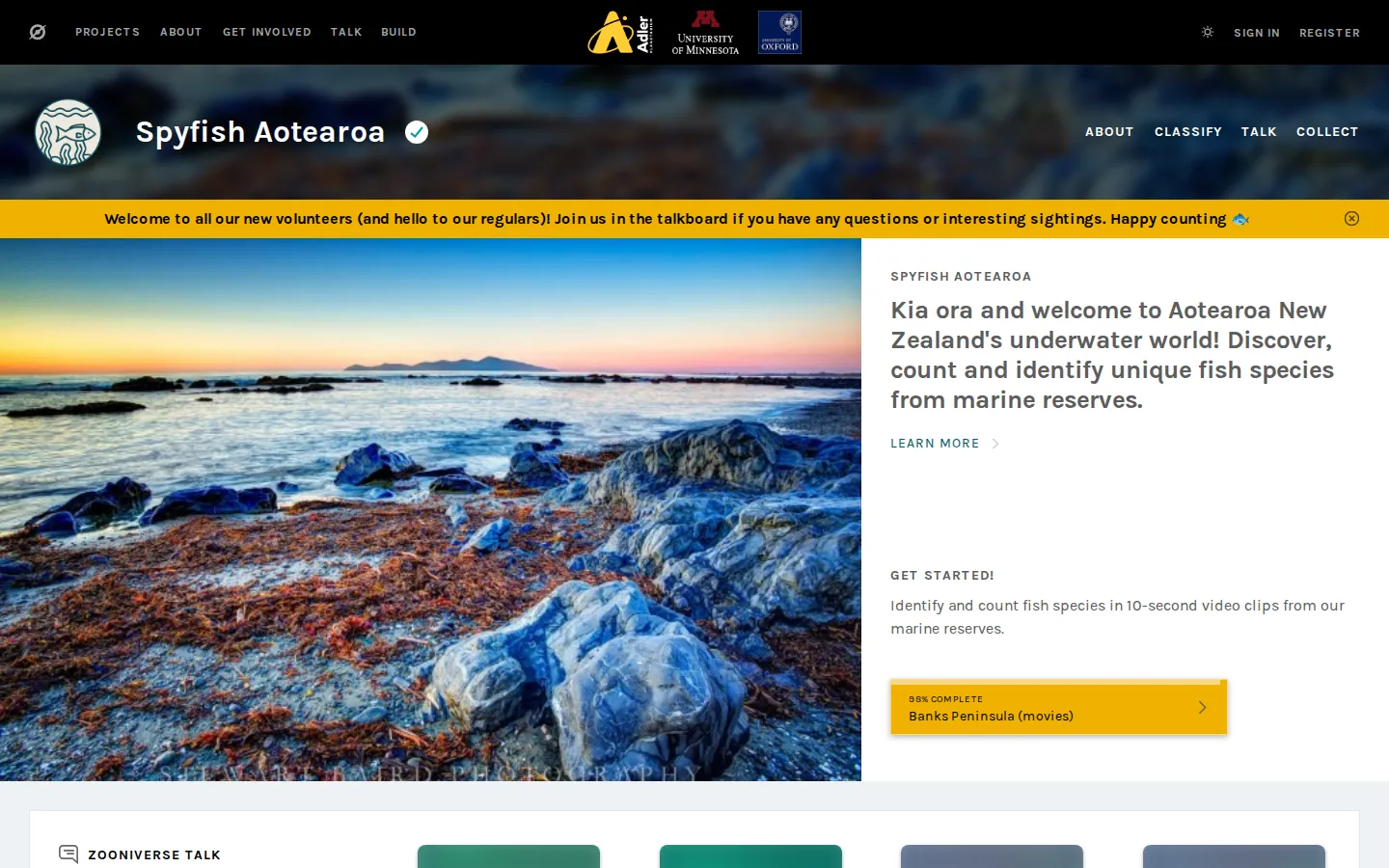
Spyfish Aotearoa serves short bait-camera clips from New Zealand marine reserves and asks you to identify each fish species and record its maximum headcount. Empty water counts too: every clip helps describe where marine life appears and where it does not.
What is Spyfish Aotearoa?
This is wildlife watching with a small but important clipboard attached. Pick a reserve, play a ten-second underwater clip, pause when something finned crosses the frame, then use photos, shape and pattern filters, or the field guide to make the closest species match. For each species, you record the largest number visible at the same moment rather than adding every appearance across the clip. That keeps the task methodical even when fish loop past the bait or disappear into kelp. Multiple volunteers review each clip, and uncertain cases can be flagged for scientist attention. The resulting classifications support comparisons of fish populations inside and outside protected areas and help reduce the mountain of video that specialists must inspect by hand.
What you can do there
- Watch short underwater clips
- Identify fish species
- Record the maximum number visible at once
- Discuss uncertain sightings
Why we picked it
Spyfish makes conservation monitoring feel wonderfully concrete: ten seconds, one careful count, one more piece of a national underwater picture. The useful friction is built in, too. Murky water, similar silvery fish, and empty frames reward attention instead of pretending every click is an instant discovery.
How to get the most from it
Start with the tutorial and keep the field guide open. Pause, slow, or zoom the clip before choosing a species, then find the moment when the greatest number of that species is visible together. Repeat for other species, use Nothing here when the frame stays empty, and send odd sightings to Talk.
Good to know
Some clips contain only sand, rock, or kelp, and that absence is valid data. The current landing page reported the active work as 100 percent complete while its counters were zeroed, so fresh clips may be intermittent even though the project pages and guidance remain available.
Who made it, and when?
New Zealand Department of Conservation and Wildlife.AI is the credited creator or organization. The earliest supported launch date we found is September 13, 2021.
Creator’s official page Open Spyfish AotearoaMore like this
Zooniverse

Help real research by classifying galaxies, wildlife, weather records, manuscripts, and more.
StopotS

A fast little word scramble where your friends become the jury
Mandalagaba

A symmetry sketchpad where one stroke recruits a whole geometry crew
Kick the Ball Back

A tiny football emergency, one dragging foot, and several children who have no time for excuses.