
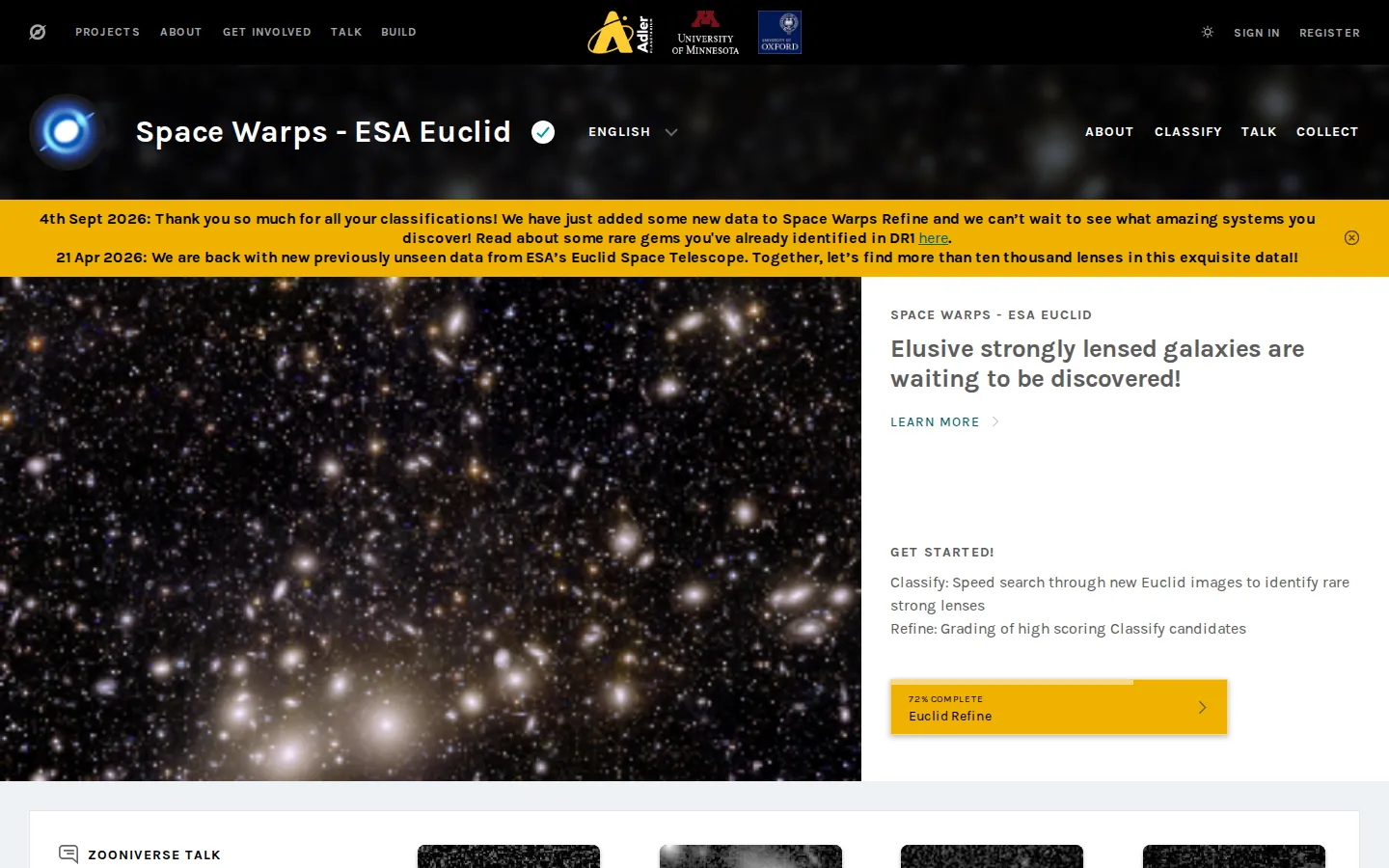
Space Warps hands you real ESA Euclid galaxy images and asks a wonderfully narrow question: is gravity bending something here? A fast Classify pass filters the haystack, while Refine gives promising systems a closer grade before researchers assemble the serious candidates.
What is Space Warps - ESA Euclid?
Most cutouts will not contain a gravitational lens, which is exactly why this works as citizen science rather than cosmic sightseeing. The job is to inspect compact Euclid images for curved arcs, repeated blobs, counter-images, or ring-like light arranged around a plausible foreground galaxy. The current project divides that work into Classify, built for quick lens-or-not decisions, and Refine, where high-scoring candidates receive more careful grades. A substantial education section teaches the visual grammar and the traps: edge-on disks, galaxy mergers, chance neighbors, stars, satellite trails, and processing artifacts can all dress up like a lens. Behind the queue, automated rankings have already narrowed tens of millions of galaxies, but people still supply the useful stubbornness to notice odd cases and reject convincing impostors. It is astronomy as visual proofreading, with spacetime doing the typos.
What you can do there
- Inspect Euclid galaxy images for strong-lensing features
- Mark possible arcs or repeated images
- Grade high-scoring candidates in Refine
- Compare examples with common lens impostors
Why we picked it
The task is tiny, the stakes are real, and the feedback loop is unusually visible. Earlier Euclid rounds already produced published candidate lists, while the current DR1 work scales the same human-versus-haystack idea to a far larger survey. The field guide also turns a simple marker into a sharp lesson in how scientific images mislead the eye.
How to get the most from it
Read the lens and impostor examples before opening Classify. Look for a curved feature wrapped around a massive central galaxy, then search the opposite side for a matching counter-image. Compare all available color views, zoom when needed, and keep genuinely ambiguous cases in play; the project prefers an inclusive first pass because later crowd scoring and expert review do the pruning.
Good to know
A blank-looking image is still useful because ruling out non-lenses is much of the work. Workflow availability changes as Classify and Refine batches fill, and the live statistics currently contradict one another, so treat completion counters cautiously. Signing in matters for saved credit, team listing, Talk, and certificates. Zooniverse also restricts framing, so the project needs to open directly rather than inside Site Stumble's embedded viewer.
Who made it, and when?
Space Warps, Euclid Consortium, and Zooniverse teams is the credited creator or organization. The earliest supported launch date we found is November 19, 2024. A documented update was recorded September 4, 2026.
Creator’s official page Open Space Warps - ESA EuclidMore like this
Stellarium Web

Turn the browser into a planetarium matched to the sky above your location.
The Scale of the Universe 2

Slide from the smallest known scales to the largest structures in the observable universe.
100,000 Stars
Fly from the Sun into a 3D neighborhood of one hundred thousand nearby stars.
WorldWide Telescope

A sky atlas with a time machine tucked into its controls