
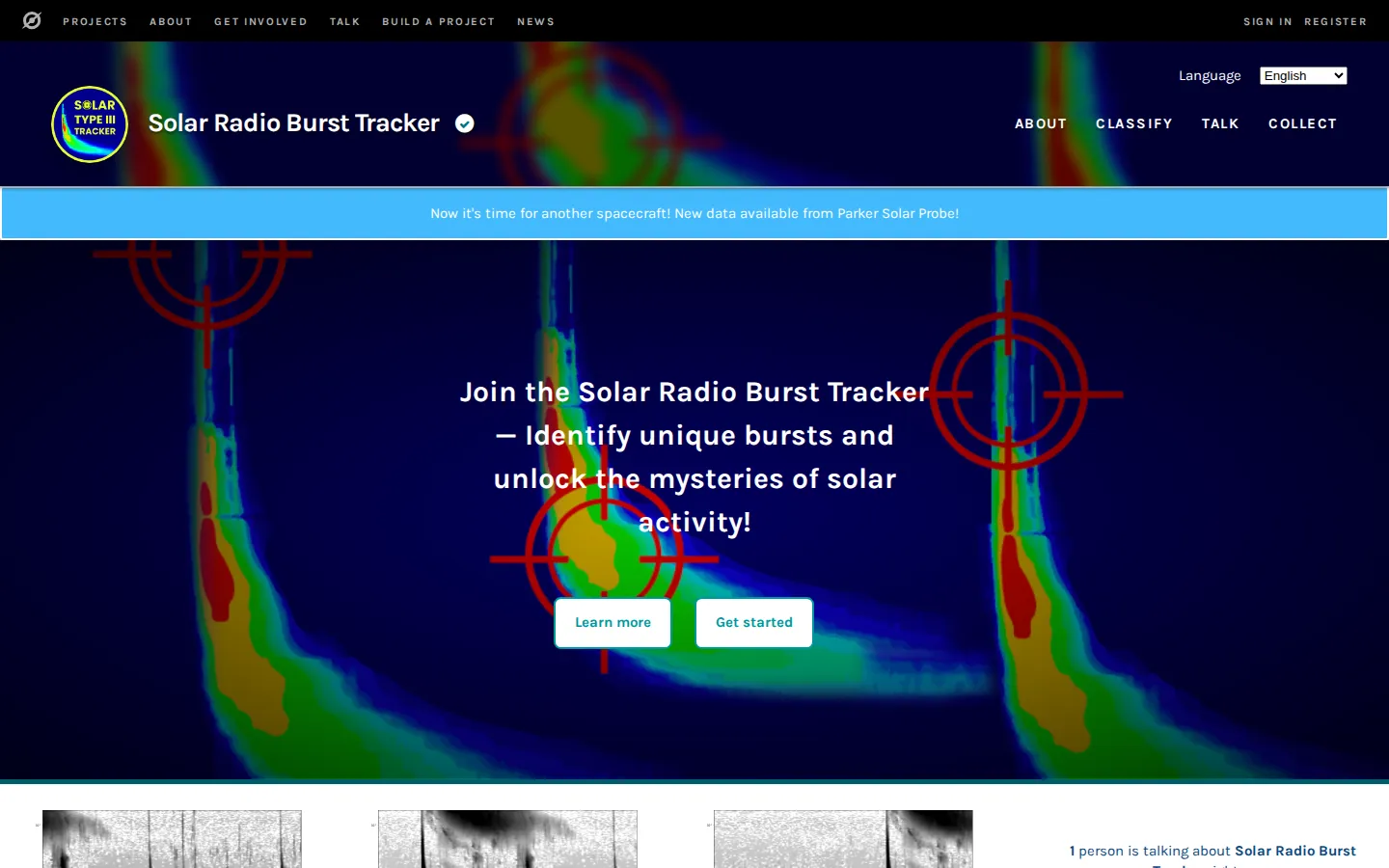
Solar Radio Burst Tracker swaps postcard views of the Sun for radio spectra and asks volunteers to mark the signals hiding inside. Its first Solar Orbiter campaign fed a public, research-team-validated catalog; the live page now advertises a newer Parker Solar Probe workflow.
What is Solar Radio Burst Tracker?
The original job was wonderfully concrete: scan six-hour plots and outline every Type III burst you can defend. These streaks can be faint, fuzzy, or oddly shaped, which is precisely where human pattern recognition complements automatic detectors. The project did more than collect clicks. Its first published catalog covers 13,647 Solar Orbiter spectra, preserves uncertainty information, and credits more than 900 volunteers. The current statistics page has moved on to Parker Solar Probe data, although the retrieved supporting pages still describe the earlier Solar Orbiter phase in much greater detail.
What you can do there
- Inspect radio spectra
- Identify visible solar radio bursts
- Outline burst regions for aggregation
Why we picked it
This is graph reading with consequences. A small contour drawn around a sloping signal joins many other judgments, then passes through aggregation and expert validation before becoming solar-physics data. The published catalog makes that path unusually tangible while the new spacecraft phase keeps the hunt from feeling frozen in amber.
How to get the most from it
Start with the tutorial, learn the expected sloping burst shapes, and resist outlining every bright patch. Work through each spectrum methodically and use the discussion area when a feature is ambiguous. Treat your mark as one vote in a pooled analysis rather than a confirmed solar event.
Good to know
The project launched on March 11, 2025. Its live page now shows a Parker Solar Probe workflow at 56 percent complete, while several headline counters remain stuck at zero and an outside listing describes the earlier phase as completed. We did not execute the classifier, so current drawing controls, account rules, accessibility, autosave, and device behavior remain unverified.
Who made it, and when?
Katerina Pesini and collaborators is the credited creator or organization. The earliest supported launch date we found is March 11, 2025.
Creator’s official page Open Solar Radio Burst TrackerMore like this
Stellarium Web

Turn the browser into a planetarium matched to the sky above your location.
The Scale of the Universe 2

Slide from the smallest known scales to the largest structures in the observable universe.
100,000 Stars
Fly from the Sun into a 3D neighborhood of one hundred thousand nearby stars.
WorldWide Telescope

A sky atlas with a time machine tucked into its controls