
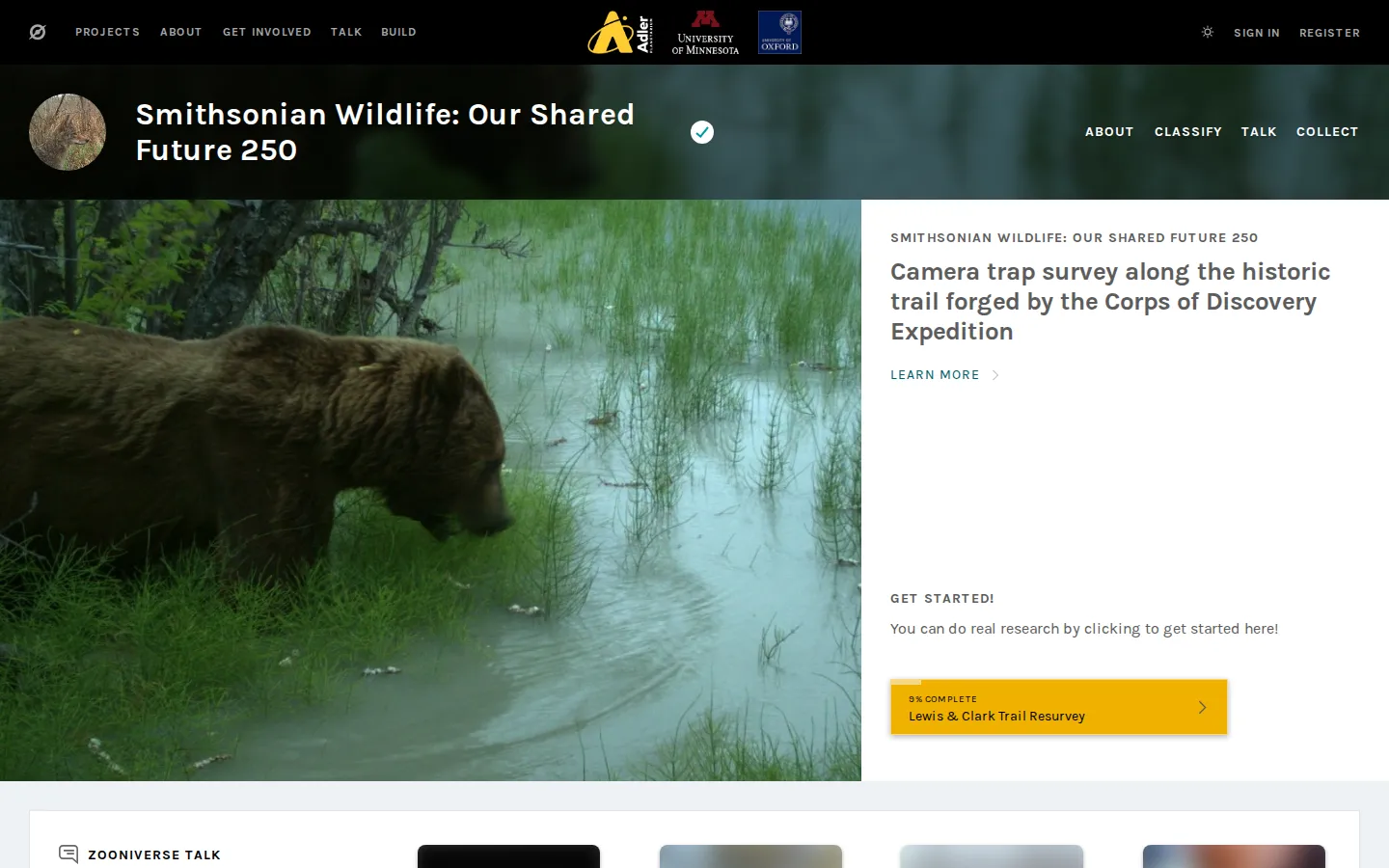
Smithsonian Wildlife hands you camera-trap sequences from a modern survey of the Lewis and Clark route and asks you to identify species, count animals, and note visible behavior. The task is focused and genuinely useful, though the live workflow and its changing dataset deserve more attention than the platform's inconsistent public counters.
What is Smithsonian Wildlife: Our Shared Future 250?
This is fieldwork by proxy, one camera sequence at a time. The survey follows the historic expedition corridor with modern motion-triggered cameras, then brings the resulting images to Zooniverse for human checking. A classification can include several species, animal counts, visible characteristics, behavior, and an image-quality judgment. The project becomes more interesting once you notice the two clocks running together: nineteenth-century journal observations supply the comparison point, while cameras deployed across an 80-kilometer corridor record what occupies those landscapes now. The FAQ is unusually practical about uncertainty. Volunteers should make the most specific identification they can, and disagreement is handled by showing an image to more people. That makes a blurry tail or half-hidden set of ears part of the work instead of a dead end.
What you can do there
- Identify wildlife species in camera-trap images
- Count animals and record visible behavior
- Discuss notable images with other volunteers
Why we picked it
The hook is bigger than spotting charismatic animals. Each small classification feeds a geographically ambitious attempt to compare wildlife distributions across more than two centuries, and independent field reports show that cameras are actually being deployed by university teams along the route. It is a satisfying collision of archive, field ecology, and crowd judgment: old notebooks on one side, night-vision mammals on the other.
How to get the most from it
Read the short instructions before starting, then inspect every frame in a sequence before naming an animal. Add each different species separately, keep counts conservative when bodies overlap, and use the broadest defensible label when the view is poor. Finish with Done, or choose Done and Talk when an injury, collar, unusual behavior, or genuinely puzzling animal deserves a second set of eyes.
Good to know
Submitted classifications cannot be reopened, but the project deliberately combines several volunteers' answers and requests more judgments when they disagree. A Zooniverse login is needed to view your personal classification totals. The field survey and image-processing schedule runs into 2027, so subject availability and completion figures can move; the public statistics currently contradict themselves and should not be treated as a reliable activity meter. Audio, device support, accessibility, privacy, and runtime behavior were not tested.
Who made it, and when?
Smithsonian's National Zoo and Conservation Biology Institute is the credited creator or organization. The earliest supported launch date we found is June 15, 2026.
Creator’s official page Open Smithsonian Wildlife: Our Shared Future 250More like this
OneZoom Tree of Life

Zoom through the evolutionary tree connecting millions of living species.
WindowSwap

Borrow someone else's window for a quiet view of another life and place.
OCEARCH Shark Tracker

A map where each dot has teeth and a travel itinerary
Is it dark outside?

A one-word verdict for a question your window could answer