
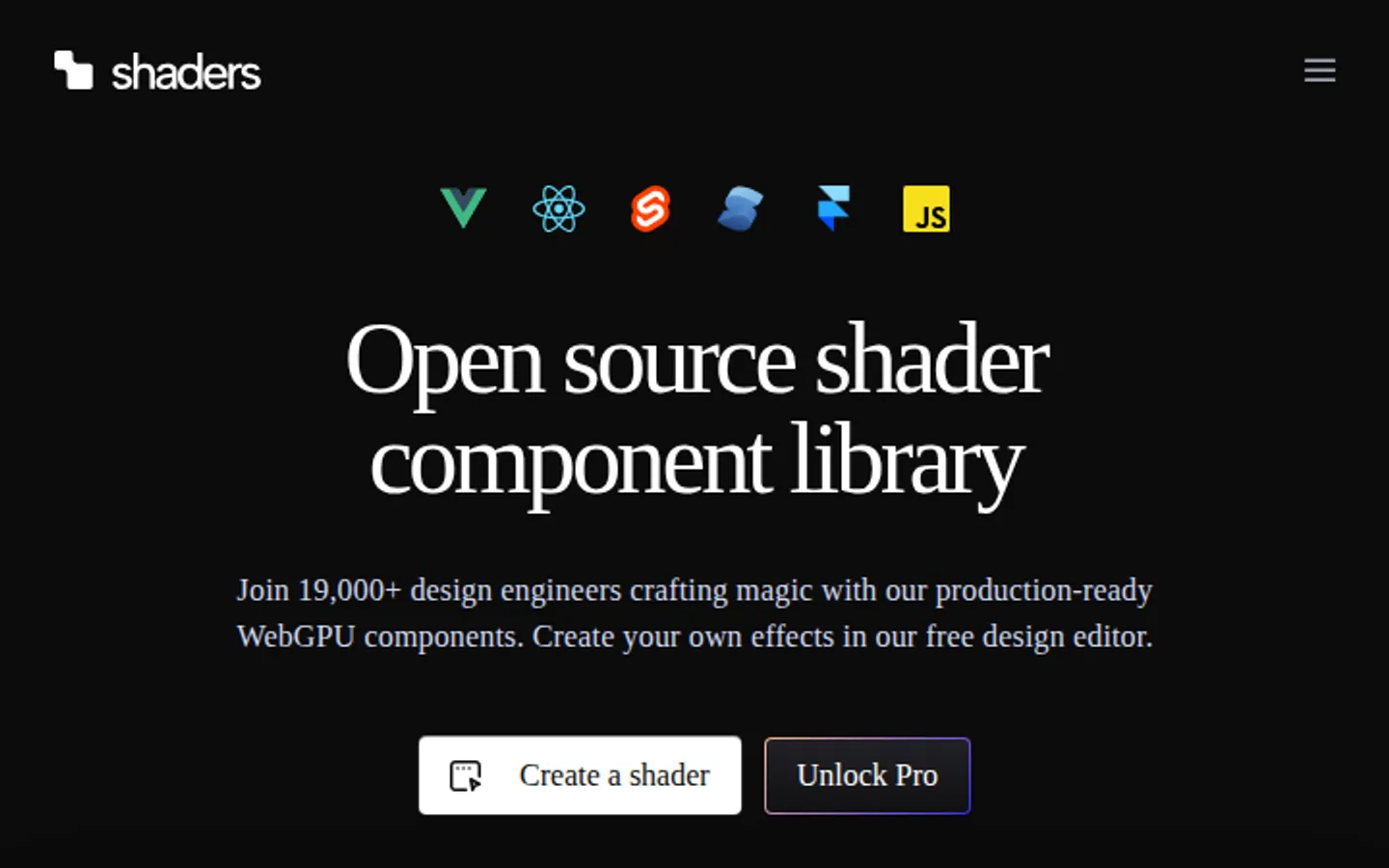
Shaders turns GPU effects into composable layers for React, Vue, Svelte, Solid, plain JavaScript, and Framer. Its visual editor lets you tune a look on an infinite canvas and export the resulting component tree, while the open-source package keeps the code side inspectable.
What is Shaders?
Shaders sits between a visual-effects playground and a frontend component kit. Gradients, noise, glass, chrome, refraction, ASCII, dithering, cursor reactions, and other pieces stack inside one canvas much like layers in a design tool. You can assemble them visually, feed in your own image, video, or SVG, and export the composition for a supported framework. Developers who prefer code can install the same components from one package, while CLI, MCP, and Framer routes connect the editor to different workflows. The result is a practical bridge between making something shimmer and actually shipping the shimmer.
What you can do there
- Stack and tune shader effect components
- Import images, videos, and SVG artwork
- Export effects as framework code
- Install and synchronize effects through code tools
Why we picked it
Shader work often begins with attractive experiments and ends with a painful rewrite. This project makes the experiment and the implementation share the same component model, which is the clever part. The layer metaphor lowers the entry barrier, but the exported code and public repository keep the result from becoming a visual-editor dead end.
How to get the most from it
Begin with one texture or gradient, add a single distortion or material layer, and watch how each new child changes the stack beneath it. Connect one property to cursor movement only after the static composition works. When the effect feels settled, export it for your framework and test the transparent WebGPU fallback inside the real page layout.
Good to know
WebGPU is the hard requirement: unsupported devices receive a transparent canvas rather than a WebGL version. The engine, components, and framework bindings are MIT licensed, while the free editor is closed source and requires an account for saved projects and export. The full preset library and several extended workflows are Pro features. Performance, mobile behavior, accessibility, asset privacy, and reduced-motion handling still need project-specific testing.
Who made it, and when?
Shader Effects Inc. is the credited creator or organization.
Creator’s official page Open ShadersMore like this
AutoDraw

Sketch badly on purpose and let machine-assisted suggestions turn it into a crisp icon.
Calligrapher.ai
A browser scribble machine that gives typed words a wobblier set of shoes.
Sketch Toy: Draw sketches and share replays with friends!

A doodle pad that remembers every stroke and turns the making into the show.
Wombo Dream AI

A prompt-powered sketchbook for images and video.