
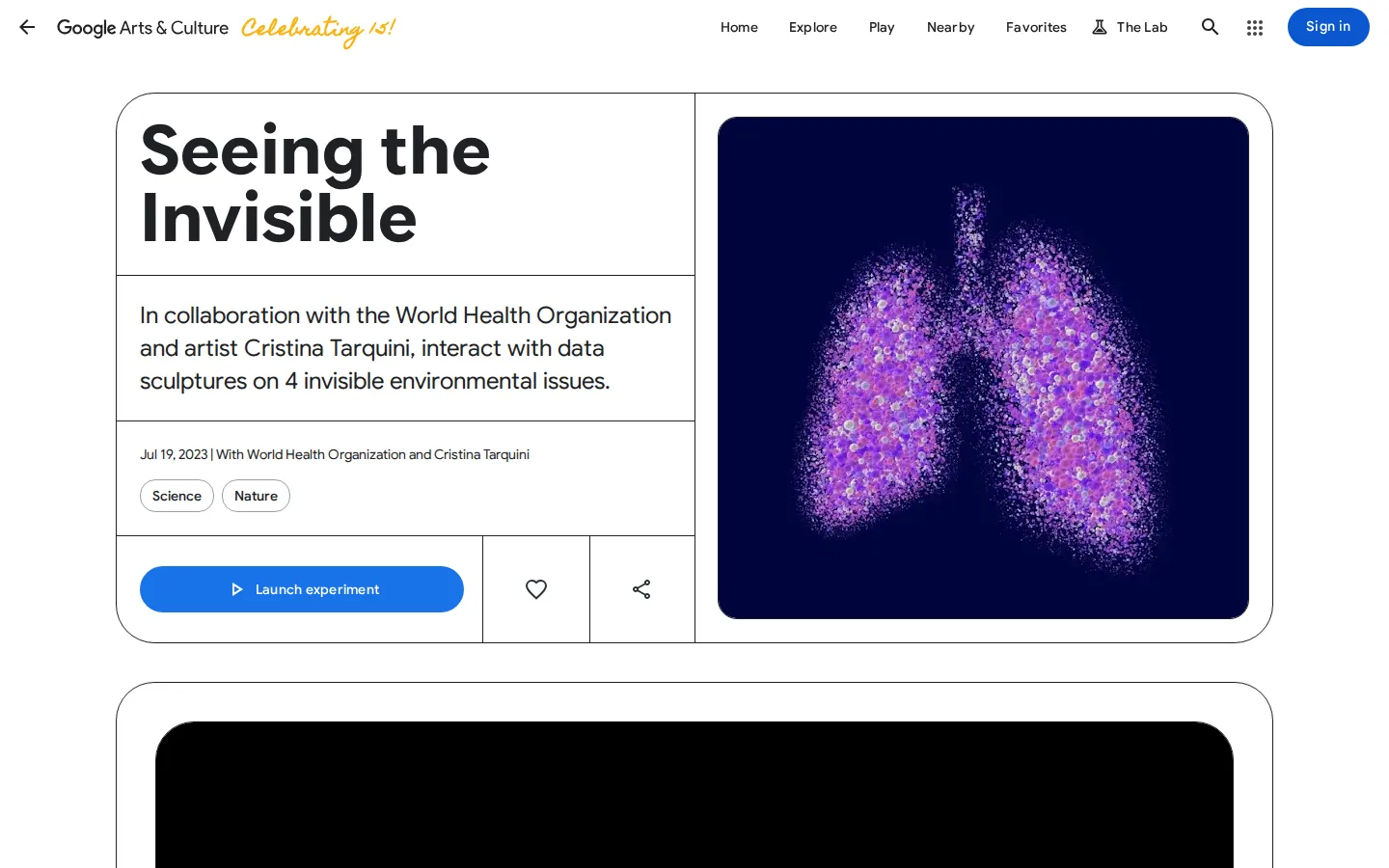
Seeing the Invisible turns air pollution, noise, microplastic intake, and thawing permafrost into four interactive data sculptures. The result is a compact art-and-science encounter that makes large, hard-to-picture harms feel less like background statistics and more like objects demanding a closer look.
What is Seeing the Invisible?
Four environmental problems enter as abstractions and leave with shape, scale, and motion. Cristina Tarquini's online artwork, made with Google Arts & Culture and scientific input from the World Health Organization, gives each topic its own data sculpture. Rather than marching through a long report, visitors choose a problem and meet it through a visual metaphor built from measurements and health context. The subjects range from the air surrounding nearly everyone to tiny plastic particles and carbon held in frozen ground. That spread is useful: it links everyday exposure with planetary systems without pretending they are the same kind of problem. The project works best as an invitation to notice and investigate, not as a substitute for the underlying science.
What you can do there
- Choose among four environmental topics
- Interact with a data sculpture for each topic
- Connect abstract measurements with environmental and health consequences
Why we picked it
Most climate explainers ask charts and paragraphs to do all the lifting. This one lets art carry part of the load, turning four easy-to-ignore hazards into distinct objects with enough strangeness to slow down a restless cursor. Its restraint is the charm: four topics, four sculptures, and a clear reason for each to exist.
How to get the most from it
Begin with the issue that feels least tangible, then compare its sculpture with one you already understand. Pause for the source and health context around each topic instead of racing through all four; the differences in how the data is represented are a large part of the experience.
Good to know
The overview is in English and sits inside Google Arts & Culture. Keyboard, touch, motion, audio, accessibility, account, and privacy behavior inside the launched experiment are not documented on the overview page. Treat the sculptures as interpretive gateways and follow their named scientific sources for detailed evidence.
Who made it, and when?
Cristina Tarquini is the credited creator or organization. The earliest supported launch date we found is July 19, 2023.
Open Seeing the InvisibleMore like this
Zoomquilt
An endlessly falling illustrated world nested inside itself.
Thisissand

Pour tiny grains of color into layered landscapes, patterns, and patient accidents.
Click Click Click

A green button that turns browser habits into a tiny surveillance drama.
Beige balls

Twelve colorful-looking spheres, one beige reality, and a tidy lesson in how nearby stripes boss your eyes around.