
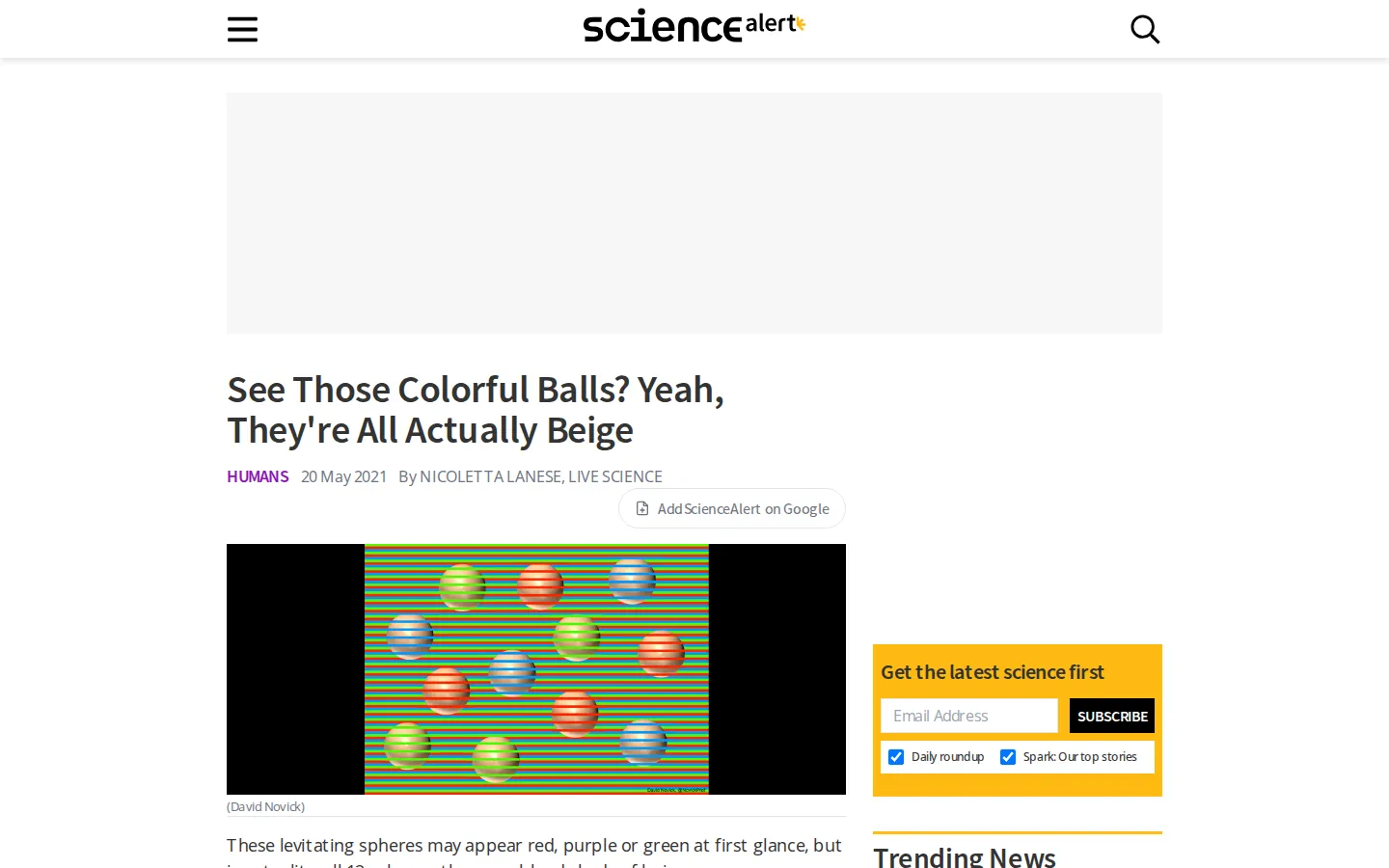
This compact ScienceAlert explainer pairs the Confetti Spheres 5 optical illusion with a readable account of why twelve identical beige balls seem red, green, or purple. The reveal arrives immediately; the useful payoff is learning how foreground stripes and image size steer perceived color.
What is Beige balls?
The page opens with David Novick's striped sphere image, then wastes little time springing the trap: every ball has the same beige base color. From there, Nicoletta Lanese explains the Munker-White effect in practical terms, showing how colors crossing in front of a shape can pull its apparent hue toward the stripes. A flat-disc example broadens the idea, while the final section traces Novick's interest in extending the illusion into new forms. It is a quick illustrated read, not a playable color lab, but the central trick has enough visual mischief to make the explanation stick.
What you can do there
- Inspect the Confetti Spheres 5 illusion
- Read why foreground stripes change perceived color
Why we picked it
The article earns its place with a clean one-image contradiction: your first color judgment feels obvious, and is wrong. Better still, it follows the reveal with enough visual-science context to turn a passing gotcha into a useful lesson about color assimilation.
How to get the most from it
Give the lead image a few seconds before reading the first paragraph. Then make it smaller and larger to compare the strength of the effect, and notice which colored stripes cross in front of each sphere rather than behind it.
Good to know
The headline gives away the beige-ball answer, and the destination is a conventional illustrated article rather than an interactive demo. ScienceAlert credits Nicoletta Lanese and identifies the piece as originally published by Live Science.
Who made it, and when?
David G. Novick is the credited creator or organization.
Creator’s official page Open Beige ballsMore like this
Zoomquilt
An endlessly falling illustrated world nested inside itself.
Thisissand

Pour tiny grains of color into layered landscapes, patterns, and patient accidents.
Click Click Click

A green button that turns browser habits into a tiny surveillance drama.
Particle Life

Tiny force tweaks bloom into drifting clans, knots, and cheerful particle chaos.