
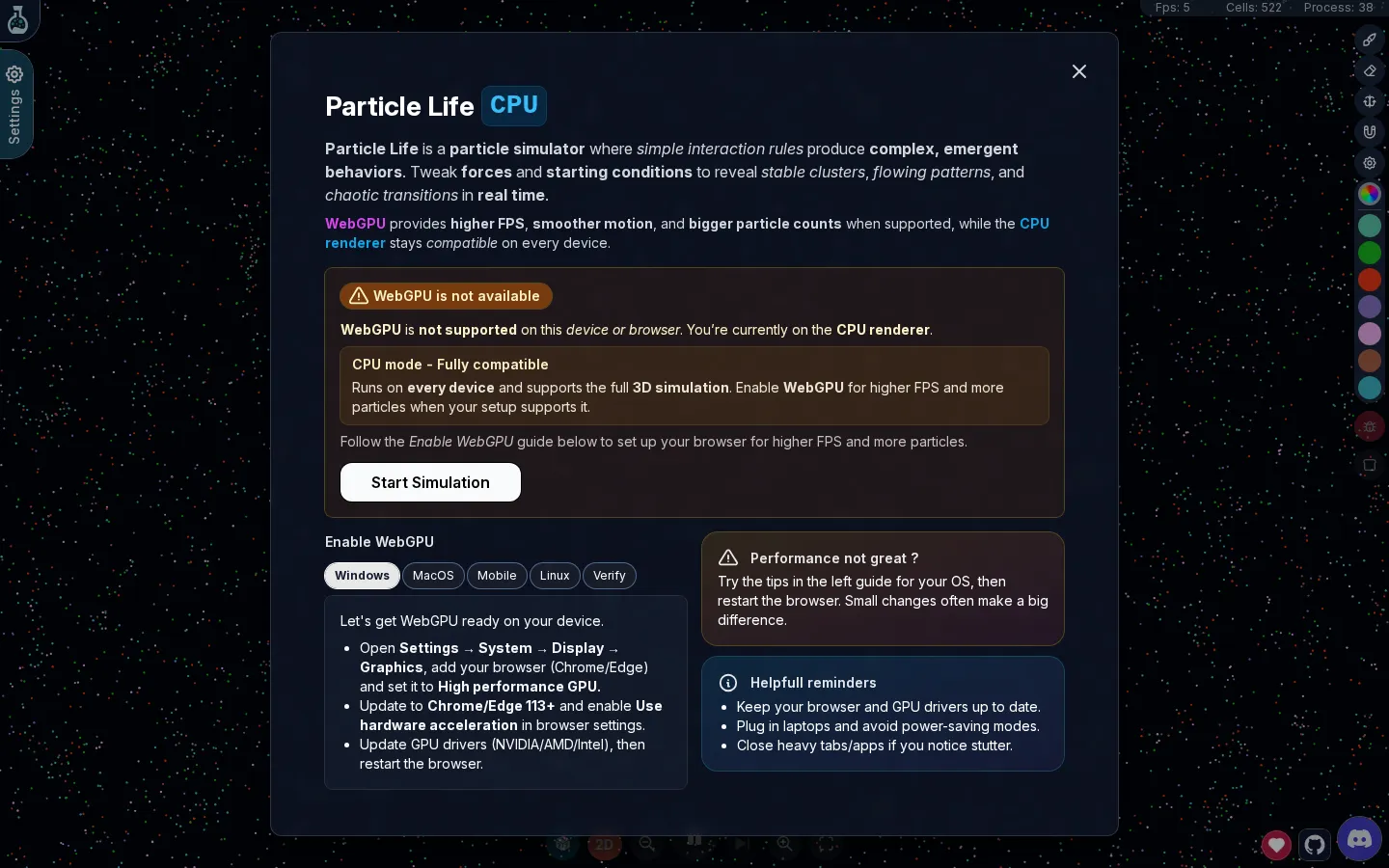
Particle Life is an open-ended 2D and 3D sandbox where colored particle types pull, push, cluster, and scatter according to adjustable rules. The pleasure is not beating a level; it is changing one variable and watching an entire miniature ecology reorganize.
What is Particle Life?
The control panel is the real toy box. Particle and color counts set the cast, an interaction matrix decides who attracts or repels whom, and friction, force, boundaries, depth, presets, and randomization reshape the stage. Simple combinations can settle into clumps, streams, orbit-like knots, or complete confetti weather. A CPU fallback is presented for broad compatibility, while WebGPU is the optional faster lane for larger swarms. This is more lab bench than game board: there is no score or finish line, just patterns worth perturbing and configurations worth comparing.
What you can do there
- Adjust how colored particle groups attract and repel one another
- Change particle counts, colors, boundaries, friction, and force
- Explore presets and randomized starting conditions
- Observe emergent patterns in 2D or 3D
Why we picked it
Particle Life makes cause and effect unusually watchable. The controls are dense, but each slider or matrix cell is an invitation to make one small intervention and see whether the swarm finds order, invents a new wobble, or flies apart with theatrical commitment.
How to get the most from it
Start in 2D with a modest particle count, choose a preset or random setup, and let it settle before changing anything. Then adjust one force, friction value, or color relationship at a time so the result remains readable. Try right-clicking in the particle field for direct interaction, though behavior may vary by device.
Good to know
Sandbox Science labels the wider project beta and warns that some features may be incomplete. WebGPU is optional, with a CPU mode offered as the compatibility path. Large particle counts can be demanding, and the continuously moving field deserves caution for motion-sensitive visitors.
Who made it, and when?
Charly Luzzi is the credited creator or organization.
Creator’s official page Open Particle LifeMore like this
Zoomquilt
An endlessly falling illustrated world nested inside itself.
Thisissand

Pour tiny grains of color into layered landscapes, patterns, and patient accidents.
Click Click Click

A green button that turns browser habits into a tiny surveillance drama.
Beige balls

Twelve colorful-looking spheres, one beige reality, and a tidy lesson in how nearby stripes boss your eyes around.