
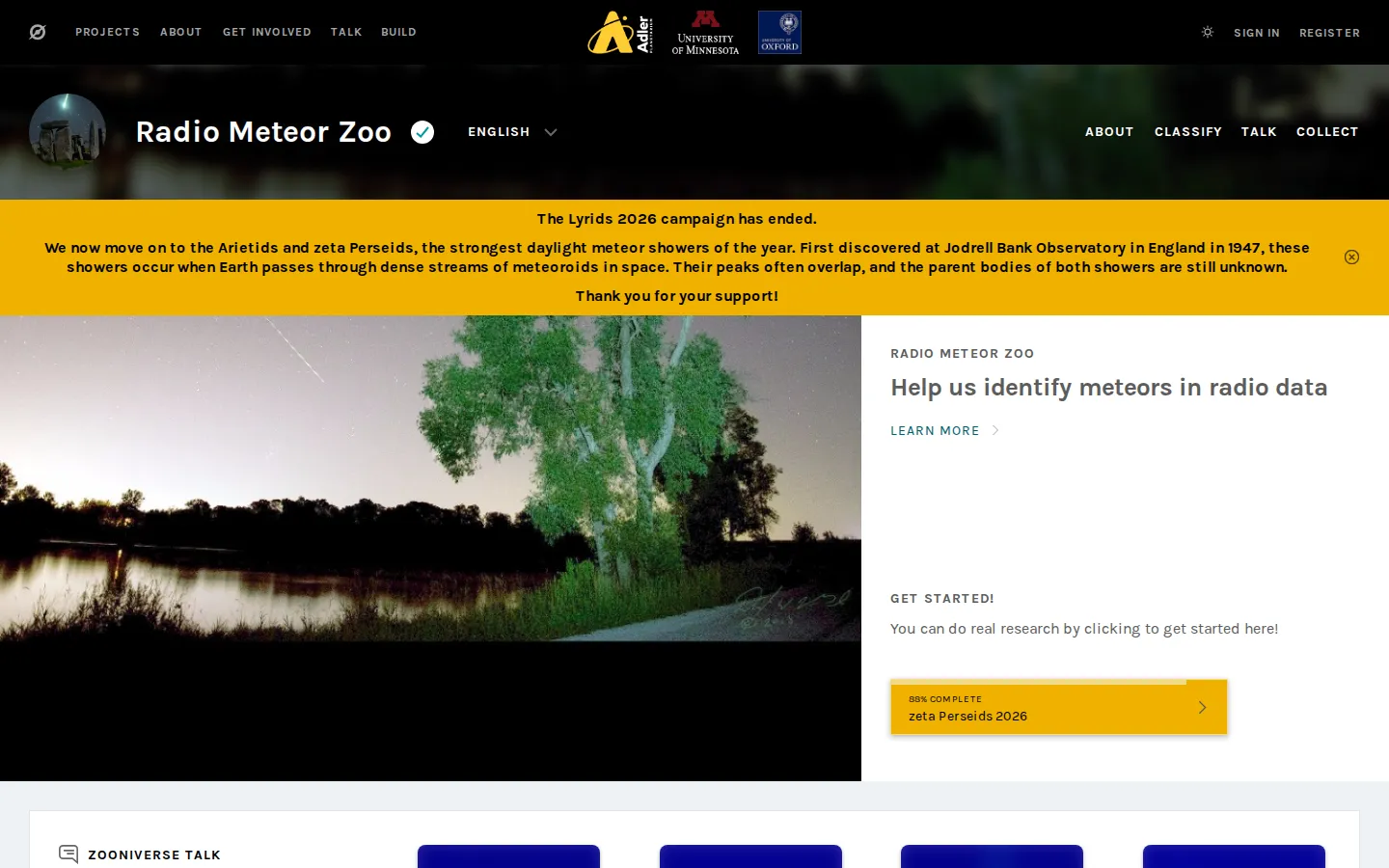
Radio Meteor Zoo replaces the telescope view with color-coded radio spectrograms. Volunteers draw boxes around echoes created when meteoroid trails reflect a Belgian beacon, helping researchers turn meteor-shower campaigns into activity curves. Campaigns come and go, so check the live task before settling in.
What is Radio Meteor Zoo?
A shooting star can leave a radio fingerprint even when clouds, daylight, or sheer faintness keep it out of sight. Belgium's BRAMS network transmits a steady radio signal and records the brief reflections produced by ionized meteoroid trails. Radio Meteor Zoo turns those recordings into five-minute spectrograms and hands the stubborn shapes to human eyes. The job is delightfully specific: draw a box around everything that looks like a meteor echo while learning to ignore aircraft tracks, interference, and the beacon itself. The boxes do more than count streaks. Researchers aggregate multiple volunteers' marks, estimate the ordinary background, and build activity curves around showers such as the Perseids, Geminids, and Quadrantids. The long-running Results archive is the payoff, showing where peaks line up with visual observations and where geometry or limited data still complicates the story. The live page is plainly campaign-driven. Its banner says the Lyrids 2026 set has ended and names daylight showers next, while the visible counters do not agree with the project's documented history, so treat the status panel as a loose weather vane rather than a precise ledger.
What you can do there
- Draw boxes around likely meteor echoes
- Compare campaign activity plots and background-corrected results
Why we picked it
Radio Meteor Zoo makes invisible astronomy legible without sanding off the science. The spectrograms have enough visual grammar to learn, the volunteer action is concrete, and the results archive demonstrates how thousands of boxes become shower curves rather than disappearing into a data void.
How to get the most from it
Read the Research page's spectrogram legend first; knowing the horizontal beacon, S-shaped aircraft tracks, vertical interference, and common meteor shapes prevents a great deal of enthusiastic rectangle drawing. Then try Classify if a campaign is available, and visit Results to see how raw counts are corrected for background activity.
Good to know
The landing page currently says the Lyrids 2026 campaign ended and shows 85 percent completion, yet its visible counters are zero, so live availability is uncertain. The annotation interface was not rendered or tested here. The destination's frame policy also keeps it out of Site Stumble's embedded browser.
Who made it, and when?
BRAMS at the Royal Belgian Institute for Space Aeronomy is the credited creator or organization. The earliest supported launch date we found is August 12, 2016.
Creator’s official page Open Radio Meteor ZooMore like this
Stellarium Web

Turn the browser into a planetarium matched to the sky above your location.
The Scale of the Universe 2

Slide from the smallest known scales to the largest structures in the observable universe.
100,000 Stars
Fly from the Sun into a 3D neighborhood of one hundred thousand nearby stars.
WorldWide Telescope

A sky atlas with a time machine tucked into its controls