
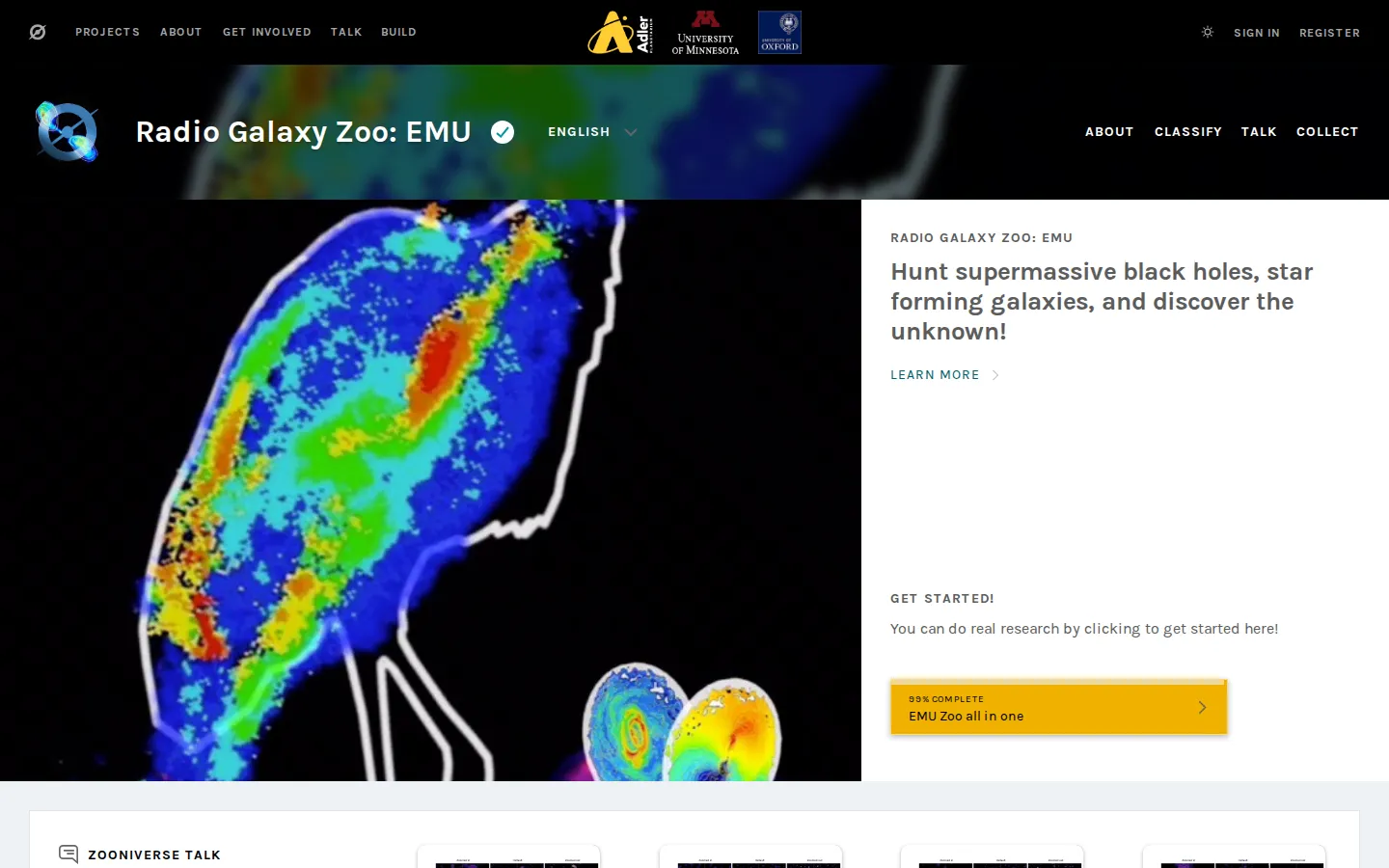
Radio Galaxy Zoo: EMU asks you to connect patches of invisible-sky radio emission, locate their likely optical or infrared host, and tag the resulting shape. It is closer to forensic map reading than postcard astronomy, with tutorials and a field guide translating the contours into a usable visual language.
What is Radio Galaxy Zoo: EMU?
Each subject layers several views of the same patch of sky. Radio contours show where emission brightens; optical and infrared images offer possible host galaxies underneath. First you decide which radio islands belong to one source and mark its host, then you describe the structure with one or more tags. That second step matters because a bent jet, an X shape, a double-double, or an odd radio circle can point researchers toward a genuinely unusual system. The current page reports 99 percent complete with zero active subjects, so the data tap may be nearly dry or waiting for another batch.
What you can do there
- Group related patches of radio emission
- Match radio structures to optical or infrared host galaxies
- Tag source shapes and discuss unusual objects
Why we picked it
It makes the invisible universe feel like a solvable desk puzzle without pretending the puzzle is easy. Human eyes remain useful precisely where extended radio structures refuse to fit tidy boxes, and the project turns those judgments into material for catalogues and machine-learning work rather than treating a single click as a discovery stamp.
How to get the most from it
Do both tutorials before classifying. In the first step, trace radio contours as a whole shape before choosing a host in the optical or infrared view. In the second, use every tag that genuinely fits instead of forcing one label. Keep the Field Guide open, and send strange off-center or untaggable structures to Talk with a clear note about what caught your eye.
Good to know
The task has more moving parts than a simple yes-or-no classifier and benefits from an unhurried screen. Current counters showed no active subjects during this check despite the Get Started invitation, so availability may be batch-dependent. The Results page still frames project studies as works in progress; one volunteer classification should not be read as a confirmed black hole, host, or new source.
Who made it, and when?
Eleni Vardoulaki and Hongming Tang is the credited creator or organization. The earliest supported launch date we found is July 8, 2024.
Creator’s official page Open Radio Galaxy Zoo: EMUMore like this
Zooniverse

Help real research by classifying galaxies, wildlife, weather records, manuscripts, and more.
StopotS

A fast little word scramble where your friends become the jury
Mandalagaba

A symmetry sketchpad where one stroke recruits a whole geometry crew
Kick the Ball Back

A tiny football emergency, one dragging foot, and several children who have no time for excuses.