
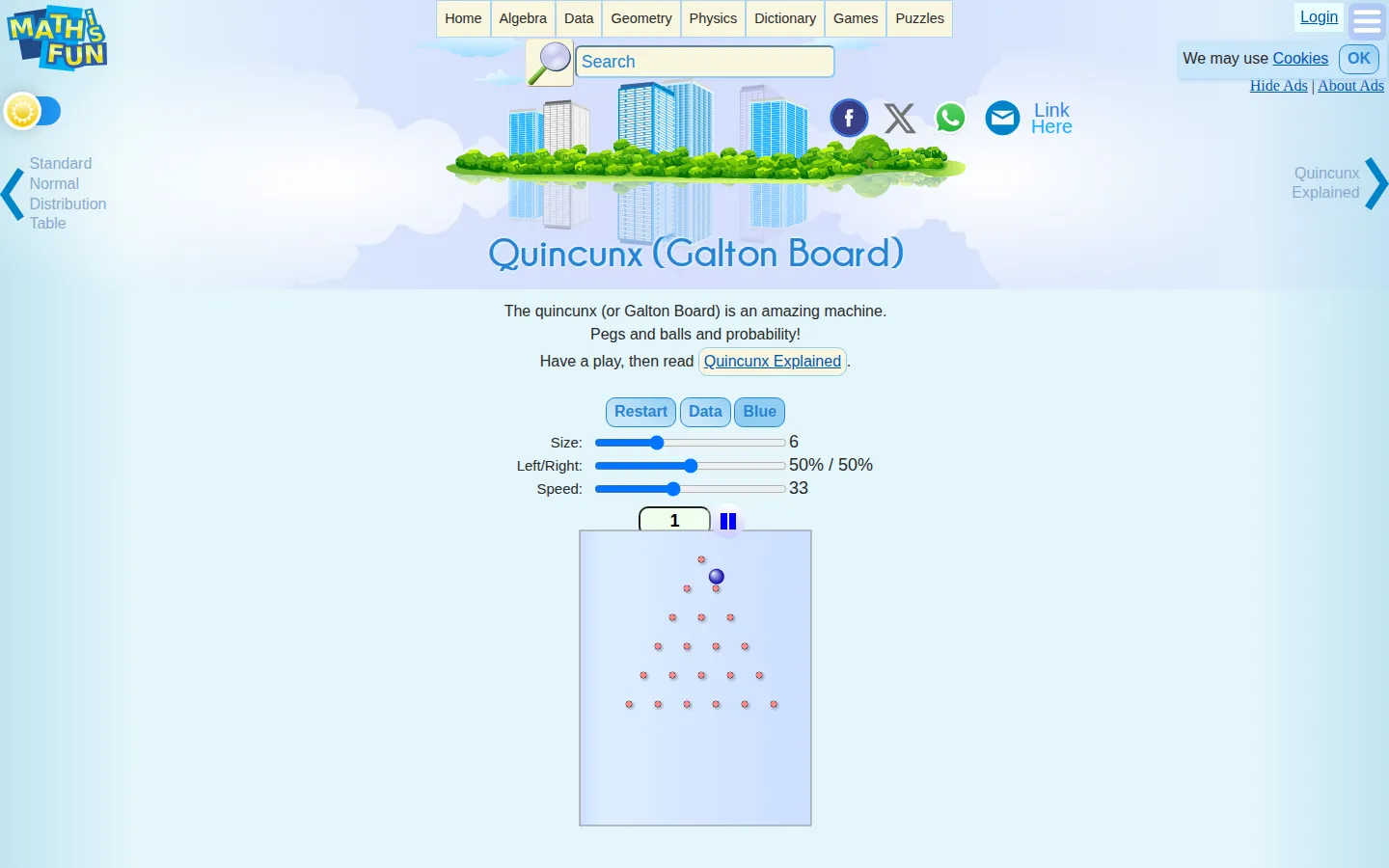
Math Is Fun's Quincunx pairs a compact Galton-board simulation with a clear explanation of the binomial distribution. Each ball makes a chain of left-or-right choices; the growing heap shows why the middle is common and the edges are lonely.
What is Quincunx (Galton Board)?
A single ball can ricochet through the triangular peg field with all the dignity of a dropped lentil. Repeat the trip enough times, though, and order appears: the center bins fill fastest while the outer bins wait for the rare all-left or all-right wanderer. The companion explanation connects that pile to Pascal's triangle, combinations, and the binomial formula, then shows why more rows and more trials produce a smoother bell-shaped outline. It is a tidy bridge from random motion to predictable structure.
What you can do there
- Send virtual balls through a peg field
- Watch a distribution accumulate
- Read the binomial explanation
Why we picked it
The payoff arrives as a shape rather than a lecture. Watching many tiny independent choices accumulate makes the central peak feel inevitable, and the nearby explanation is concise enough to turn that intuition into actual probability reasoning.
How to get the most from it
Start with the equal 50/50 case and let at least 100 balls accumulate. Compare the crowded middle bins with the sparse edges, then open Quincunx Explained to trace those piles through Pascal's triangle and the n-choose-k formula.
Good to know
Individual runs will not match the ideal probability table perfectly; that variation is part of the lesson. The finite result is binomial, while the familiar smooth normal curve is an increasingly close visual approximation as the board and sample grow.
Open Quincunx (Galton Board)More like this
Close Hue

A daily test of whether ‘mauve’ in your head has any relationship to mauve on a screen.
Sudoku.com

Six difficulty rungs, pencil notes, and a daily grid—with a three-strike rule
Riddle of the Day

One thoughtful logic problem a day, with an archive for second helpings.
Dino Pal

Five tiny conference warm-ups disguised as a puzzle box with a very large logo on it.