
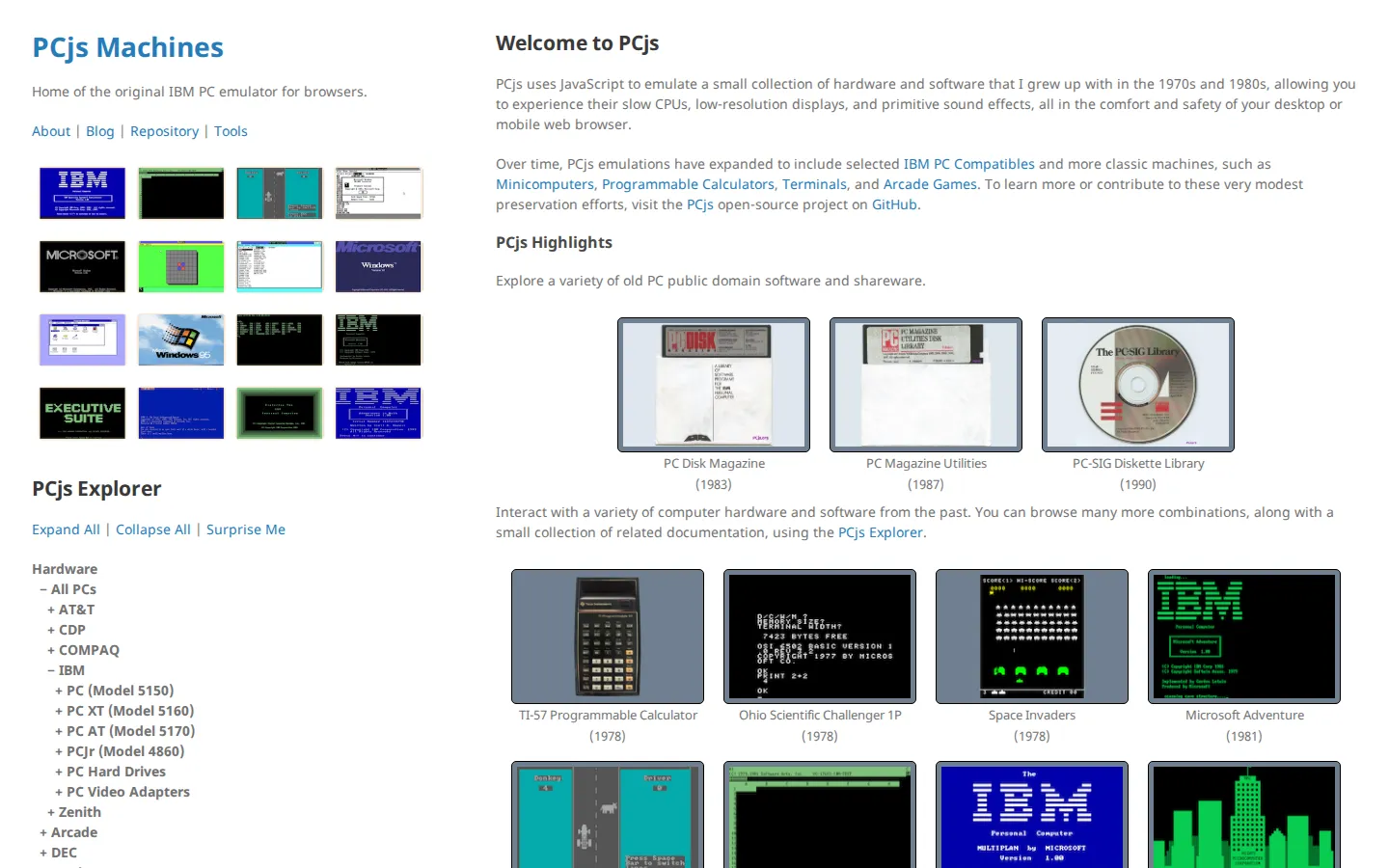
PCjs Machines puts old PCs, minicomputers, terminals, calculators, arcade hardware, software, and manuals behind browser links. It is part emulator workshop and part preservation archive, with enough specific configurations to turn a quick nostalgia stop into a very long evening.
What is PCjs Machines?
The homepage starts with a highlight reel, then opens into an enormous Explorer organized by hardware, software, and documents. One branch may lead to an IBM PC with a particular display adapter; another to a PDP-11, a TI calculator, Windows 1.0, VisiCalc, Zork, or a scanned technical reference. The machinery is more than decorative: PCjs configurations can expose virtual keyboards, disks, reset controls, and a debugger, letting the browser behave like a workbench for systems that normally require shelves, repair skills, and a forgiving power outlet.
What you can do there
- Browse historical computers and software
- Open a machine simulation in the browser
- Read archived manuals and technical material
- Experiment with virtual disks and debugger controls
Why we picked it
PCjs makes computer history runnable. The delight is not only seeing an old screen but tracing the odd, specific combinations of hardware, software, manuals, and development tools that made early computing feel so gloriously particular.
How to get the most from it
Start with a homepage highlight or press Surprise Me in the Explorer. Give a selected machine time to initialize, read its accompanying notes before changing disks or reset controls, and open the debugger only when you are ready for the rabbit hole beneath the rabbit hole.
Good to know
Some machines may be slower or fussier than a modern web app, and audio, saving, downloads, and mobile controls vary by configuration. The library is unusually candid that older document and software provenance is not always complete, so treat it as a working preservation collection rather than a uniform rights catalog.
Who made it, and when?
Jeff Parsons is the credited creator or organization.
Creator’s official page Open PCjs MachinesMore like this
CERN Line Mode Browser

A link list from the Web before it learned to decorate itself
Quenq

An interactive museum for playable internet history.
The Million Dollar Homepage
One million pixels from a gloriously chaotic web experiment.
Windows 93

A fake 1993 desktop where every click may take a glorious wrong turn.