
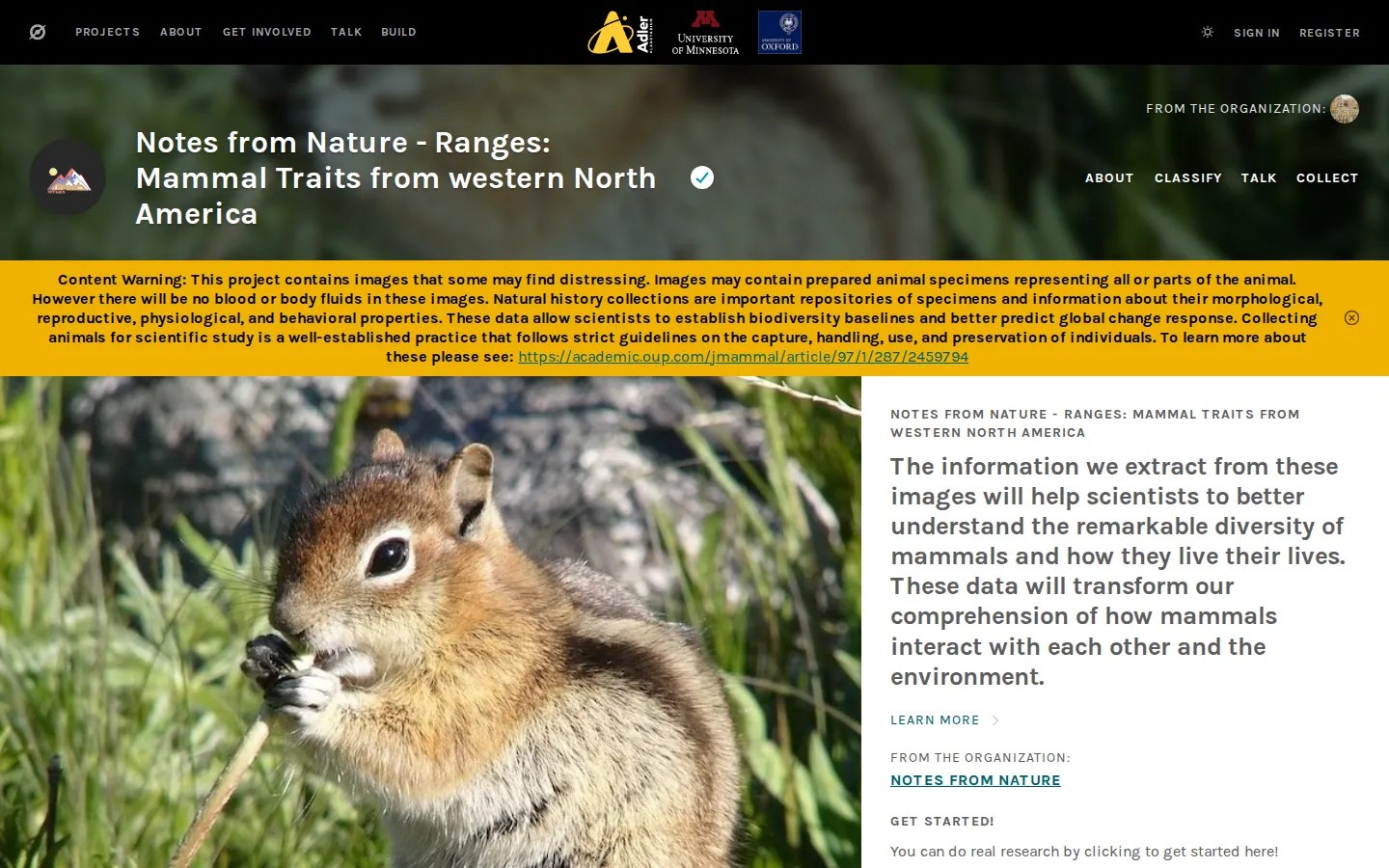
Ranges hands you the labels attached to western North American mammal specimens and asks for the traits hiding in their compact notation. Pull out age, sex, lengths, and weight so researchers can compare individual animals across places, decades, and changing environments.
What is Notes from Nature - Ranges: Mammal Traits?
A museum tag can compress an animal's biography into a few words and a row of numbers. This Notes from Nature project teaches volunteers to unpack that shorthand: total length, tail, hind foot, ear, weight, sex, age, and related traits recorded when a specimen entered a collection. The task belongs to a much larger digitisation network spanning museums across western North America, but the satisfying unit is one label at a time. Its FAQ is unusually practical, explaining when to preserve abbreviations, how to handle missing values, and what to do when a bat's measurements refuse to follow the usual pattern. The finished traits are meant to join public systems such as iDigBio and FuTRES, where specimen-level detail can support questions that the original collector could not have anticipated.
What you can do there
- Inspect a mammal specimen label
- Transcribe age, sex, measurements, and weight
- Submit structured trait data
- Flag uncertain records in Talk
Why we picked it
This is archival code-breaking with scientific consequences. The labels look modest, yet standardized individual measurements help researchers study variation rather than flattening a species into one average. Independent museum reporting shows the unglamorous but essential pipeline behind the screen: staff identify records, photograph tags, group images, and prepare them before volunteers supply the structured text.
How to get the most from it
Read the FAQ before decoding a hyphenated measurement string. Transcribe what the label actually says, keep abbreviations and unfamiliar language intact, and use the verbatim field whenever the number order is uncertain. Leave unsupported values blank or unknown instead of guessing, then use Done and Talk to flag a faulty image or a record that needs a researcher's judgment.
Good to know
The project carries a clear content warning: images can show prepared whole mammals or animal parts, though it says there is no blood or body fluid. It was labeled 99 percent complete during review, and the zeroed public counters did not reliably reveal remaining work. We did not execute the classification or discussion flows, inspect subject imagery, or capture an approved screenshot, so availability, legibility, accessibility, account, privacy, autosave, and device behavior still need review. Detected icons and social artwork remain unapproved evidence only.
Who made it, and when?
Ranges Digitization Network and Notes from Nature is the credited creator or organization. The earliest supported launch date we found is September 24, 2024. A documented update was recorded January 9, 2026.
Creator’s official page Open Notes from Nature - Ranges: Mammal TraitsMore like this
OneZoom Tree of Life

Zoom through the evolutionary tree connecting millions of living species.
WindowSwap

Borrow someone else's window for a quiet view of another life and place.
OCEARCH Shark Tracker

A map where each dot has teeth and a travel itinerary
Is it dark outside?

A one-word verdict for a question your window could answer