
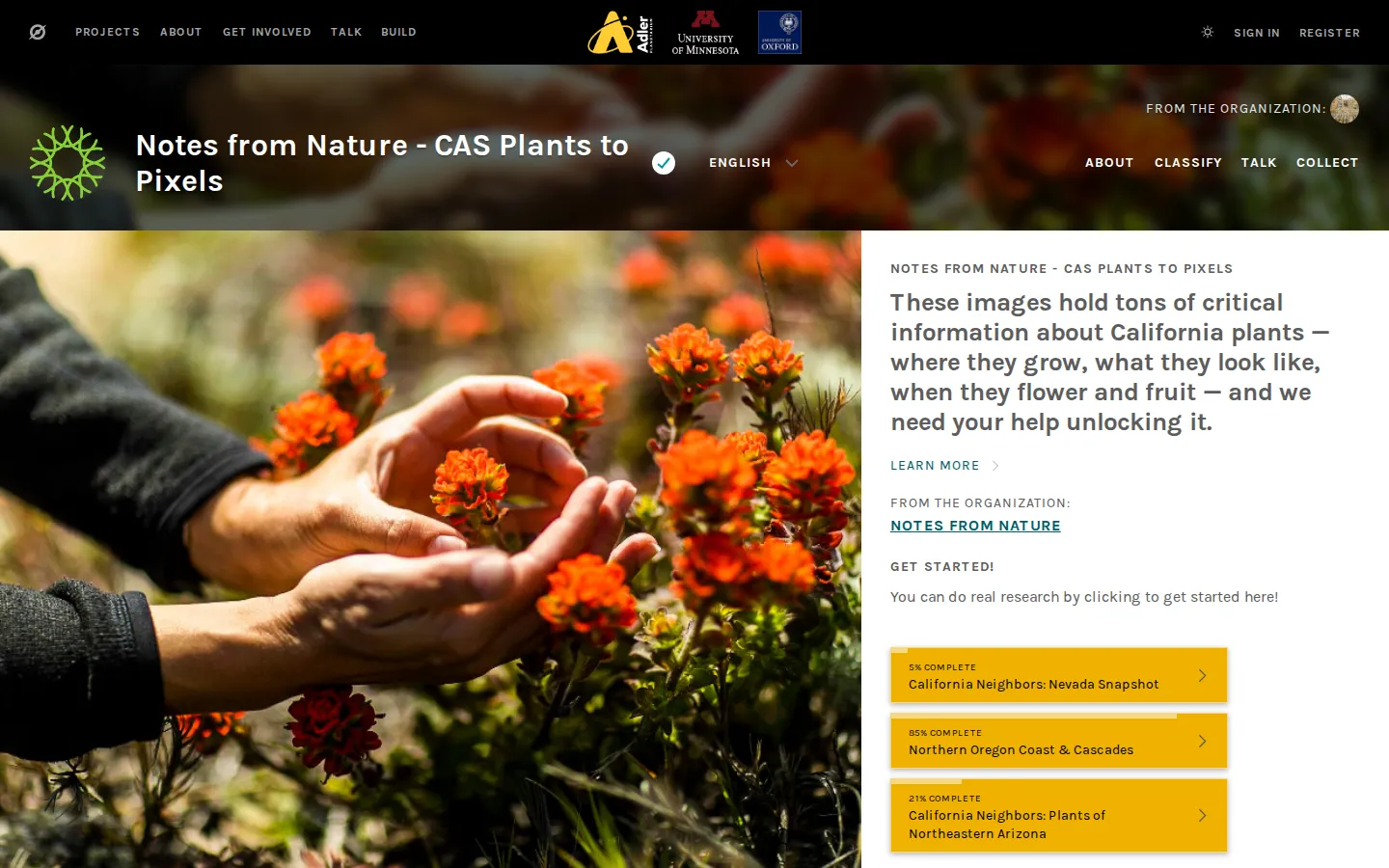
Plants to Pixels puts the California Academy of Sciences herbarium on your transcription desk. Read a scanned specimen label, sort details such as locality and habitat into structured fields, and help convert a vast physical collection into biodiversity data that researchers can search and share.
What is Notes from Nature - CAS Plants to Pixels?
A herbarium sheet is part dried plant, part time capsule, and part administrative puzzle. This Notes from Nature project asks volunteers to extract the useful bits from high-resolution scans: accession numbers, coordinates, habitat notes, descriptions, elevations, and other label details. The source collection reaches back to 1853 and numbers roughly 2.3 million specimens, so even a short session contributes to a genuinely large digitisation effort. The work is more exacting than a simple image tag. Its FAQ explains how to preserve wording, separate location from habitat, research uncertain counties, and flag bad images or corrections for the team. Finished data is intended to move into the Academy's database and public biodiversity aggregators, giving each careful keystroke a route beyond the task screen.
What you can do there
- View a digitised plant specimen
- Transcribe label fields
- Submit the record
- Flag ambiguous or faulty material in Talk
Why we picked it
This is small-scale volunteer work with an unusually clear data trail. You can move from a pressed plant and a sometimes-fussy label to information that supports collection access, historical range research, and conservation questions. UC Irvine Libraries even used Plants to Pixels as its concrete example of how citizen-science volunteers turn museum images into searchable records.
How to get the most from it
Begin with one specimen and keep the FAQ open before guessing at a cramped label. Enter only what the image supports, distinguish a broad habitat from a precise locality, and use the provided place-name resources when a county is uncertain. If the image is faulty or you make a researched correction, send it through the discussion path the project describes. The Academy says a typical specimen can take under a minute, but difficult handwriting deserves more time.
Good to know
The landing page was close to complete during review, and public counters were inconsistent, so available expeditions may change or run out. We did not execute the viewer, form, Talk, or submission flows, and no approved screenshot was available; image legibility, account rules, autosave, accessibility, privacy, and device behavior still need review. The 500,000-transcription goal was tied to the end of 2025 and should not be read as a current counter. Detected icons and social artwork remain unapproved evidence only.
Who made it, and when?
California Academy of Sciences and Notes from Nature is the credited creator or organization. The earliest supported launch date we found is July 1, 2024.
Creator’s official page Open Notes from Nature - CAS Plants to PixelsMore like this
OneZoom Tree of Life

Zoom through the evolutionary tree connecting millions of living species.
WindowSwap

Borrow someone else's window for a quiet view of another life and place.
OCEARCH Shark Tracker

A map where each dot has teeth and a travel itinerary
Is it dark outside?

A one-word verdict for a question your window could answer