
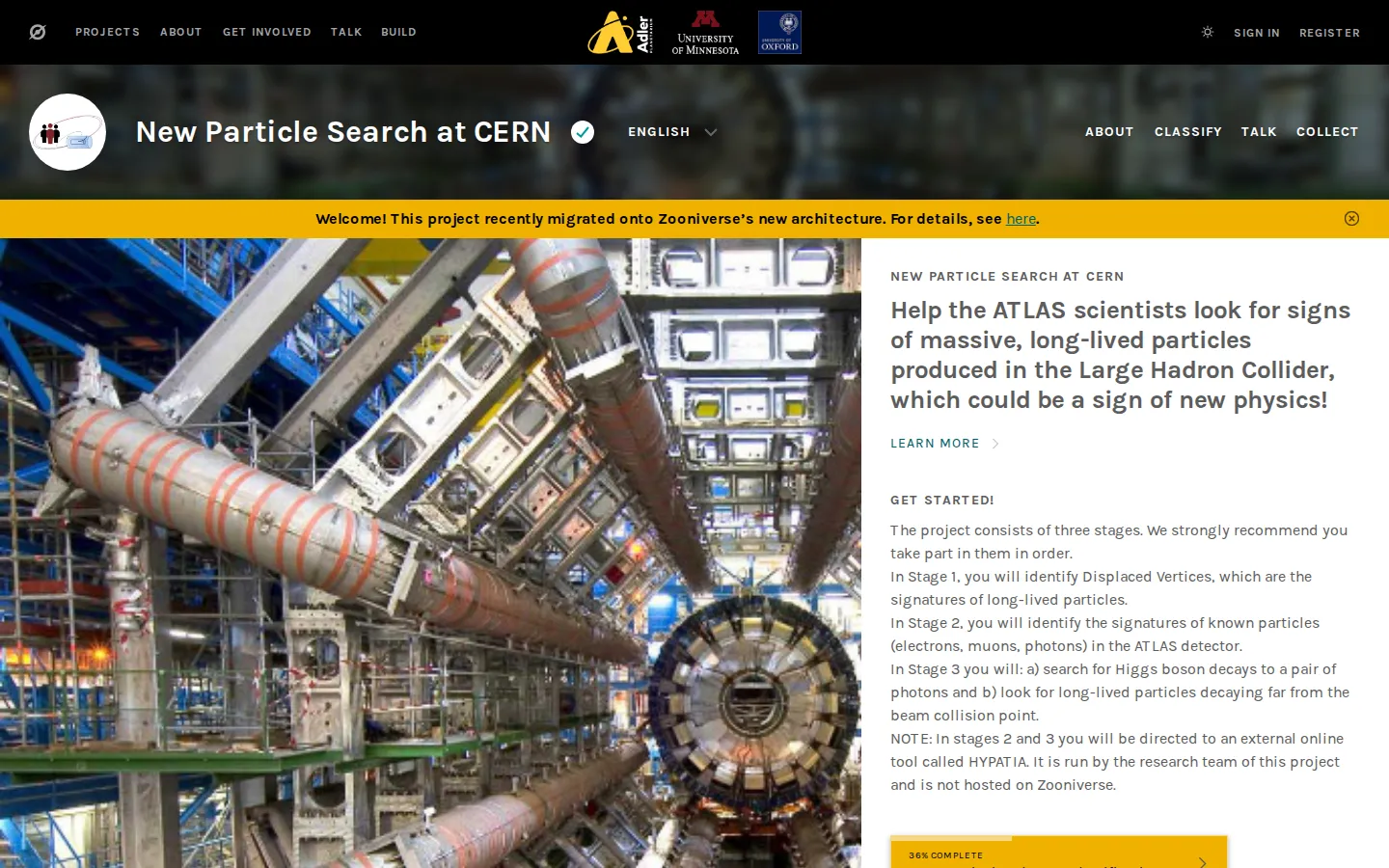
This Zooniverse project turns ATLAS event displays into a three-stage citizen-science course. You begin by spotting displaced vertices, graduate to familiar particle signatures, and eventually inspect possible Higgs and long-lived-particle events. The science is substantial, but the current landing page's zeroed activity counters make live task availability uncertain.
What is New Particle Search at CERN?
Particle collisions leave dense sprays of tracks, and New Particle Search at CERN asks ordinary eyes to notice where those tracks tell an unusual story. Stage one teaches the giveaway for a particle that travels before decaying: several tracks meeting away from the central collision point. Later stages move through electrons, muons, and photons before reaching searches for two-photon Higgs decays and long-lived particles. A published review of the earlier project found that combined volunteer judgments identified displaced vertices at about 93 percent efficiency, close to a 94 percent automated baseline. That does not turn every bright squiggle into new physics; it does show why careful human pattern recognition belongs in this particular laboratory.
What you can do there
- Identify displaced vertices in ATLAS event displays
- Recognize electron, muon, and photon signatures
- Rate possible Higgs and long-lived-particle events
Why we picked it
The project makes frontier particle physics feel less like a press release and more like a careful visual investigation. Its ordered stages give the work a satisfying learning curve, while the comparison between volunteer consensus and an automated detector gives the clicks a concrete research purpose.
How to get the most from it
Start with Stage 1 and follow the recommended order. Learn what the collision center looks like before marking any off-center meeting of tracks, then use the tutorials and Talk discussions to calibrate your eye. Budget extra time for stages two and three, which can hand you off to the separate HYPATIA tool.
Good to know
The destination currently reports 37 percent complete but also shows zero active subjects and classifications, so a specific workflow may be between data batches. The later stages leave Zooniverse for HYPATIA. No isolated screenshot or hands-on accessibility, account, audio, mobile, or submission test was available for this review.
Who made it, and when?
ATLAS experiment collaboration and REINFORCE is the credited creator or organization. The earliest supported launch date we found is October 19, 2021.
Creator’s official page Open New Particle Search at CERNMore like this
Stellarium Web

Turn the browser into a planetarium matched to the sky above your location.
The Scale of the Universe 2

Slide from the smallest known scales to the largest structures in the observable universe.
100,000 Stars
Fly from the Sun into a 3D neighborhood of one hundred thousand nearby stars.
WorldWide Telescope

A sky atlas with a time machine tucked into its controls