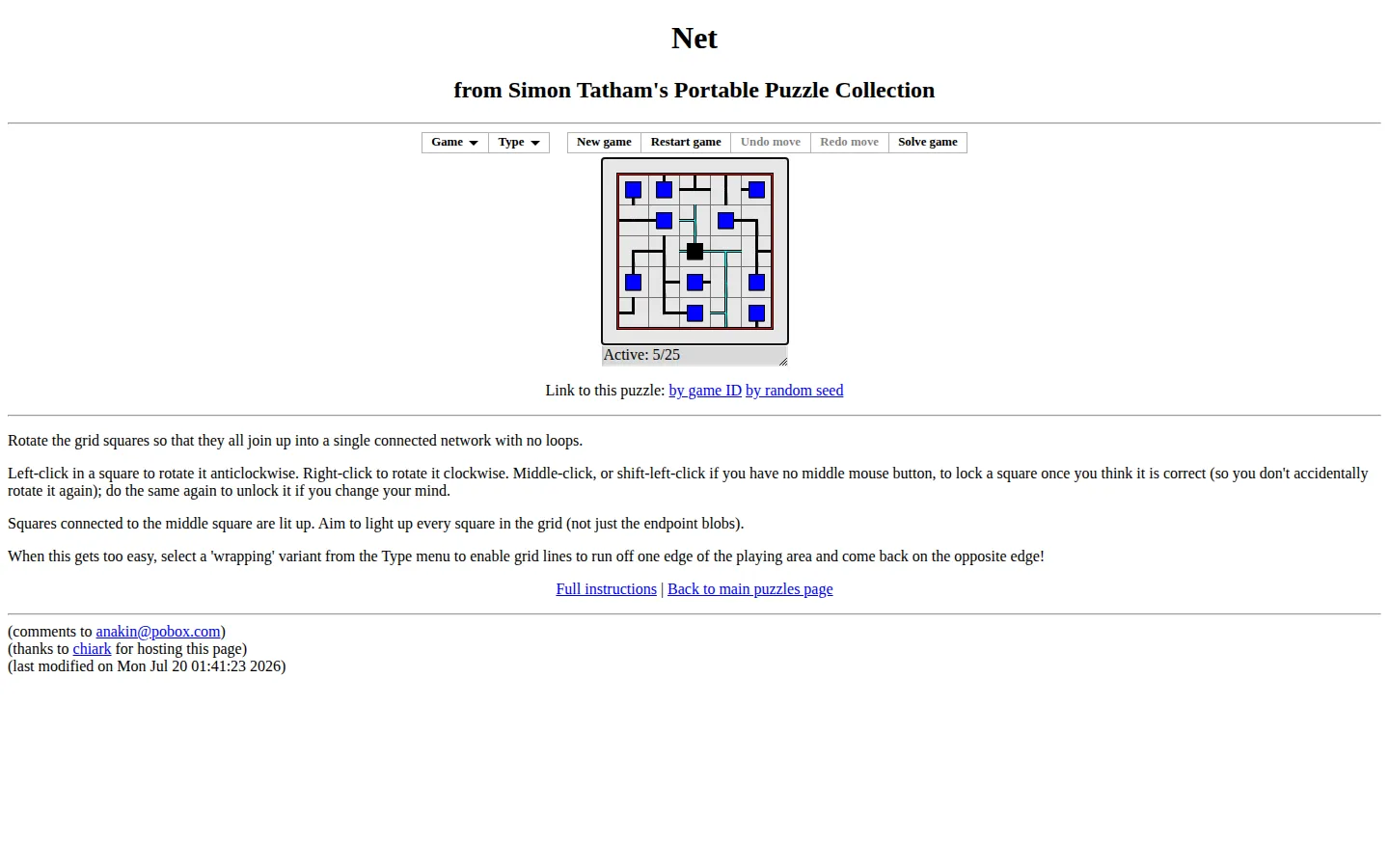
Net hands you a scrambled grid of branching lines and asks for one clean result: connect every tile into a single network without creating a loop. The rules fit in a breath, while locking, wrapping variants, and generated boards give the puzzle more bite than its spare presentation suggests.
What is Net?
The web page puts a logic puzzle inside a deliberately plain frame. Each square carries part of a network; turning those pieces gradually sends a highlighted connection outward from the center. The useful twist is restraint: a tile that looks settled can be locked, reducing accidental backtracking while the remaining branches are reasoned into place. Menus expose fresh boards, restart, undo, redo, solving, saved-game transfer, game IDs, random seeds, preferences, and variants that wrap the grid across opposite edges. It is less a pipe dream than a pipe accounting exercise, and that is exactly the charm.
What you can do there
- Rotate tiles to form one connected loop-free network
- Lock tiles whose orientation is settled
Why we picked it
Net turns a tiny set of actions into a satisfying chain of deductions. The objective is immediately legible, the lock control supports careful play, and the seed and variant tools let one compact browser puzzle stretch well beyond a single board.
How to get the most from it
Begin at edges and obvious dead ends, then lock any tile whose orientation cannot change. Follow the highlighted network outward rather than rotating at random. Once the standard grid feels routine, try a wrapping variant or save a game ID so the same board can be revisited.
Good to know
The browser edition depends on JavaScript and WebAssembly. Mouse and keyboard controls are documented, including alternate keys for rotation and locking, but live execution, touch behavior, audio, accessibility, advertising, privacy behavior, and mobile layout were not verified during this review.
Who made it, and when?
Simon Tatham is the credited creator or organization.
Creator’s official page Open NetMore like this
Close Hue

A daily test of whether ‘mauve’ in your head has any relationship to mauve on a screen.
Sudoku.com

Six difficulty rungs, pencil notes, and a daily grid—with a three-strike rule
Riddle of the Day

One thoughtful logic problem a day, with an archive for second helpings.
Dino Pal

Five tiny conference warm-ups disguised as a puzzle box with a very large logo on it.