
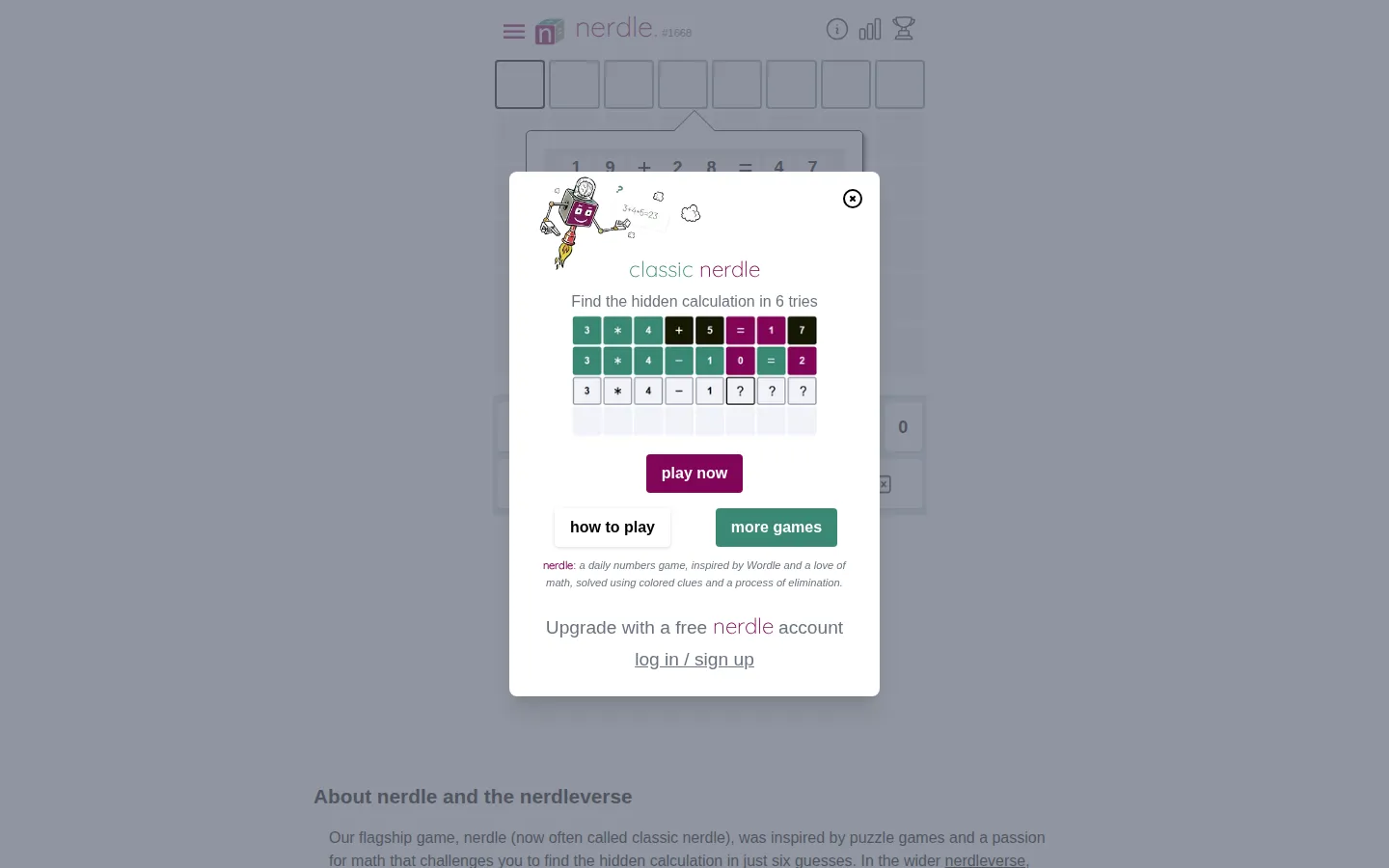
Nerdle trades five-letter words for an eight-character calculation. You get six valid equations, colored positional clues, and one daily target, creating a tidy logic workout where the equals sign can be as revealing as any digit.
What is Nerdle?
Every classic Nerdle guess must balance correctly, so random symbol soup never makes it onto the board. Green, purple, and black tiles gradually expose both the arithmetic and its layout, turning familiar school operators into a compact deduction system. The standard puzzle changes daily, while shorter, timed, one-guess, replay, and custom modes provide extra homework for anyone who finishes too quickly.
What you can do there
- Guess the hidden eight-character equation in six tries
- Use colored clues to refine each valid calculation
- Try shorter, timed, one-guess, or custom variants
Why we picked it
The clever turn is that arithmetic does double duty: a guess must solve its own equation while also testing the hidden one. That constraint gives the familiar color-tile format a genuinely different rhythm and makes each row useful even when the answer is still several deductions away.
How to get the most from it
Begin with a valid equation that samples several digits and more than one operator. Watch the equals sign as closely as the numbers, respect multiplication and division before addition and subtraction, and use Mini mode if eight slots feel like too much algebra before coffee.
Good to know
Basic play is free and does not require an account; signing in is offered for backing up scores and statistics. The official site uses ads and accepts donations, and a recent independent review encountered a large consent notice before the board. The default daily reset is midnight GMT, with a local-time option in settings.
Who made it, and when?
Richard Mann, Imogen Mann, Alex Mann, and Marcus Tettmar is the credited creator or organization. The earliest supported launch date we found is January 20, 2022.
Creator’s official page Open NerdleMore like this
Little Alchemy 2

Combine simple elements until your small world contains everything from rain to robots.
TinyFingers

A tiny digital decoy for the child who has declared your keyboard public property.
PlayingCards.io

A shared card table that trusts your group to know the rules.
AI Magnate

Run a fictional AI lab where every breakthrough comes with a burn-rate headache.